
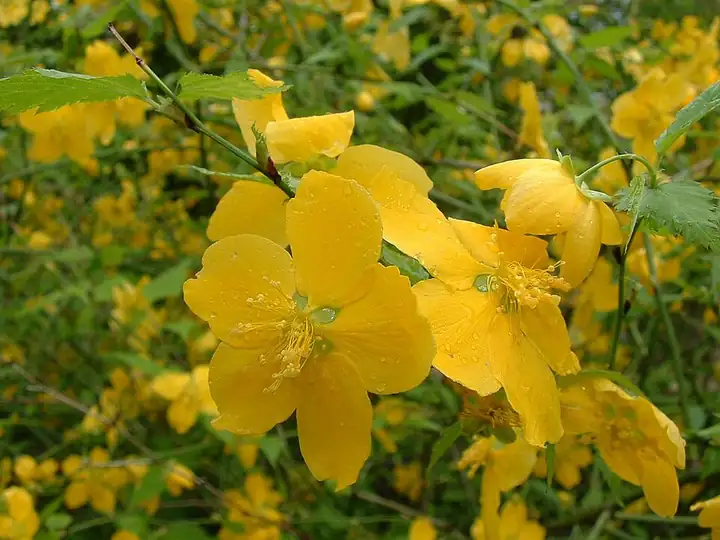
Kerria (Japanese kerria)
Kerria japonica · Rose family (Rosaceae)
When to plant: Plant container shrubs in spring or fall in part shade; in full sun the flowers fade (NC State, Morton Arboretum).
| Hardiness zones | 4 to 9 |
|---|---|
| Sun | part shade |
| Water | moderate |
| Life cycle | perennial |
| Frost | Hardy: takes frost |
About Kerria (Japanese kerria)
Japanese kerria is a deciduous shrub from China, Korea and Japan with slender, bright green, cane-like stems and yellow flowers around Easter, single or in double pom-poms, plus a few more through summer (NC State, Morton Arboretum). It is one of the few shrubs that blooms well in shade, and its green stems add color in winter. It suckers and can form large colonies, and it has escaped from gardens into woods and forest edges in a few places in New England and North Carolina (Go Botany, NC Parks flora); USDA PLANTS gives it no noxious or invasive status, and we found no state invasive listing.
Hardy in zones 4-9 (NC State, Morton Arboretum). Stem tips can die back in harsh winters (Morton Arboretum). Not native to the U.S.
When to plant
Plant container shrubs in spring or fall in part shade; in full sun the flowers fade (NC State, Morton Arboretum).
Water deeply until established, which takes at least two growing seasons (UMN). Give it room or plan to pull suckers.
Soil
Well-drained, loamy soil rich in organic matter; it tolerates some alkaline soil and clay (Morton Arboretum), but NC State says to avoid heavy, poorly drained clay. Once established it handles some dryness.
Test the soil first and work in organic matter for a loose, well-drained loam; avoid heavy, soggy clay (NC State, Morton Arboretum, Clemson).
Feeding
- Spring after new growth starts, only if a soil test shows a need: slow-release complete fertilizer in a 3:1:2 ratio, or what the soil test calls for. Use a light hand: spread it evenly over the root zone and water it in; a typical soil-test rate for shrubs is about 2 lb of 12-6-6 per 100 sq ft (Clemson). Follow a soil test.
Look for: mostly nitrogen, in spring as growth starts. Spring feeding grows the new shoots and leaves that carry flowers and fruit; feeding after midsummer pushes soft growth that may not harden before winter.
Too much fertilizer gives leafy growth with fewer flowers and makes kerria spread more aggressively (Morton Arboretum, NC State). For new plants, water daily for 2 weeks, every 2-3 days through week 12, then weekly until established (UMN).
Harvest
Blooms in late April and May, often around Easter, with scattered flowers through summer (Morton Arboretum, NC State). Flowers come on stems grown the year before, so cut back right after flowering; snip dead tips each spring, and every few years you can cut an overgrown plant to the ground after it blooms to renew it (Morton Arboretum, Oklahoma State).
Varieties (7)
NC State, the Morton Arboretum and Oklahoma State document these 7 cultivars.
| Variety | Type | Season and days | Zones | Notes |
|---|---|---|---|---|
| Pleniflora | Double-flowered | Spring | 4–9typical for kerria | Double, ball-shaped golden-yellow flowers 1-2 inches across on an upright plant; NC State gives 8-10 ft tall, the Morton Arboretum 4-5 ft tall and 6-9 ft wide. Takes dense shade or full sun. Also listed as 'Flora Pleno' (Morton Arboretum). Sources: [1][3][4] |
| Chiba Gold | Gold-leaf | Spring | 4–9typical for kerria | Gold leaves on a 3-6 ft plant that spreads into colonies. A newer gold-leaf introduction from Japan (NC State). Sources: [2] |
| Albescens | Single-flowered | Spring | 4–9typical for kerria | Creamy pale yellow flowers about 2 inches across with irregular petals; 4-5 ft tall, yellow fall color. Sources: [1] |
| Golden Guinea | Single-flowered | Spring, with a long bloom period | 4–9typical for kerria | Large single yellow flowers up to 2-2.5 inches on a 6-8 ft plant with heavily veined leaves. Sources: [1][3] |
| Honshu | Single-flowered | Spring | 4–9typical for kerria | Up to 5 ft tall and 3 ft wide, with larger 2-inch single yellow flowers. Grown at the JC Raulston Arboretum (NC State). Sources: [2] |
| Simplex | Single-flowered | Spring | 4–9typical for kerria | Lots of five-petaled yellow flowers on arching stems that stay bright green to yellowish in winter. Sources: [1] |
| Picta | Variegated | Spring | 4–9typical for kerria | Low, broadly rounded and slow-spreading, with variegated leaves and single yellow flowers. Sources: [1][3] |
Diseases and problems
Twig and leaf blight, Phomopsis stem blight, Septoria leaf spot, Cankers, Root rot
In the kitchen
Safety: The extension sources we used give no poison rating or toxicity warning for kerria. It is grown for looks, not food.
Pets: Not listed by the ASPCA (no kerria entry on its dog, cat or horse plant lists).
Sources
- plants.ces.ncsu.edu
- extensiongardener.ces.ncsu.edu
- mortonarb.org
- extension.okstate.edu
- gobotany.nativeplanttrust.org
- auth1.dpr.ncparks.gov
- plantsservices.sc.egov.usda.gov
- extension.umn.edu
- aspca.org
- aspca.org
- aspca.org
- extension.rutgers.edu
- hgic.clemson.edu
Photo: Photo: Jeffdelonge, CC BY-SA 3.0, via Wikimedia Commons (CC BY-SA 3.0). Photo resized for the web.

Planting dates and advice are general guidance; check with your local Cooperative Extension office for your area.