
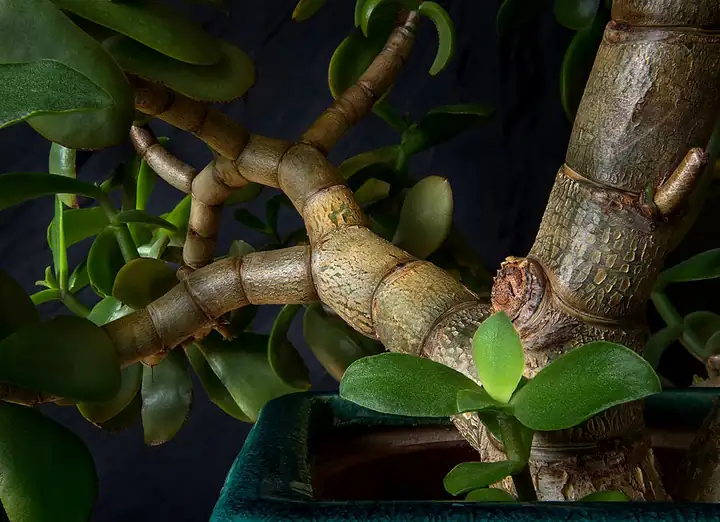
Jade plant
Crassula ovata (formerly Crassula argentea) · Stonecrop family (Crassulaceae)
When to plant: Any time of year, since it grows indoors. Repot every 2-3 years as new growth starts in spring; cuttings root easily in dry succulent mix.
| Hardiness zones | 11 to 12 |
|---|---|
| Sun | full sun to part shade |
| Water | low |
| Life cycle | perennial |
| Frost | Tender: killed by frost |
Will it grow in your window?
Pick the window it sits in. This is the same check Sow & Tell runs for every plant in your house.
It wants bright, direct light.
Pick a window above and this will tell you whether the spot suits it.
Watering: soak it, then let it dry right out — about every 14 days, stretching to every 28 from November to February.
Summering outside? Bring it in before nights drop below 50°F.
About Jade plant
The jade plant is a slow, long-lived South African succulent that builds a thick brown trunk and branches topped with glossy, fleshy oval leaves, so an old one looks like a little tree (NC State, Clemson). It wants a sunny window and very little water, tolerates a cramped pot for years, and can outlive its owner; mature plants grown outdoors in warm climates cover themselves in starry white-pink flowers, though it rarely blooms indoors.
Hardy outdoors only in zones 11-12 (NC State, Penn State); it is grown indoors everywhere and can summer outdoors in part shade once nights stay above about 50 F, coming back in before the first frost (Penn State, Clemson).
When to plant
Any time of year, since it grows indoors. Repot every 2-3 years as new growth starts in spring; cuttings root easily in dry succulent mix.
Usually bought as a nursery plant or started from a stem or leaf cutting, which root easily in dry succulent mix (Clemson, NC State).
Growing it indoors
- Light: Wants at least 4 hours of direct sun a day, ideally a south window; in low light it grows leggy and pale, and NC State suggests some afternoon shade indoors in summer (Clemson, Penn State).
- Water: Penn State waters only when the mix is completely dry, then thoroughly; Clemson keeps it a little moister in spring and summer and lets it dry out fully between waterings in winter. Keep water off the leaves, never let the pot stand in water, and let the mix dry after repotting (Clemson).
- Humidity: Ordinary dry room air is fine; no misting needed (Iowa State on succulents).
- Temperature: Clemson gives 50-55 F nights and 65-75 F days (MU Extension suggests 65 F nights); keep it away from winter drafts and cold glass.
- Feeding: Clemson feeds a liquid houseplant fertilizer once every 3-4 months; Penn State says a balanced liquid fertilizer 2-3 times in spring and summer; both say wait 4 months after repotting before feeding.
- Repotting: Every 2-3 years as new growth starts in spring, though it is happy root-bound for years; move a top-heavy plant into a wide, heavy pot and go easy on water afterward (Penn State, Clemson).
- More plants: Stem cuttings root easily, and single leaves laid on dry succulent mix sprout new plants too (Clemson, NC State); let the cut end dry for a few days first (Iowa State).
If something looks wrong
| What you see | Likely cause | What to do |
|---|---|---|
| Leaves dropping, stems soft, mix stays wet | Overwatering or slow-draining soil | Let the mix dry out completely, make sure the pot drains, and repot into cactus mix if the roots are mushy (Clemson, Penn State). |
| Leaves shriveling and dropping with bone-dry mix | Left too dry for too long | Water thoroughly and then return to the soak-and-dry routine (Clemson). |
| Long, floppy stems with small leaves | Too little light, or too much fertilizer | Give it 4+ hours of direct sun, pinch tips back in spring, and cut back on feeding (Penn State). |
| White cottony fluff in the leaf joints | Mealybugs, its most common pest | Dab them with a cotton swab dipped in rubbing alcohol; Clemson warns not to use insecticidal soap on jade, which can damage the leaves. |
Soil
A very well-drained cactus mix, or 1 part sterilized potting soil, 1 part sphagnum peat and 3 parts coarse sand, in a clay pot with a drainage hole (Clemson, Penn State).
Pot in a very well-drained cactus mix, or 1 part potting soil, 1 part peat and 3 parts coarse sand, in a pot with a drainage hole (Clemson, Penn State).
Feeding
- Spring and summer, while it is growing: balanced liquid houseplant fertilizer. Penn State feeds 2-3 times over spring and summer; Clemson feeds once every 3-4 months. Water first, and wait 4 months after repotting before the first feeding.
- Fall and winter: none. No feeding while it rests and the mix is kept drier (Clemson, MU Extension).
Overfeeding gives leggy, weak growth; a lean, sunny, dry jade is a sturdy one (Penn State).
Varieties (15)
| Variety | Type | Zones | Notes |
|---|---|---|---|
| Bronze Beauty | Colored-leaf | 11+typical for jade plant | The copper jade tree, with bronze-tinted leaves (Clemson). Sources: [2] |
| California Red Tip | Colored-leaf | 11+typical for jade plant | The red jade tree: leaves edged and tipped in red (Clemson). Sources: [2] |
| Hummel's Sunset | Colored-leaf | 11+typical for jade plant | Golden-yellow leaves edged in red when grown in sun; Clemson lists it as 'Sunset', the golden jade tree. Sources: [1][2][3] |
| Baby Jade | Compact | 11+typical for jade plant | A dwarf about 12 in tall with small leaves that edge red in sun (Penn State). Sources: [3] |
| Crosby's Compact | Compact | 11+typical for jade plant | A small, dense form named by NC State. Sources: [1] |
| Minima | Compact | 11+typical for jade plant | A miniature form named by NC State. Sources: [1] |
| Pink Beauty | Flowering | 11+typical for jade plant | Pink flowers instead of the usual white (NC State). Sources: [1] |
| Silver jade (Crassula arborescens) | Related species | 11+typical for jade plant | A related species with rounder blue-gray leaves edged red, sold as silver jade or blue bird jade; 'ripple jade' is its wavy-leaved subspecies (Clemson, Penn State). Sources: [2][3] |
| Obliqua | Standard | 11+typical for jade plant | Pointed oval leaves that can turn purple in direct sun (Penn State). Sources: [3] |
| ET's Fingers | Tubular-leaf | 11+typical for jade plant | Tubular leaves ending in red suction-cup tips (Penn State). Sources: [3] |
| Gollum | Tubular-leaf | 11+typical for jade plant | Trumpet-shaped tubular leaves with red-tinted tips; a variegated form ('Gollum Variegata') exists. Sources: [1] |
| Hobbit | Tubular-leaf | 11+typical for jade plant | Leaves curl into tubes with red tips; a compact plant about 3 ft tall (Clemson). Sources: [1][2] |
| Skinny Fingers | Tubular-leaf | 11+typical for jade plant | Narrow, finger-like leaves. Sources: [1] |
| Tricolor | Variegated | 11+typical for jade plant | Leaves streaked green and white with pink margins (Penn State, Clemson). Sources: [2][3] |
| Variegata | Variegated | 11+typical for jade plant | Green leaves with creamy white variegation. Sources: [1][3] |
Pests to watch for
Diseases and problems
In the kitchen
Safety: NC State lists no human poisoning for jade plant, but it flags it as a problem for cats, dogs and horses, so keep it where pets can't chew it.
Pets: Toxic to dogs, cats and horses (ASPCA, listed under its old name Crassula argentea): the toxic principle is unknown; signs are vomiting, depression and incoordination.
Sources
- plants.ces.ncsu.edu
- hgic.clemson.edu
- extension.psu.edu
- extension.missouri.edu
- yardandgarden.extension.iastate.edu
- aspca.org
Photo: Photo: W.carter, CC0, via Wikimedia Commons (CC0). Photo resized for the web.

Planting dates and advice are general guidance; check with your local Cooperative Extension office for your area.