
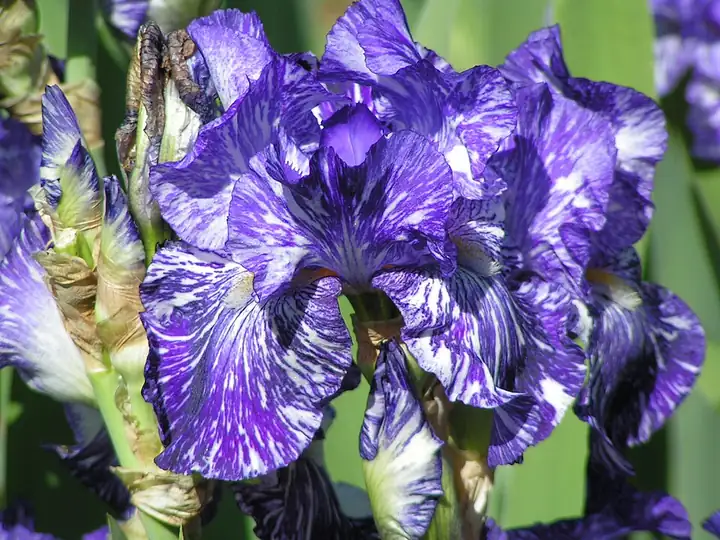
Iris
Iris x germanica (bearded iris), I. sibirica (Siberian), I. ensata (Japanese), Louisiana irises and others · Iris family (Iridaceae)
When to plant: Plant bearded iris rhizomes from about six weeks after bloom through September, on a ridge of soil with the top of the rhizome at or just above the surface and the roots spread below (Clemson; Illinois).
| Hardiness zones | 3 to 10 |
|---|---|
| Sun | full sun |
| Water | low |
| Life cycle | perennial |
| Frost | Hardy: takes frost |
| Spacing | 12 to 18 inches |
About Iris
Irises bloom in late spring with ruffled flowers in nearly every color, and some bearded kinds rebloom in late summer. Bearded irises want sun and sharp drainage with their rhizomes half above ground, while Siberian, Japanese and Louisiana irises like moister soil. Heads-up: yellow flag iris (Iris pseudacorus) is a wetland invader that is not the garden bearded iris; it is a noxious weed in Washington and Colorado, so don't plant it.
Bearded irises grow in zones 3-10 and Siberian irises in 3-9 (Iowa State). Yellow flag iris is on Washington's noxious weed list (Class C, banned from sale) and Colorado's noxious weed list.
When to plant
Plant bearded iris rhizomes from about six weeks after bloom through September, on a ridge of soil with the top of the rhizome at or just above the surface and the roots spread below (Clemson; Illinois).
Louisiana irises go about 1 inch deep with mulch on top. Divide crowded bearded clumps every 3-5 years, 4-6 weeks after bloom. Clearing old leaves in fall helps control iris borer.
Soil
Bearded irises need well-drained soil and will not stand wet ground; mulch and overwatering cause rot. Siberian and Louisiana irises like moist, slightly acid soil (NC State, Clemson, Iowa State).
Follow a soil test; when making a new bed, work in about 1 lb of 5-10-10 per 100 sq ft (Clemson).
Feeding
- early spring: low-nitrogen fertilizer such as 5-10-10. NC State advises feeding irises in early spring; use a light hand and water it in.
Look for: a balanced or all-purpose fertilizer at the label rate. Skip high-phosphorus "bloom boosters" unless a soil test shows low phosphorus: most garden soils already have enough, and the extra can wash into streams.
Don't bury or mulch bearded iris rhizomes or overwater them; that invites rot (NC State).
Harvest
Most bloom in mid to late spring; reblooming bearded types flower again later. Snap off faded blooms (NC State). Bearded irises make good cut flowers.
Varieties (22)
| Variety | Type | Season and days | Zones | Notes |
|---|---|---|---|---|
| Clarence | Bearded | 3–10typical for iris | Lavender-blue flowers on a vigorous plant. Sources: [6] | |
| Passion and Purity | Bearded | 3–10typical for iris | Purple and white flowers. Sources: [1] | |
| Sugar Blues | Bearded | 3–10typical for iris | Blue flowers. Sources: [1] | |
| Tickled Peach | Bearded | 3–10typical for iris | Peach-toned flowers. Sources: [1] | |
| Again and Again | Bearded, reblooming | 3–10typical for iris | Fragrant yellow flowers that rebloom. Sources: [1] | |
| Concertina | Bearded, reblooming | 3–10typical for iris | A reblooming bearded iris. Sources: [1] | |
| Powder Blue Giant | Dwarf crested (Iris cristata) | 3–10typical for iris | Pale blue flowers with gold crests; under 8 in tall. Sources: [10] | |
| Ocean Mist | Japanese (Iris ensata) | June-July | 3–10typical for iris | Blooms June to July. Sources: [10] |
| Ann Chowning | Louisiana | 3–10typical for iris | Rich blue flowers; a reliable bloomer. Sources: [6] | |
| Black Gamecock | Louisiana | 3–10typical for iris | Velvety deep purple flowers. Sources: [6] | |
| Cajun Sunrise | Louisiana | 3–10typical for iris | Warm yellow tones. Sources: [6] | |
| Butter and Sugar | Siberian | 3–10typical for iris | White and yellow flowers. Sources: [2] | |
| Caesar's Brother | Siberian | 3–10typical for iris | Deep purple flowers on plants over 3 ft tall. Sources: [2][10] | |
| Perry's Blue | Siberian | 3–10typical for iris | Sky blue flowers with white markings. Sources: [2] | |
| Roaring Jelly | Siberian | 3–10typical for iris | Deep purple flowers. Sources: [10] | |
| White Swirl | Siberian | 3–10typical for iris | Ruffled ivory-white flowers. Sources: [2] | |
| Harvest of Memories | Standard bearded | 3–10typical for iris | A standard bearded iris. Sources: [1] | |
| Variegata | Sweet iris (Iris pallida) | 4–8 | Cream-and-green striped leaves and pale blue, fragrant flowers; 2-3 ft. Sources: [5] | |
| Beverly Sills | Tall bearded | 3–10typical for iris | Coral-pink flowers on strong stems. Sources: [6] | |
| Dusky Challenger | Tall bearded | 3–10typical for iris | Deep purple flowers. Sources: [6] | |
| Orange Harvest | Tall bearded | 3–10typical for iris | Orange flowers on 27-40 in stems. Sources: [10] | |
| Immortality | Tall bearded, reblooming | 3–10typical for iris | White, lightly fragrant flowers that bloom again later in the season. Sources: [1][6] |
Pests to watch for
Aphids, Slugs, Brown garden snail, Iris borer, Narcissus bulb fly, Foliar nematodes
Diseases and problems
Bacterial soft rot, Leaf spot, Crown rot, Mosaic viruses
In the kitchen
Safety: All parts can upset the stomach if eaten, the roots most of all, and the sap can irritate skin; wear gloves when dividing (NC State).
Pets: Toxic to dogs, cats and horses (ASPCA): it can cause drooling, vomiting, diarrhea and lethargy, and the rhizomes are the most toxic part.
Sources
- plants.ces.ncsu.edu
- plants.ces.ncsu.edu
- extension.illinois.edu
- hgic.clemson.edu
- yardandgarden.extension.iastate.edu
- beaufort.ces.ncsu.edu
- nwcb.wa.gov
- ag.colorado.gov
- aspca.org
- arboretum.psu.edu
Photo: Photo: Bev Sykes, CC BY 2.0, via Wikimedia Commons (CC BY 2.0). Photo resized for the web.

Planting dates and advice are general guidance; check with your local Cooperative Extension office for your area.