
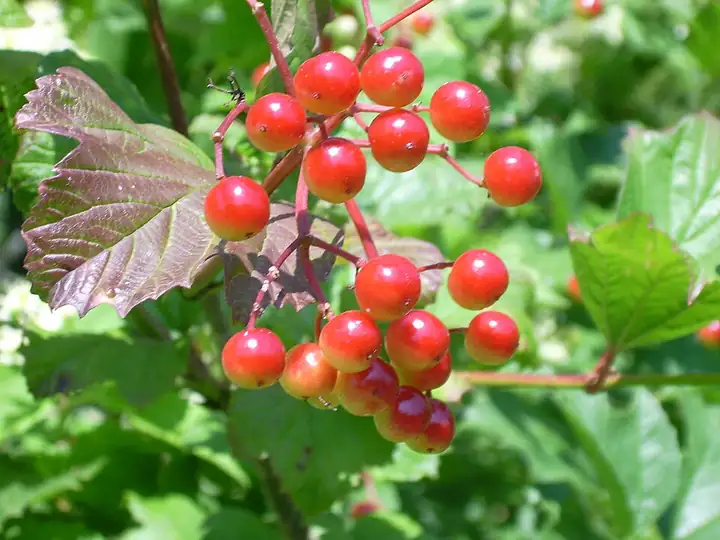
Highbush cranberry (American cranberrybush)
Viburnum trilobum (syn. Viburnum opulus var. americanum) · Moschatel family (Adoxaceae)
| Hardiness zones | 2 to 7 |
|---|---|
| Sun | full sun to part shade |
| Water | moderate |
| Life cycle | perennial |
| Frost | Hardy: takes frost |
| Soil pH | 6.0–7.5 |
About Highbush cranberry (American cranberrybush)
American highbush cranberry is a native shrub, not a true cranberry, with flat white flower clusters in spring and bright red, very tart fruit in late summer and fall. The fruit makes a good sauce or jelly. Buy the native plant: the look-alike European cranberrybush (Viburnum opulus) has bitter fruit, has escaped into the wild from Newfoundland to Virginia and west to Washington, and crosses with the native (NC State; NRCS).
NC State lists zones 2-7; the University of Wisconsin gives zones 3-7.
Planting
Plant nursery-grown shrubs of native cultivars such as 'Wentworth', 'Phillips', 'Hahs' or 'Andrews' (NRCS). It tolerates shade, but flowers and fruits best in full sun (NRCS). Watch for viburnum leaf beetle, which can kill shrubs stripped of leaves 2 to 3 years in a row (NRCS). The shrub reaches 8 to 12 feet tall and wide (NC State).
Soil
Moist but well-drained loam or silt loam; it does not like wet soil and is not drought tolerant (University of Wisconsin).
Plant in moist, well-drained loam with a pH of about 6.0-7.5 (University of Wisconsin).
Feeding
- Once a year, in spring: compost or well-rotted manure. Spread a layer around the shrub to keep up growth and yields (NRCS).
Look for: mostly nitrogen, in spring as growth starts. Spring feeding grows the new shoots and leaves that carry flowers and fruit; feeding after midsummer pushes soft growth that may not harden before winter.
Prune right after flowering, not in winter, or you cut off next year's flowers and fruit; pruning keeps plants from getting leggy (NRCS).
Harvest
Pick in late August or September, when berries are red but still a bit underripe and sour, for sauces and jelly (NRCS). If left on the shrub, birds often wait to eat them until they have frozen and thawed (NC State).
Highbush cranberry fruits once a year, in August-September; pick in late August or early September while slightly underripe and sour for sauces and jelly. Uneaten fruit often hangs on all winter.
Varieties (6)
Only 6 named fruiting selections are documented (USDA NRCS), and only Wentworth and Phillips are described (University of Wisconsin). No source rates single cultivars for hardiness. Compact ornamental forms such as 'Compactum' are cultivars of European cranberrybush (Viburnum opulus), which can be invasive, so they are left out.
| Variety | Type | Season and days | Zones | Notes |
|---|---|---|---|---|
| Andrews | Fruiting selection (American cranberrybush) | 2–7typical for highbush cranberry | USDA NRCS lists it among native American cranberrybush cultivars chosen for better fruit and processing quality. No source we opened describes its fruit or plant. Sources: [2] | |
| Hahs | Fruiting selection (American cranberrybush) | 2–7typical for highbush cranberry | USDA NRCS lists it among native American cranberrybush cultivars chosen for better fruit and processing quality. No source we opened describes its fruit or plant. Sources: [2] | |
| Hogg's Red | Fruiting selection (American cranberrybush) | 2–7typical for highbush cranberry | USDA NRCS lists it among native American cranberrybush cultivars chosen for better fruit and processing quality. No source we opened describes its fruit or plant. Sources: [2] | |
| Manitou | Fruiting selection (American cranberrybush) | 2–7typical for highbush cranberry | USDA NRCS lists it among native American cranberrybush cultivars chosen for better fruit and processing quality. No source we opened describes its fruit or plant. Sources: [2] | |
| Phillips | Fruiting selection (American cranberrybush) | About two weeks later than Wentworth | 2–7typical for highbush cranberry | Darker, firmer red fruit than Wentworth, borne in larger clusters. Established quickly in University of Wisconsin trials, reaching about 6 ft; one planting gave about 15 lb of fruit in its second fruiting year. USDA NRCS lists it among native American cranberrybush cultivars chosen for better fruit and processing quality. Sources: [1][2] |
| Wentworth | Fruiting selection (American cranberrybush) | Earlier than Phillips | 2–7typical for highbush cranberry | Lighter red fruit than Phillips. Slow to establish in University of Wisconsin trials; plants were still struggling several years after planting. USDA NRCS lists it among native American cranberrybush cultivars chosen for better fruit and processing quality. NC State notes it may be sold under the species name Viburnum trilobum. Sources: [1][2][4] |
Pests to watch for
Diseases and problems
Bacterial leaf spot, Powdery mildew, Shoot blight
In the kitchen
Too tart to eat fresh; cooked into jelly, sauce, juice and pies, as a stand-in for cranberries. Strain out the flat seeds, which are astringent (University of Wisconsin; NRCS).
Keeping it: Make juice soon after picking, or freeze it for jelly later.
Safety: Raw fruit is very sour and astringent (University of Wisconsin). European cranberrybush fruit is more bitter and less pleasant, so make sure you have the native plant (NC State).
Pets: Not listed by the ASPCA
Sources
- uncommonfruit.cias.wisc.edu
- plants.sc.egov.usda.gov
- plants.ces.ncsu.edu
- plants.ces.ncsu.edu
- plantsservices.sc.egov.usda.gov
- plantsservices.sc.egov.usda.gov
- aspca.org
Photo: Photo: Fungus Guy / Wikimedia Commons, CC BY-SA 3.0 (CC BY-SA 3.0). Photo resized for the web.

Planting dates and advice are general guidance; check with your local Cooperative Extension office for your area.