
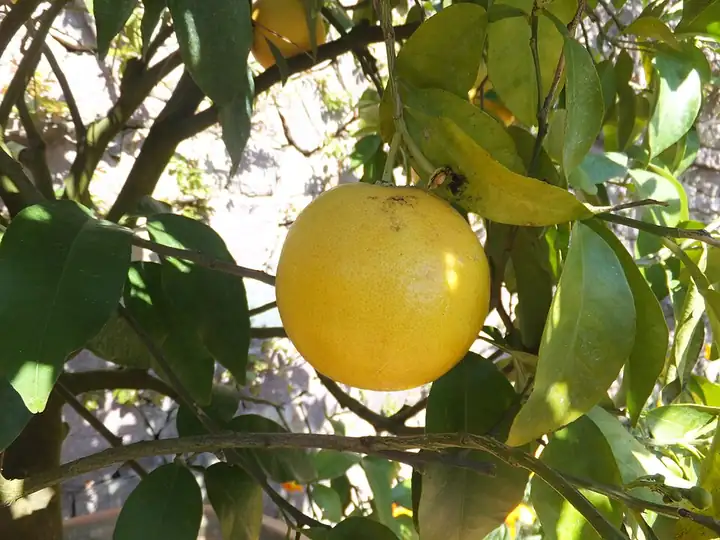
Grapefruit
Citrus x paradisi · Citrus family (Rutaceae)
| Hardiness zones | 9 to 11 |
|---|---|
| Sun | full sun |
| Water | moderate |
| Life cycle | perennial |
| Frost | Tender: killed by frost |
| Soil pH | 5.0–6.0 |
About Grapefruit
Grapefruit is a big evergreen citrus tree with fragrant white flowers and large yellow fruit that hold on the tree for months. It was first reported in Barbados around 1750 and reached Florida in 1823 (UF/IFAS); home types range from white 'Marsh' and 'Duncan' to deep red 'Rio Red' and 'Star Ruby'. It is less cold-hardy than oranges and grows too big for most pots, so it is best in the ground in the warmest parts of the country.
NC State lists zones 9-11. Well-hardened mature trees may get through the mid-20s F, but fruit freezes after 3 to 5 hours at 27 F (Texas A&M); in colder zones it needs a big pot and winter shelter.
Planting
In zones 9-11 plant in full sun on the south or southeast side of the house, at least 12 feet from buildings, drives and walks, with the bud union above the soil and no basin around the trunk (Texas A&M). Budded trees should bear in the third season; pick off any fruit in the first two years (Texas A&M).
Soil
Deep, well-drained loam; heavy clay and wet soil shorten its life, and it is sensitive to salty soil (Texas A&M; NC State).
Plant in deep, well-drained soil; in good soil don't add topsoil, compost or peat to the planting hole (Texas A&M).
Feeding
- First year, once growth starts: Nitrogen fertilizer such as ammonium sulfate (21-0-0). About 1 cup for the year, split into 3 or 4 feedings scattered around the tree and watered in (Texas A&M).
Look for: mostly nitrogen, in spring as growth starts. Spring feeding grows the new shoots and leaves that carry flowers and fruit; feeding after midsummer pushes soft growth that may not harden before winter. - Second and third years: Nitrogen fertilizer such as 21-0-0. About 2 cups in year two and 3 cups in year three, split into several feedings (Texas A&M).
Look for: mostly nitrogen, in spring as growth starts. Spring feeding grows the new shoots and leaves that carry flowers and fruit; feeding after midsummer pushes soft growth that may not harden before winter. - Bearing trees: February, May and September: Nitrogen fertilizer such as 21-0-0. About 1 cup per year of tree age, split across the three feedings; adjust the amount for fertilizers with a different nitrogen content (Texas A&M).
Look for: mostly nitrogen, in spring as growth starts. Spring feeding grows the new shoots and leaves that carry flowers and fruit; feeding after midsummer pushes soft growth that may not harden before winter. - Potted trees: several times during the growing season: Slow-release citrus fertilizer such as 12-6-6 or 12-4-6 with iron, manganese and zinc. Follow the label for timing; citrus in pots often runs short of these micronutrients (Mississippi State).
Look for: mostly nitrogen, in spring as growth starts. Spring feeding grows the new shoots and leaves that carry flowers and fruit; feeding after midsummer pushes soft growth that may not harden before winter.
Don't mulch against the trunk or dig a basin around a young tree; both raise the risk of foot rot, which has no cure (Texas A&M).
Harvest
Taste tells ripeness better than color: Texas fruit is legally mature by mid to late October while the peel is still green, and it gets bigger and sweeter the longer it hangs (Texas A&M). Pick as needed from late fall through May; red flesh fades over the season in 'Ruby Red' but stays red in 'Rio Red' (Texas A&M).
One crop a year, but it stores on the tree: pick as needed from late fall through May, and the fruit gets sweeter the longer it hangs (Texas A&M).
Varieties (14)
Extension sources document 14 grapefruit and grapefruit-hybrid varieties grown in U.S. home yards.
| Variety | Type | Season and days | Zones | Notes |
|---|---|---|---|---|
| Melogold | Grapefruit x pummelo hybrid | November to January in interior California and Arizona | 9–11typical for grapefruit | Mild, pummelo-like flavor. Sibling of Oroblanco; about a quarter larger, with a thinner peel. Sources: [3][4] |
| Oroblanco | Grapefruit x pummelo hybrid | December to January in inland California | 9–11typical for grapefruit | Sweeter and less acidic than Marsh. Always seedless; slightly larger and flatter than white grapefruit, with a thick, greenish-yellow rind; big, spreading tree. Sources: [3][4] |
| Foster | Pink | Early | 9–11typical for grapefruit | First pink-fleshed grapefruit on record; very seedy, with a pink blush on the peel. Sources: [2][4] |
| Thompson | Pink | Early | 9–11typical for grapefruit | Like Marsh. Also called Pink Marsh. First seedless pink grapefruit (1924); pink color fades late in the season. Sources: [2][4] |
| Burgundy | Red | April to May or later in Florida | 9–11typical for grapefruit | Seedless, with deep, even red flesh that holds its color late. Sources: [2][3] |
| Flame | Red | February to June at Riverside | 9–11typical for grapefruit | Good sweet-acid balance; tender and juicy. Deep red flesh almost as dark as Star Ruby; smooth yellow peel with a pink blush; vigorous, large tree. More cold tolerant than Star Ruby. Sources: [2][4][5] |
| Henderson | Red | Late fall into spring | 9–11typical for grapefruit | A limb sport of Ruby Red, nearly the same as Ray; redder flesh that starts fading in late February or March. Sources: [3] |
| Ray Ruby | Red | Late fall into spring | 9–11typical for grapefruit | Found in a Texas grove of Redblush; redder flesh and more peel blush that hold color later in the season. Sources: [2][3] |
| Rio Red | Red | Late fall to late May or early June | 9–11typical for grapefruit | Good sweet-acid balance. Intense red flesh that does not fade; large, vigorous, productive tree. Sold as Rio Star. The most commonly planted grapefruit in Arizona, California and Texas. Sources: [3][4] |
| Ruby Red | Red | Late fall into spring | 9–11typical for grapefruit | Excellent quality. Also called Redblush. Red-pink flesh that fades after New Year's; 0 to 6 seeds; red blush on yellow peel. Sources: [2][3][4] |
| Star Ruby | Red | Matures with Rio Red and holds into late spring | 9–11typical for grapefruit | Very sweet; the darkest red flesh. Thin, smooth peel; few or no seeds; smaller, compact tree that bears erratically and is prone to foot rot, frost and herbicide damage. Now grown mostly by home gardeners in Texas. Sources: [2][3][4] |
| Duncan | White | Late November, best by February | 9–11typical for grapefruit | Rich, balanced, high in both sugar and acid. Pale yellow flesh with 30 to 60 seeds; big, spreading tree that is hardier than Marsh. Florida's oldest grapefruit. Best for juice and sections because of the seeds. Sources: [2][4] |
| Garner Seedless | White | 9–11typical for grapefruit | White grapefruit found near Laredo, Texas; seems hardier because it grows on its own roots. Sources: [3] | |
| Marsh | White | Ripens later and holds longer than Duncan | 9–11typical for grapefruit | Sweet with some acid; tender and juicy, can turn bland late in the season. Light yellow flesh with few seeds; the most widely planted grapefruit worldwide. Less frost tolerant than Duncan. Sources: [2][4] |
Pests to watch for
Diseases and problems
Phytophthora foot rot and root rot, Citrus canker, Tristeza virus, Psorosis
In the kitchen
Mostly eaten fresh or juiced; also made into jams, jellies and baked goods, and the peel is candied (Texas A&M; NC State).
Keeping it: Grapefruit keeps best on the tree, so pick as you need it (Texas A&M). Fresh juice keeps chilled for up to a couple of weeks.
Safety: Grapefruit and its juice can change how some medicines work, raising or lowering the amount in your blood: examples include some statins, blood pressure drugs, transplant drugs, anti-anxiety drugs, heart-rhythm drugs and fexofenadine (FDA). If you take any prescription medicine, ask your doctor or pharmacist before eating grapefruit; pomelos, Seville oranges and tangelos can act the same way (FDA). The peel oils can cause skin irritation in some people (NC State).
Pets: Toxic to dogs, cats and horses (ASPCA): the fruit is edible, but the peel and plant contain essential oils and psoralens that can cause vomiting, diarrhea, depression and skin irritation.
Sources
- plants.ces.ncsu.edu
- ufdcimages.uflib.ufl.edu
- aggie-hort.tamu.edu
- extension.arizona.edu
- citrusvariety.ucr.edu
- extension.msstate.edu
- fda.gov
- aspca.org
- extension.umd.edu
- aphis.usda.gov
- usda.gov
Photo: Photo: Syrio / Wikimedia Commons, CC BY-SA 4.0 (CC BY-SA 4.0). Photo resized for the web.

Planting dates and advice are general guidance; check with your local Cooperative Extension office for your area.