
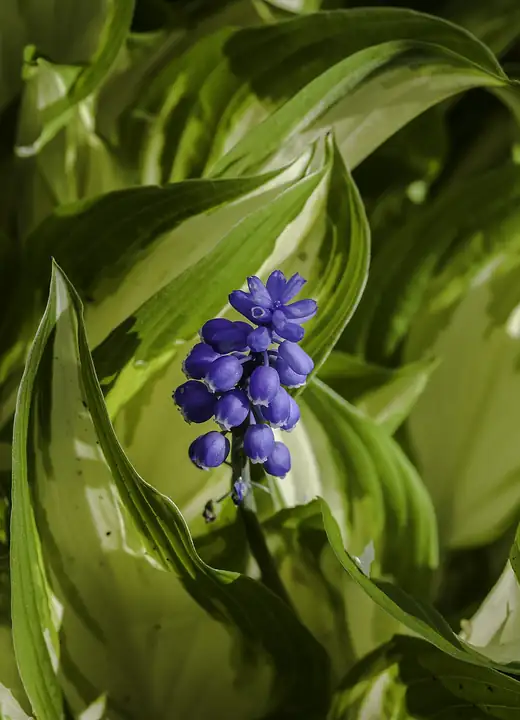
Grape hyacinth
Muscari armeniacum and other Muscari species (M. botryoides, M. neglectum, M. azureum, M. latifolium, M. comosum) · Asparagus family (Asparagaceae)
When to plant: Plant bulbs in fall, 3-5 inches deep and 2-4 inches apart (Wisconsin, NC State); in Minnesota plant mid-September to mid-October (UMN).
| Hardiness zones | 3 to 9 |
|---|---|
| Sun | full sun to part shade |
| Water | moderate |
| Life cycle | perennial |
| Frost | Hardy: takes frost |
| Soil pH | 6.0–7.0 |
| Spacing | 2 to 4 inches |
About Grape hyacinth
Grape hyacinths are small spring bulbs with tight clusters of cobalt-blue bells that look like tiny bunches of grapes. They aren't true hyacinths. They are easy, cheap and quick to fill in under shrubs and along walks (Wisconsin, NC State, Clemson). They spread fast by offsets and seed and can crowd out other plants; the Tennessee Invasive Plant Council includes M. neglectum in its invasive plant list, so keep them in pots or contained beds near wild areas.
Hardy in zones 3-9 (Wisconsin; NC State lists 4-8). Starch hyacinth (M. neglectum) and feather hyacinth grow especially well in the South (Clemson).
When to plant
Plant bulbs in fall, 3-5 inches deep and 2-4 inches apart (Wisconsin, NC State); in Minnesota plant mid-September to mid-October (UMN).
New leaves come up in fall and stay through winter; that's normal (NC State, Wisconsin).
Soil
Average, well-drained soil; it handles poor soil and summer drought but needs moisture while growing in fall and spring (NC State).
Average, well-drained soil is fine; for long-term beds, mix bone meal or a slow-release complete fertilizer into the rooting area and keep the pH about 6-7 (Wisconsin, Clemson).
Feeding
- After bloom in spring: bone meal. Scatter a light dressing around the clumps after flowering (Wisconsin); follow a soil test.
Look for: a balanced or all-purpose fertilizer at the label rate. Skip high-phosphorus "bloom boosters" unless a soil test shows low phosphorus: most garden soils already have enough, and the extra can wash into streams.
Water less once the leaves start to die back in late spring (NC State, Wisconsin).
Harvest
Grape hyacinths bloom in mid-spring (March-May) and make sweet little cut flowers; cut when about half the florets on the spike are open (NC State, Oklahoma State). Let the leaves die back on their own after bloom.
Varieties (15)
| Variety | Type | Season and days | Zones | Notes |
|---|---|---|---|---|
| Album | M. armeniacum | 3–9typical for grape hyacinth | Fragrant white flowers; less vigorous than the blue type. Sources: [2] | |
| Blue Spike | M. armeniacum | 3–9typical for grape hyacinth | Double, flax-blue florets on branched spikes. Sources: [2] | |
| Cantab | M. armeniacum | Slightly later than most | 3–9typical for grape hyacinth | Sky-blue, lightly scented flowers, 6-9 inches tall. Sources: [1][2] |
| Carneum | M. armeniacum | 3–9typical for grape hyacinth | Pinkish flowers. Sources: [2] | |
| Christmas Pearl | M. armeniacum | Early (March) | 3–9typical for grape hyacinth | Soft violet-blue flowers, 6-9 inches tall. Sources: [1] |
| Fantasy Creation | M. armeniacum | 3–9typical for grape hyacinth | Double blue flowers that may turn greenish as they age. Sources: [2] | |
| Saffier | M. armeniacum | 3–9typical for grape hyacinth | Deep blue; sterile, so the flowers last longer. Sources: [2] | |
| Superstar | M. armeniacum | 3–9typical for grape hyacinth | Periwinkle florets edged in white, with paler florets on top. Sources: [2] | |
| Valerie Finnis | M. armeniacum | 3–9typical for grape hyacinth | One to three stiff 8-inch spikes per bulb of densely packed, cone-shaped, lightly fragrant blue flowers. Sources: [1] | |
| Tassel hyacinth | Muscari comosum | Late spring | 3–9typical for grape hyacinth | Purplish-brown flowers on 8-12 inch stems. Sources: [2] |
| Feather hyacinth | Muscari comosum 'Plumosum' | 3–9typical for grape hyacinth | Sterile, threadlike purple-blue flowers in a feathery plume. Grows especially well in the South (Clemson). Sources: [2][3] | |
| Starch hyacinth | Muscari neglectum | 3–9typical for grape hyacinth | Blue flowers; spreads quickly by seed and offset bulbs. Grows especially well in the South (Clemson), but the Tennessee Invasive Plant Council lists it; keep it away from natural areas. Sources: [3][7] | |
| Muscari azureum | Species | Early spring | 3–9typical for grape hyacinth | Bright blue flowers that open wider than M. armeniacum, 4-6 inches tall; a white form exists. Sources: [2] |
| Muscari botryoides | Species | 3–9typical for grape hyacinth | Looks almost the same as M. armeniacum. Sources: [2] | |
| Muscari latifolium | Species | Early spring | 3–9typical for grape hyacinth | One broad leaf per bulb; two-tone spikes, pale blue on top and nearly black-blue below, 6-12 inches tall. Wisconsin says it does best in zones 2-5. Sources: [2] |
Pests to watch for
In the kitchen
Safety: Grown only as an ornamental; NC State's Plant Toolbox lists no poison warning for it. Don't eat the bulbs.
Pets: Not toxic to dogs, cats or horses (ASPCA lists Muscari armeniacum as non-toxic).
Sources
- plants.ces.ncsu.edu
- mastergardener.extension.wisc.edu
- hgic.clemson.edu
- extension.umn.edu
- extension.okstate.edu
- aspca.org
- tnipc.org
Photo: Photo: Diego Delso / Wikimedia Commons, CC BY-SA 3.0 (CC BY-SA 3.0). Photo resized for the web.

Planting dates and advice are general guidance; check with your local Cooperative Extension office for your area.