
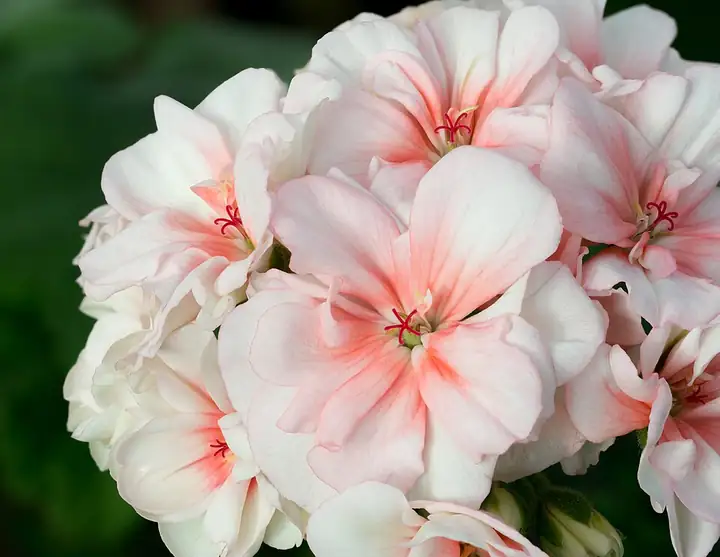
Geranium (annual, Pelargonium)
Pelargonium x hortorum (zonal) and P. peltatum (ivy) · Geranium family (Geraniaceae)
When to plant: Start seeds indoors 16 weeks before the last frost and set out plants up to 2 weeks after the last frost.
| Hardiness zones | 10 to 11 |
|---|---|
| Sun | full sun |
| Water | moderate |
| Life cycle | tender perennial (grown as an annual) |
| Frost | Tender: killed by frost |
| Soil pH | 6.4–6.8 |
About Geranium (annual, Pelargonium)
Annual geraniums are the classic pot and window-box flowers, with round clusters of red, pink, salmon, orange or white blooms over scalloped, often banded leaves. Zonal types are upright; ivy geraniums trail. They are Pelargonium, a different plant from the hardy perennial geraniums (cranesbills) and our native wild geranium, which are 'true' Geranium (Iowa State).
Winter hardy only in zones 10-11 (Missouri Botanical Garden); grown as a summer annual or overwintered indoors elsewhere.
When to plant
Timing is counted from your average last spring frost (and first fall frost). Sow & Tell works out the actual dates for your ZIP code.
- Start seeds indoors: 16 weeks before the last frost
- Set out plants: up to 2 weeks after the last frost
Seed must be started about 4 months before the last frost; it sprouts in 7-14 days at 70-75 F (Cornell). Most people buy plants and set them out after frost danger is past and the soil has warmed (Clemson). Give at least 6 hours of sun; in hot areas afternoon shade helps when it's over 85 F.
Soil
Moist, fertile, well-drained soil; Kentucky Extension says zonal geraniums need pH 6.4-6.8 for normal growth.
Before planting, work in 1-2 lb of all-purpose fertilizer per 100 sq ft (Iowa State) into moist, fertile, well-drained soil; follow a soil test.
Feeding
- Every 4-6 weeks through the growing season (beds): water-soluble balanced fertilizer. Clemson feeds every 4-6 weeks; Iowa State feeds beds once or twice a month in summer and containers every 2-4 weeks.
Look for: a balanced or all-purpose fertilizer at the label rate. Skip high-phosphorus "bloom boosters" unless a soil test shows low phosphorus: most garden soils already have enough, and the extra can wash into streams.
Overwatering causes edema (corky spots under leaves) and root rot; let soil dry a bit between waterings and keep water off the leaves.
Harvest
Blooms from late spring until frost. Snap off faded flower clusters to keep blooms coming, and pinch stems for bushier plants. Before frost, take cuttings or bring plants indoors to overwinter.
Varieties (19)
| Variety | Type | Notes |
|---|---|---|
| Calliope Large Burgundy | Interspecific hybrid | Burgundy; 24 in tall and 21 in wide in Penn State trials. Ranked second of 19 geraniums at Penn State in 2017. Sources: [10] |
| Calliope Large Orange Splash | Interspecific hybrid | Orange; 12 in tall and 22 in wide in Penn State trials. Rated 4.53 of 5 at Penn State in 2019. Sources: [11] |
| Calliope Medium Dark Red | Interspecific hybrid | Velvety dark red flowers all summer; about 9 in tall and 19 in wide in Penn State trials. 2017 AAS national winner. Sources: [12][13] |
| Balcon types | Ivy geranium (Pelargonium peltatum) | Mini-cascade type that can trail 2 ft from a window box, even on a north side. Sources: [4] |
| Mexicana | Ivy geranium (Pelargonium peltatum) | An established ivy geranium cultivar (Iowa State). Sources: [4] |
| Salmon Queen | Ivy geranium (Pelargonium peltatum) | An established ivy geranium cultivar (Iowa State). Sources: [4] |
| Summer Showers | Ivy geranium (Pelargonium peltatum) | Trailing; grows well from seed. Sources: [4] |
| Sybil Holmes | Ivy geranium (Pelargonium peltatum) | An established ivy geranium cultivar (Iowa State). Sources: [4] |
| Tornado | Ivy geranium (Pelargonium peltatum) | Trailing; grows well from seed. Sources: [4] |
| Americana series | Zonal, from cuttings | Listed by NC State. Sources: [1] |
| Big EEZE Pink Batik | Zonal, from cuttings | Pink flowers streaked with white, 4-5 in across, on upright plants about 18 in tall; handles heat well. 2024 AAS ornamental winner. Sources: [14] |
| Tango Dark Red | Zonal, from cuttings | Dark red. NC State lists it; Kentucky Extension lists Tango among cutting-grown series. Sources: [1][7] |
| Elite series | Zonal, seed-grown | Listed by Kentucky Extension. Sources: [7] |
| Maverick series | Zonal, seed-grown | Listed by Kentucky Extension and NC State. Sources: [1][7] |
| Multibloom series | Zonal, seed-grown | Listed by Kentucky Extension. Sources: [7] |
| Orbit series | Zonal, seed-grown | About 14 in tall; very early flowering with big clusters in red, pink, orange and white. Sources: [6][7] |
| Pinto Premium White to Rose | Zonal, seed-grown | Flowers open white and deepen to rose-pink; 14-16 in tall with dark-zoned leaves; blooms summer to frost. 2013 AAS bedding plant winner; no deadheading needed. Sources: [7][15] |
| Pinto series | Zonal, seed-grown | Kentucky Extension lists Pinto among seed geranium series; NC State lists the Pinto group. Sources: [1][7] |
| Ringo 2000 series | Zonal, seed-grown | Listed by Kentucky Extension. Sources: [7] |
Pests to watch for
Aphids, Whiteflies, Twospotted spider mite, Mealybugs, Scale insects, Slugs, Tobacco budworm (geranium or petunia budworm)
Diseases and problems
Bacterial leaf spot (bacterial blight), Gray mold, Rust, Root rot, Edema (oedema), Cucumber mosaic, Tomato and tobacco ringspot
In the kitchen
Safety: NC State rates it low-severity: eating a lot can cause vomiting, and handling it can irritate sensitive skin.
Pets: Toxic to dogs and cats (ASPCA): geraniol and linalool can cause vomiting, poor appetite, depression and skin irritation
Sources
- plants.ces.ncsu.edu
- hgic.clemson.edu
- yardandgarden.extension.iastate.edu
- yardandgarden.extension.iastate.edu
- yardandgarden.extension.iastate.edu
- gardening.cornell.edu
- uky.edu
- missouribotanicalgarden.org
- aspca.org
- agsci.psu.edu
- agsci.psu.edu
- all-americaselections.org
- agsci.psu.edu
- all-americaselections.org
- all-americaselections.org
Photo: Photo: Petar Milošević, CC BY-SA 4.0, via Wikimedia Commons (CC BY-SA 4.0). Photo resized for the web.

Planting dates and advice are general guidance; check with your local Cooperative Extension office for your area.