
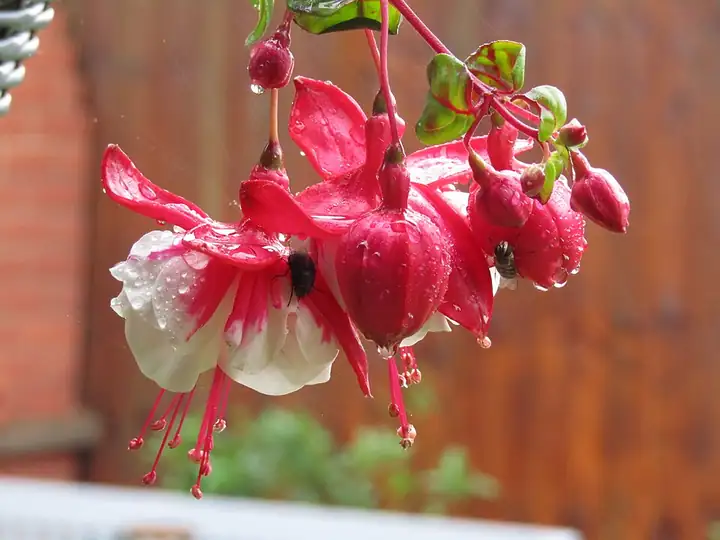
Fuchsia
Fuchsia x hybrida, F. magellanica (hardy fuchsia), F. triphylla and hybrids · Evening primrose family (Onagraceae)
When to plant: Plant hardy fuchsias in late April or early May with the crown 4-6 inches below the soil, and mulch deeply in late fall (WSU).
| Hardiness zones | 5 to 12 |
|---|---|
| Sun | part shade |
| Water | high |
| Life cycle | tender perennial (grown as an annual) |
| Frost | Tender: killed by frost |
About Fuchsia
Fuchsias are shade-loving plants, often grown in hanging baskets, with dangling two-toned flowers in red, pink, purple and white. The flowers are unscented but full of sweet nectar, and hummingbirds work them all summer (WSU; NC State). Most garden fuchsias are tender and grown as annuals or brought indoors for winter; hardy fuchsia (F. magellanica) is a shrub that dies back and regrows from the roots. Heads-up: hardy fuchsia has invaded wet forests in Hawaii and is rated high-risk there, and in coastal California the fuchsia gall mite is a serious pest, so pick resistant kinds (UC IPM).
Hardy fuchsia survives in zones 5-10 (NC State; WSU says zone 6 and warmer), while most hybrid fuchsias are hardy only in zones 10-12 and are grown as annuals or overwintered indoors elsewhere. Hardy fuchsia is naturalized and invasive in Hawaiian wet forests (Hawaii-Pacific Weed Risk Assessment: high risk).
When to plant
Plant hardy fuchsias in late April or early May with the crown 4-6 inches below the soil, and mulch deeply in late fall (WSU).
Grow in shade or morning sun; afternoon sun is too hot (WSU). To overwinter tender fuchsias, keep them cool and dark at 45-55 F with very little water, then cut them back by half about a month before your last frost (WSU).
Soil
Rich, moist, fast-draining soil or potting mix with perlite or vermiculite; roots rot if they sit in water, and plants don't tolerate drought (WSU; NC State).
Use a potting mix that contains fertilizer plus perlite or vermiculite so it drains fast; in the ground, add perlite or vermiculite for drainage (WSU).
Feeding
- spring and summer, while plants are growing: soluble balanced fertilizer such as 10-10-10. WSU feeds container fuchsias weekly in spring and summer, tapering off in fall; a slow-release fertilizer that lasts 2-4 months works instead.
Look for: a balanced or all-purpose fertilizer at the label rate. Skip high-phosphorus "bloom boosters" unless a soil test shows low phosphorus: most garden soils already have enough, and the extra can wash into streams. - hardy fuchsias in the ground, monthly during active growth: balanced fertilizer such as 20-20-20. WSU Master Gardeners call hardy fuchsias heavy feeders; feed monthly at the label rate or use a slow-release granular fertilizer.
Look for: a balanced or all-purpose fertilizer at the label rate. Skip high-phosphorus "bloom boosters" unless a soil test shows low phosphorus: most garden soils already have enough, and the extra can wash into streams.
Hot afternoon sun and soggy soil are the common killers; container plants may need water once or twice a day in hot weather (WSU).
Harvest
Flowers come on new growth from late spring until frost. Pinch the tips of young shoots to make more flowering branches, remove faded flowers, and feed regularly to keep new growth coming (WSU; Illinois Extension).
Varieties (16)
| Variety | Type | Zones | Notes |
|---|---|---|---|
| Hardy fuchsia (F. magellanica) | Hardy fuchsia species | 5–10 | Fountain-shaped shrub 5-10 ft where it doesn't freeze back; red to magenta flowers summer to frost; salt-tolerant. Highly susceptible to fuchsia gall mite (UC IPM) and invasive in Hawaii. Hardy fuchsia has spread into wet forests on Kauai, Maui and the Big Island. It is legal to plant, but gardeners in Hawaii should choose a hybrid fuchsia instead. [7] Sources: [4][7][9] |
| Angel's Earrings | Hybrid fuchsia | White flowers; also sold as a cascading type. Sources: [2][3] | |
| Baby Chang | Hybrid fuchsia | Resistant or low susceptibility to fuchsia gall mite (UC IPM). Sources: [9] | |
| Blaze | Hybrid fuchsia | Bright red sepals with vivid pink petals. Sources: [3] | |
| Chance Encounter | Hybrid fuchsia | Resistant or low susceptibility to fuchsia gall mite (UC IPM). Sources: [9] | |
| Cinnabarina | Hybrid fuchsia | Resistant or low susceptibility to fuchsia gall mite (UC IPM). Sources: [9] | |
| Dollar Princess | Hybrid fuchsia | Moderately susceptible to fuchsia gall mite (UC IPM). Sources: [9] | |
| Gartenmeister Bonstedt | Hybrid fuchsia | Heat-tolerant, with red-bronze leaves and orange-red tubular flowers. Sources: [3] | |
| Isis | Hybrid fuchsia | Resistant or low susceptibility to fuchsia gall mite (UC IPM). Sources: [9] | |
| Mendocino Mini | Hybrid fuchsia | Resistant or low susceptibility to fuchsia gall mite (UC IPM). Sources: [9] | |
| Miniature Jewels | Hybrid fuchsia | Resistant or low susceptibility to fuchsia gall mite (UC IPM). Sources: [9] | |
| Ocean Mist | Hybrid fuchsia | Resistant or low susceptibility to fuchsia gall mite (UC IPM). Sources: [9] | |
| Space Shuttle | Hybrid fuchsia | Resistant or low susceptibility to fuchsia gall mite (UC IPM). Sources: [9] | |
| Swingtime | Hybrid fuchsia | Highly susceptible to fuchsia gall mite (UC IPM); avoid where the mite is present. Sources: [9] | |
| Fuchsia boliviana | Species fuchsia | Resistant or low susceptibility to fuchsia gall mite (UC IPM). Sources: [9] | |
| Honeysuckle fuchsia (F. triphylla) | Species fuchsia | Moderately susceptible to gall mite (UC IPM); non-toxic to pets (ASPCA). Sources: [8][9] |
Pests to watch for
In the kitchen
Safety: NC State and the ASPCA list no toxic parts; NC State calls the berries of hardy fuchsia not edible for people.
Pets: Non-toxic to dogs, cats and horses (ASPCA lists honeysuckle fuchsia, F. triphylla; NC State also lists hybrid fuchsia as non-toxic).
Sources
- s3.wp.wsu.edu
- wpcdn.web.wsu.edu
- plants.ces.ncsu.edu
- plants.ces.ncsu.edu
- extension.illinois.edu
- ipm.ucanr.edu
- plantpono.org
- aspca.org
- ipm.ucanr.edu
Photo: Photo: Kolforn, CC BY-SA 4.0, via Wikimedia Commons (CC BY-SA 4.0). Photo resized for the web.

Planting dates and advice are general guidance; check with your local Cooperative Extension office for your area.