
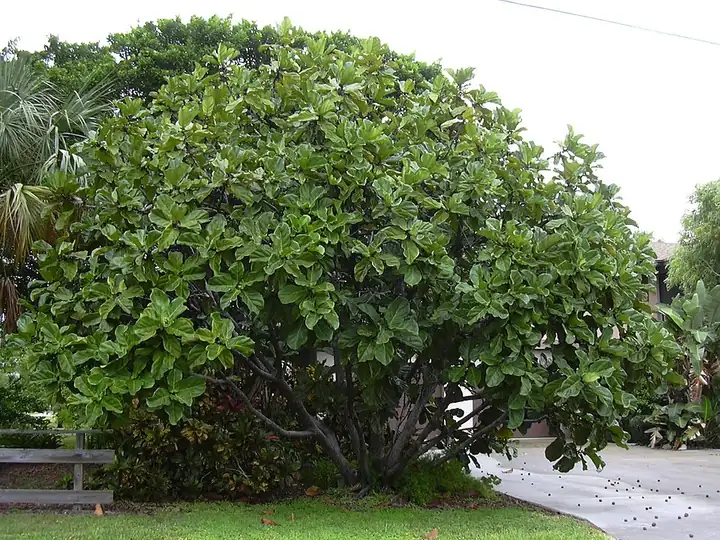
Fiddle-leaf fig
Ficus lyrata (formerly Ficus pandurata) · Mulberry family (Moraceae)
When to plant: Any time of year, since it grows indoors. Repot in late spring, after growth resumes, and only when roots fill the pot.
| Hardiness zones | 10 to 12 |
|---|---|
| Sun | part shade |
| Water | moderate |
| Life cycle | perennial |
| Frost | Tender: killed by frost |
Will it grow in your window?
Pick the window it sits in. This is the same check Sow & Tell runs for every plant in your house.
It wants bright, indirect light.
Pick a window above and this will tell you whether the spot suits it.
Watering: water when the top inch is dry — about every 7 days, stretching to every 12 from November to February.
Summering outside? Bring it in before nights drop below 55°F.
About Fiddle-leaf fig
The fiddle-leaf fig is a tropical tree from the rainforests of western and central Africa, grown indoors for its huge, leathery, violin-shaped leaves that can reach 12-18 in long on a scarcely branched woody trunk (NC State). It is a designer favorite for a bright corner, growing 2-10 ft tall in a pot, but it has a reputation for sulking: it drops leaves when its watering, light or temperature change, so pick a spot and leave it there. Outdoors in the tropics it becomes a 60-100 ft tree and almost never flowers or fruits in a house.
Hardy outdoors only in zones 10-12 (NC State); it is grown indoors everywhere and can summer outdoors on a shaded, sheltered patio once nights stay above about 55 F, moved into more light gradually so the leaves don't sunburn (NC State, Penn State Master Gardeners).
When to plant
Any time of year, since it grows indoors. Repot in late spring, after growth resumes, and only when roots fill the pot.
Almost always bought as a nursery plant; it can be started from a stem cutting or by air layering, wearing gloves because of the sap (NC State, Cornell Cooperative Extension).
Growing it indoors
- Light: Give it bright indirect light or a few hours of gentle morning sun; shield it from hot afternoon sun, which scorches the leaves (NC State), and turn the pot a quarter turn now and then so it grows straight (Penn State Master Gardeners).
- Water: Water when the mix is dry about 2 in down, soaking the whole root ball until water runs out the drainage holes; MU Extension's table says keep figs evenly moist, and NC State warns it is sensitive to overwatering and drops leaves from too much or too little water. If the mix has shrunk from the pot sides, loosen it so water doesn't run straight down the gap (Penn State Master Gardeners).
- Humidity: Medium humidity suits it (NC State); Cornell Cooperative Extension says figs need at least 40 percent humidity and drop leaves in dry, drafty air, so a humidifier helps in winter.
- Temperature: Keep it above 55 F (NC State) with nights around 65 F (MU Extension), away from drafts and from heating and cooling vents, since temperature swings cause brown spots and leaf drop (NC State).
- Feeding: Feed a water-soluble houseplant fertilizer monthly during active growth (Cornell Cooperative Extension) or a dilute 3-1-2 liquid with each watering (Penn State Master Gardeners); MU Extension says none in winter when no new leaves are coming.
- Repotting: Repot in late spring after growth resumes, one pot size up, only when the roots fill the pot; figs tolerate being a little root-bound and need repotting less often than most houseplants (Cornell Cooperative Extension, Penn State Master Gardeners).
- More plants: Stem cuttings or, for most ficus, air layering: cut a third of the way into the stem about a foot below the tip, pack the cut with moist sphagnum, wrap it in plastic and wait three weeks to three months for roots (NC State, Cornell Cooperative Extension). Wear gloves because of the sap.
If something looks wrong
| What you see | Likely cause | What to do |
|---|---|---|
| Leaves dropping, often after a move or a change in routine | Too much or too little water, a cold draft or a sudden change in light | Check the mix 2 in down before watering, keep it out of drafts and vents, and leave it in one bright spot (NC State, Cornell Cooperative Extension). |
| Brown spots in the middle of the leaves, soggy mix | Root rot from overwatering or poor drainage | Let the mix dry out, make sure the pot drains freely, and repot in fresh fast-draining mix if the roots are brown and mushy (Penn State Master Gardeners, NC State). |
| Bleached or brown scorched patches on the leaves | Too much direct sun, especially after moving it outdoors | Move it out of afternoon sun; outdoors start it in shade for a few days and shift it into filtered light a little at a time (NC State, Penn State Master Gardeners). |
| Brown spots near the leaf edges with no soggy soil | Temperature swings near a heating or cooling vent | Move it away from vents and cold windows (NC State). |
Soil
A moist but fast-draining, loamy potting mix, slightly acidic, in a pot with plenty of drainage holes (NC State).
Pot in a fast-draining, loamy, slightly acidic potting mix in a container with several drainage holes (NC State, Penn State Master Gardeners).
Feeding
- Late spring through summer, while new leaves are coming: water-soluble houseplant fertilizer, or a dilute liquid with a 3-1-2 ratio. Cornell Cooperative Extension feeds monthly during active growth; Penn State Master Gardeners mix 1 Tbsp of 3-1-2 liquid fertilizer per gallon and use it at every watering. Water first and never feed a wilted plant (MU Extension).
- Winter: none. Skip feeding while no new growth is showing (MU Extension).
Don't repot or feed a plant that is dropping leaves after a move; that is a water, light or draft problem, not a nutrient one, and figs would rather be a little root-bound (Cornell Cooperative Extension, MU Extension).
Varieties (4)
NC State Extension names 4 cultivars.
| Variety | Type | Zones | Notes |
|---|---|---|---|
| Compacta | Compact | 10+typical for fiddle-leaf fig | Up to about 5 ft tall with smaller leaves than the species. Sources: [1] |
| Bambino | Dwarf | 10+typical for fiddle-leaf fig | A dwarf form that stays a few feet tall; good for a tabletop or small room. Sources: [1] |
| Little Sunshine | Dwarf | 10+typical for fiddle-leaf fig | Small plant with bright green violin-shaped leaves. Sources: [1] |
| Variegata | Variegated | 10+typical for fiddle-leaf fig | Green leaves edged and marked with cream; uncommon. Sources: [1] |
Pests to watch for
Scale insects, Aphids, Mealybugs, Thrips, Twospotted spider mite
Diseases and problems
Root and crown rot, Leaf spots
In the kitchen
Safety: Eating any part causes burning of the mouth, tongue and lips, drooling, vomiting and trouble swallowing (NC State rates it low severity and lists bark, leaves, sap and stems as the toxic parts), and the milky sap can irritate skin, so wear gloves when you prune or take cuttings. Keep it away from young children.
Pets: Toxic to dogs and cats (ASPCA): NC State lists it as a problem for cats, dogs and horses with oral irritation, drooling and vomiting, and the ASPCA's fig (Ficus) entry gives the toxic principles as the enzyme ficin and the psoralen ficusin, causing stomach and skin irritation; the ASPCA calls the fiddle-leaf fig mildly toxic, with mild stomach upset and sap that can irritate skin.
Sources
Photo: Photo: Forest and Kim Starr, CC BY 3.0, via Wikimedia Commons (CC BY 3.0). Photo resized for the web.

Planting dates and advice are general guidance; check with your local Cooperative Extension office for your area.