
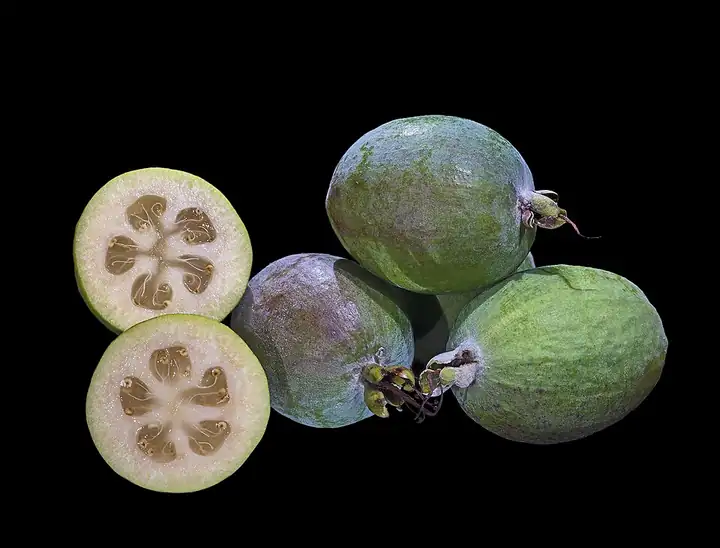
Pineapple guava (feijoa)
Acca sellowiana (syn. Feijoa sellowiana) · Myrtle family (Myrtaceae)
When to plant: Potted trees go back outside once frost danger has passed.
| Hardiness zones | 8 to 11 |
|---|---|
| Sun | full sun |
| Water | moderate |
| Life cycle | perennial |
| Frost | Half-hardy: takes a light frost |
| Soil pH | 5.5–7.0 |
| Spacing | 84 to 168 inches |
About Pineapple guava (feijoa)
Feijoa, or pineapple guava, is a tough evergreen shrub from South America with gray-green leaves, showy red-and-white flowers and egg-shaped green fruit that tastes like a minty pineapple. The flower petals are edible too. It needs some winter chill to fruit well and bears best with a second variety nearby.
UF/IFAS lists zones 8-11; the plant is injured below about 14-20 F and the fruit below 28 F (UGA; UF/IFAS). UF/IFAS says it is not invasive in Florida and is on no federal or state noxious weed list.
When to plant
Potted trees go back outside once frost danger has passed.
In the ground, space plants 7-14 ft apart (UF/IFAS). First fruit comes 2-4 years after planting, with full crops at 8-10 years (UF/IFAS).
Soil
Well-drained soil of almost any type, from sand to heavy clay (NC State; UF/IFAS); steady moisture gives the best fruit.
Test the soil; feijoa grows in well-drained soil at about pH 5.5-7.0 and also needs magnesium, sulfur and trace nutrients (UF/IFAS).
Feeding
- First-year in-ground plants, in March and July: balanced fertilizer such as 10-10-10. UGA uses 1-2 oz per plant each time, adding about 1 oz per feeding each year until year eight.
Look for: mostly nitrogen, in spring as growth starts. Spring feeding grows the new shoots and leaves that carry flowers and fruit; feeding after midsummer pushes soft growth that may not harden before winter. - Established in-ground plants, every 4-6 weeks from late winter through fall: balanced fertilizer such as 10-10-10 or 8-3-9. UF/IFAS uses 0.5-1 lb per young plant and no more than 2 lb per mature plant per feeding; water it in.
Look for: mostly nitrogen, in spring as growth starts. Spring feeding grows the new shoots and leaves that carry flowers and fruit; feeding after midsummer pushes soft growth that may not harden before winter. - Potted trees, from the start of new growth in spring through summer: complete liquid fertilizer with micronutrients, or a timed-release fertilizer. Feed liquid fertilizer at least monthly, or timed-release about every 12 weeks, because nutrients wash out of pots quickly (UF/IFAS St. Lucie County; NC State). Stop in winter and start again when new growth appears (Maryland Extension).
Look for: mostly nitrogen, in spring as growth starts. Spring feeding grows the new shoots and leaves that carry flowers and fruit; feeding after midsummer pushes soft growth that may not harden before winter.
Don't let the soil dry out for long stretches; dry spells make fruit and leaves drop (UF/IFAS).
Harvest
Fruit ripens September to November; ripe fruit drops on its own or comes off with the lightest touch, and the skin lightens and the fruit softens (UF/IFAS). Gather fallen fruit daily; it bruises easily and keeps about a week at room temperature.
Feijoa gives one crop a year: it flowers in spring and fruit is ready from about September through November, depending on variety. Wait for the first fruits to drop on their own, then gather fallen fruit.
Varieties (17)
| Variety | Type | Season and days | Zones | Notes |
|---|---|---|---|---|
| Gemini | Named cultivar | 8–11typical for pineapple guava | Listed among recommended feijoas by UGA; we found no sourced details. Sources: [5] | |
| Kawatiri | Named cultivar | 8–11typical for pineapple guava | Silver-blue leaves, edible flowers and large, fragrant fruit. Sources: [3] | |
| Superba | Needs a partner | 8–11typical for pineapple guava | Good flavor. Medium, rounded fruit on a straggly plant. From Australia; plant with another variety for good fruit set (NC State). Sources: [1][3] | |
| Variegata | Ornamental | 8–11typical for pineapple guava | White-variegated leaves. Sources: [3] | |
| Choicesana | Partly self-fertile | Midseason | 8–11typical for pineapple guava | Good flavor. Small to medium fruit on a vigorous plant. From California. Sources: [1] |
| Precocious | Partly self-fertile | 8–11typical for pineapple guava | Medium fruit; flowers over a long season, so it makes a good pollinizer. From Oregon. Sources: [1] | |
| Rannaya (Nakita) | Partly self-fertile | 8–11typical for pineapple guava | Large fruit on a compact plant. From Ukraine. Sources: [1] | |
| Apollo | Self-fertile | Early | 8–11typical for pineapple guava | Sweet, with little of the usual grit or astringency; UF/IFAS rates the flavor excellent. Medium-large fruit. From New Zealand. Sources: [1][5] |
| Coolidge | Self-fertile | 8–11typical for pineapple guava | Medium fruit. Developed in California in 1913; UF/IFAS says it does well in Florida. Sources: [1][2][3][5] | |
| Edenvale | Self-fertile | 8–11typical for pineapple guava | UF/IFAS rates the flavor excellent. Large fruit; bears young. From Santa Cruz, Calif. Sources: [1] | |
| Mammoth | Self-fertile | 8–11typical for pineapple guava | Good flavor. Large fruit. From New Zealand. Self-pollinated fruit can be hollow, so a partner still helps (UF/IFAS). Sources: [1][5] | |
| Nazemetz | Self-fertile | 8–11typical for pineapple guava | Large, pear-shaped fruit whose flesh doesn't darken when cut. From San Diego, Calif. NC State spells it 'Nazemata'. Sources: [1][3][5] | |
| Pineapple Gem | Self-fertile | 8–11typical for pineapple guava | Listed as a self-pollinating selection by NC State. Sources: [3] | |
| Robert | Self-fertile | Early | 8–11typical for pineapple guava | Juicy and mild. Medium fruit; very drought tolerant. From New Zealand. Sources: [1] |
| Trask | Self-fertile | Early | 8–11typical for pineapple guava | Very good flavor. Medium-large fruit. A bud sport of 'Coolidge'. Sources: [1][5] |
| Triumph | Self-fertile | Midseason | 8–11typical for pineapple guava | UF/IFAS rates the flavor excellent. Short, oval, medium-large fruit. From New Zealand. Sources: [1][5] |
| Unique | Self-fertile | 8–11typical for pineapple guava | UF/IFAS calls it the only reliably self-fertile feijoa. Sources: [1] |
Pests to watch for
Diseases and problems
In the kitchen
Cut in half and scoop out the pulp, or use it in desserts, jelly, juice and baking in place of banana or apple (UF/IFAS). The sweet flower petals are edible (NC State; UF/IFAS).
Keeping it: Ripe feijoas bruise easily and keep only about a week at room temperature, so gather fallen fruit daily and use it soon.
Safety: The sources we checked list no toxic parts, and we found no research-based guidance on pregnancy, drug interactions or allergies.
Pets: Not listed as toxic by the ASPCA
Sources
- ask.ifas.ufl.edu
- gardeningsolutions.ifas.ufl.edu
- plants.ces.ncsu.edu
- missouribotanicalgarden.org
- fieldreport.caes.uga.edu
- content.ces.ncsu.edu
- extension.umd.edu
- yardandgarden.extension.iastate.edu
- aspca.org
- aspca.org
- aspca.org
- blogs.ifas.ufl.edu
Photo: Photo: Didier Descouens, CC BY-SA 4.0, via Wikimedia Commons (CC BY-SA 4.0). Photo resized for the web.

Planting dates and advice are general guidance; check with your local Cooperative Extension office for your area.