
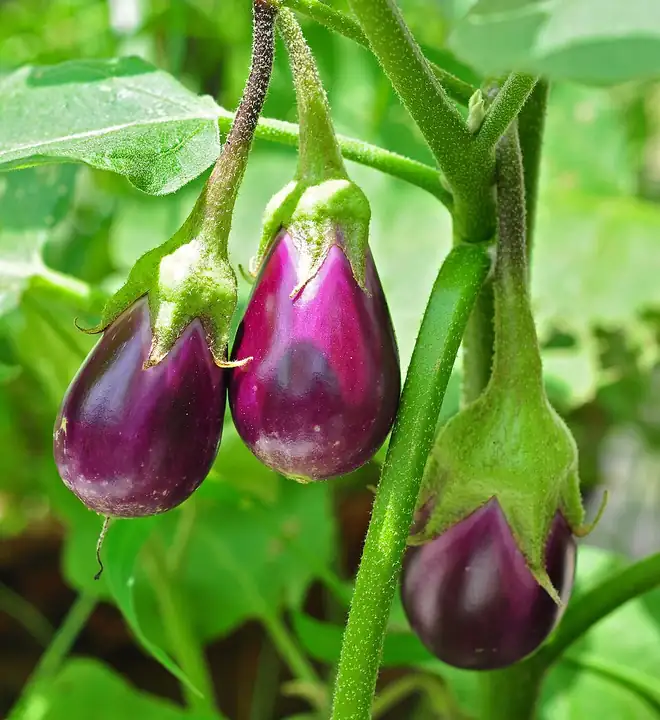
Eggplant
Solanum melongena · Nightshade family (Solanaceae)
When to plant: Start seeds indoors 6 to 8 weeks before the last frost and set out plants 2 to 3 weeks after the last frost.
| Hardiness zones | 3 to 11 |
|---|---|
| Sun | full sun |
| Water | moderate |
| Life cycle | tender perennial (grown as an annual) |
| Frost | Tender: killed by frost |
| Soil pH | 6.0–6.5 |
| Spacing | 18 to 24 inches |
| Days to harvest | 65 to 80 days |
| Soil temperature to plant | at least 60°F |
About Eggplant
Eggplant is a heat-loving cousin of the tomato, grown for glossy purple, white or striped fruit. It needs warm days and nights to flower well, so it does best where summers are long and hot.
Grown as a warm-season annual in every zone; it is killed by frost, so plant it out after the danger of frost has passed. It grows best at 70 to 85F.
When to plant
Timing is counted from your average last spring frost (and first fall frost). Sow & Tell works out the actual dates for your ZIP code.
- Start seeds indoors: 6 to 8 weeks before the last frost
- Set out plants: 2 to 3 weeks after the last frost
Days to harvest count from transplanting 6- to 8-week-old plants (about 100 to 120 days from seed). Wait until nights stay above 50F before planting out.
Soil
Fertile, well-drained soil improved with compost or well-rotted manure.
Follow a soil test, work any pre-plant fertilizer or up to 1 inch of compost into the top 6 inches of soil, and keep soil pH about 6.0 to 6.5.
Feeding
- 3 to 4 weeks after transplanting: nitrogen fertilizer such as calcium nitrate (15.5-0-0) or 21-0-0. Use about 1/2 lb of calcium nitrate per 30 ft of row, or 1/2 Tbsp of 21-0-0 per plant, beside the plants and water it in.
Look for: nitrogen, in a light feeding. Early on the plant needs leaves to feed its fruit later, but too much nitrogen makes a big leafy plant that is slow to flower. Later, when flowers open and the first small fruits form, switch to a lower-nitrogen fertilizer such as 5-10-15 or 6-12-12. - 3 to 4 weeks after the first side-dressing: a lower-nitrogen fertilizer such as 5-10-15 or 6-12-12. Use the bag's rate for vegetables, scatter it beside the plants (not against the stems) and water it in.
Look for: lower nitrogen, more phosphorus and potassium, such as 5-10-15 or 6-12-12. Now the plant should put its energy into flowers and fruit. Extra nitrogen at this stage grows leaves instead and can make blossoms drop; phosphorus helps only if your soil is short of it (a soil test tells you). - right after picking the first fruits: a lower-nitrogen fertilizer such as 5-10-15 or 6-12-12. Use the bag's rate for vegetables, scatter it beside the plants (not against the stems) and water it in.
Look for: lower nitrogen, more phosphorus and potassium, such as 5-10-15 or 6-12-12. Now the plant should put its energy into flowers and fruit. Extra nitrogen at this stage grows leaves instead and can make blossoms drop; phosphorus helps only if your soil is short of it (a soil test tells you).
Harvest
Pick while the skin is still shiny and the fruit is firm; a thumb press that springs back means it is ready. Dull or brown skin means it is overripe. Clip the fruit off with shears.
As long as you keep picking, plants keep flowering and setting fruit; harvest about once or twice a week while the skin is still shiny. Cold nights late in the season damage fruit left on the plant.
Varieties (30)
| Variety | Type | Season and days | Notes |
|---|---|---|---|
| Ichiban | Asian (Japanese), long (hybrid) | Early · 61 days | As an Asian type, thin-skinned with a delicate flavor. Slender, cylinder-shaped dark purple fruit about 12 inches long with a purple calyx. Sources: [2][9][10][11][12] |
| Millionaire | Asian (Japanese), slender (hybrid) | Early · 55 days | Slender purple-black fruit about 10 inches long with a purple calyx. Sources: [2][10][12][13][14] |
| Pingtung Long | Asian, long (heirloom) | 70 days | Long, slender purple-red fruit with a purple-green calyx on tall, upright plants. Tolerates heat and bacterial wilt. Texas A&M spells it 'Ping Tung Long'. Sources: [11][15] |
| Orient Express | Asian, long (hybrid) | Early · 58 days | Long, slender glossy black fruit 8 to 10 inches with a purple calyx. Sets fruit well across varied weather. Sources: [11][12][14] |
| Calliope | Asian, striped (hybrid) | 64 days | Oval fruit, purple variegated with white, with a green calyx. Sources: [2][14] |
| Applegreen | Green, oval (open-pollinated) | Early | Very early, productive upright plant with pale green oval fruit about 5 to 6 inches long. Sets fruit in cooler northern gardens. Sources: [10][11] |
| Rosa Bianca | Heirloom | 75 to 80 days | Heirloom eggplant recommended for Texas and Oklahoma home gardens. Sources: [15][16] |
| Megal | Italian (hybrid) | 60 days | NC State notes excellent flavor. Uniform cylindrical fruit 7 to 9 inches long, purple-black; long shelf life. Resistant to TMV. Sources: [11][14] |
| Night Shadow | Italian (hybrid) | 68 to 75 days | Elongated oval to teardrop fruit about 8 by 3.5 inches, dark glossy black; holds its color well and is very productive. Sources: [2][11][14][17] |
| Santana | Italian (hybrid) | 80 days | Long, glossy dark purple teardrop fruit on an upright bush. Sources: [2][11][14][17] |
| Florida Market | Italian / American (open-pollinated) | Late · 85 days | Large upright plant with smooth, glossy blackish-purple oval to teardrop fruit. Adapted to the Southeast. Sources: [9][11] |
| Black Beauty | Italian / American globe (open-pollinated) | 80 days | Oval to deep globe fruit 6 to 7 inches long, smooth and glossy purple-black with a green calyx. A long-time open-pollinated standard for home gardens and markets. Sources: [9][10][11][12][13] |
| Classic | Italian, elongated oval (hybrid) | Glossy purple-black, elongated-oval fruit on a medium-tall upright plant. Resistant to tobacco mosaic virus. Sources: [2][11] | |
| Nadia | Italian, long oval (hybrid) | Midseason · 67 to 70 days | Firm, glossy black fruit about 4.5 x 9 inches. Resistant to tobacco mosaic virus. Sets fruit well in cool weather. Sources: [11][13][14] |
| Dusky | Italian, oval (hybrid) | Early · 60 days | Glossy black, elongated-oval to pear-shaped fruit about 6 to 7 inches long with a green calyx. Resistant to tobacco mosaic virus. Sources: [2][10][11][12] |
| Epic | Italian, oval (hybrid) | Early-midseason · 64 days | Deep purple-black oval fruit about 4 x 8 inches with a green calyx. Resistant to tobacco mosaic virus. Sources: [2][11][12][14] |
| Black Magic | Italian, round-oval (hybrid) | Midseason · 72 days | Early and productive, with glossy deep purple round-oval fruit. Suited to the eastern US. Sources: [2][9][11] |
| Long Purple | Long / cylindrical (open-pollinated) | Midseason · 75 days | Tall plant with long, smooth, dark purple cylindrical fruit. Widely adapted; 'Early Long Purple' is a common strain. Sources: [9][11] |
| Bride | Long, white and rose (hybrid) | Long, slender fruit about 8 by 1.5 inches, white blushed and striped with light rose. Sources: [11][12] | |
| Fairy Tale | Mini / specialty (hybrid) | Early · 50 to 65 days | Compact plant about 18 inches tall with small (about 4 x 2 inch) purple-and-white striped fruit. 2004 All-America Selections winner. Sources: [11][12][13][14] |
| Hansel | Mini, Japanese type (hybrid) | Early · 55 days | Mini, slender purple fruit. A white counterpart, 'Gretel', is also sold. Sources: [2][12][14] |
| Gretel | Mini, Japanese type, white (hybrid) | Early · 55 days | Small, slender white fruit. Sources: [2][12][14] |
| Bambino | Miniature | Tiny oval purple-black fruit about 1 inch long. Sources: [10] | |
| Easter Egg | Ornamental / mini (hybrid) | Early · 52 days | Compact 2-foot plant with white, egg-size oval fruit that turns yellow at maturity. Resistant to tobacco mosaic virus. Grown mostly as an ornamental. Sources: [9][11] |
| Barbarella | Sicilian (hybrid) | 65 days | Round purple fruit with a purple calyx. Sources: [14] |
| Rosita | Specialty, pink | Teardrop-shaped, rose-pink fruit about 8 inches long. Sources: [10][11] | |
| Kermit | Thai, round (hybrid) | Early · 60 days | Small, round (about 2 inch) fruit, green with a white blossom end. Sources: [2][10][11][14] |
| Cloud Nine | White | Oval white fruit about 6 inches long. Sources: [10][18] | |
| Casper | White, cylindrical (open-pollinated) | Cylindrical white fruit about 6 inches long with a green calyx. Also spelled 'Caspar'. Sources: [2][10][11] | |
| Ghostbuster | White, oval | Sweet flavor. Oval white fruit about 6 to 7 inches long on a broad, semi-upright plant. Sources: [2][10][11][12] |
Good neighbors
UMD Extension shows eggplant sharing space with parsley and shade-tolerant greens; this is about using space, not pest control.
Pests to watch for
Flea beetles, Colorado potato beetle, Twospotted spider mite, Aphids, Whiteflies, Tomato hornworm, Cutworms, Root-knot nematodes, Leafminers, Stink bugs, Harlequin bug, Leafhoppers, Eriophyid mites (rust, bud, blister and gall mites), Mole crickets, Red imported fire ant, Potato psyllid (tomato psyllid), Broad mite, Tomato pinworm, Beet armyworm, Pepper weevil, Pepper maggot, Fungus gnats
Diseases and problems
Verticillium wilt, Early blight, Phomopsis blight, Phytophthora blight, Bacterial wilt, Southern blight, Transplant shock, Too little light (leggy plants), Leaf sunburn, Magnesium deficiency, Black walnut toxicity, Blossom end rot, Herbicide injury, Frost and freeze injury, Bacterial canker of tomato, Fusarium wilt, Tomato spotted wilt, Powdery mildew, Damping-off, White mold, Root and crown rot, Sooty mold, Tobacco mosaic and tomato mosaic
In the kitchen
Roasted, grilled, fried or stewed; it is the base of dishes like baba ghanoush, ratatouille and eggplant parmesan.
Keeping it: Refrigerate eggplant and use it within several days to a week; long chilling pits the skin. Cut flesh browns fast, so cook soon after slicing.
Safety: Only the fruit is eaten. The leaves, flowers, stems and roots contain solanine and can cause a burning throat, nausea, vomiting and an irregular heartbeat if eaten (NC State).
Pets: Not listed as toxic by the ASPCA
Sources
- extension.umn.edu
- hgic.clemson.edu
- extension.illinois.edu
- extension.unh.edu
- extension.colostate.edu
- extension.umd.edu
- plants.ces.ncsu.edu
- extension.usu.edu
- agrilifeextension.tamu.edu
- yardandgarden.extension.iastate.edu
- cucurbitbreeding.wordpress.ncsu.edu
- bookstore.ksre.ksu.edu
- extension.msstate.edu
- extension.umd.edu
- agrilifeextension.tamu.edu
- extension.okstate.edu
- publications.mgcafe.uky.edu
- ask.ifas.ufl.edu
Photo: Photo: Joydeep, CC BY-SA 3.0, via Wikimedia Commons (CC BY-SA 3.0). Photo resized for the web.

Planting dates and advice are general guidance; check with your local Cooperative Extension office for your area.