
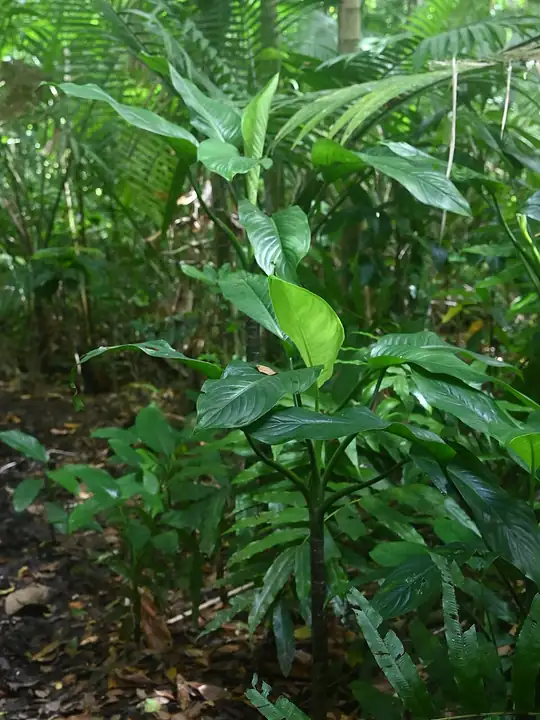
Dieffenbachia (dumb cane)
Dieffenbachia seguine (syn. D. amoena, D. maculata, D. picta) and hybrids · Arum family (Araceae)
When to plant: Any time of year, since it grows indoors. Repot in early spring when roots fill the pot; take cuttings in spring or early summer.
| Hardiness zones | 10 to 11 |
|---|---|
| Sun | part shade |
| Water | moderate |
| Life cycle | perennial |
| Frost | Tender: killed by frost |
Will it grow in your window?
Pick the window it sits in. This is the same check Sow & Tell runs for every plant in your house.
It wants bright, indirect light.
Pick a window above and this will tell you whether the spot suits it.
Watering: water when the top inch is dry — about every 7 days, stretching to every 12 from November to February.
Summering outside? Bring it in before nights drop below 60°F.
About Dieffenbachia (dumb cane)
Dieffenbachia is a bold, cane-stemmed foliage plant from the Caribbean and tropical South America with big oblong leaves splashed in cream, white or yellow (NC State). It grows fast in bright filtered light and makes a 3-6 ft floor plant. Its name, dumb cane, comes from the sap: needle-like calcium oxalate crystals numb and swell the mouth and throat and can take away speech, so it is the most poisonous plant in this group and a poor choice for homes with toddlers or chewing pets (Clemson, NC State).
Hardy outdoors only in zones 10-11 (NC State); it is grown indoors everywhere and can summer outdoors in shade once nights stay above 60 F.
When to plant
Any time of year, since it grows indoors. Repot in early spring when roots fill the pot; take cuttings in spring or early summer.
Usually bought as a nursery plant or started from a cane or tip cutting taken in spring or early summer (Clemson).
Growing it indoors
- Light: Bright filtered light spring through fall, with some direct sun welcome in winter; it tolerates low light but grows slowly there, and darker-leaved kinds take dim rooms best (Clemson, Penn State).
- Water: Water thoroughly, then let the top inch of mix dry completely before watering again (Clemson, NC State); overwatering and poor drainage cause most dieffenbachia problems. Water less in fall and winter when growth slows.
- Humidity: Prefers high humidity (NC State); a pebble tray or grouping with other plants helps in winter.
- Temperature: Ideal 60-75 F; protect it from cold drafts and sudden temperature changes (Clemson).
- Feeding: A foliage houseplant fertilizer at half strength every 2-4 weeks from March through September, or a time-release fertilizer per the label, and none in winter; too much burns the leaf margins (Clemson).
- Repotting: Repot in early spring when roots fill the pot, one size up in a loose, rich mix (Clemson).
- More plants: Cane cuttings laid on moist mix, stem-tip cuttings or air layering in spring or early summer (Clemson); older clumps can be divided (NC State). Wear gloves: the sap burns.
If something looks wrong
| What you see | Likely cause | What to do |
|---|---|---|
| Yellow leaves, soft stem base, soggy mix | Root rot from slow-draining mix or watering too often | Let the top inch dry between waterings, check the drainage hole and repot in fresh mix if roots are brown (Clemson). |
| Brown, burned leaf margins | Too much fertilizer | Flush the pot with plain water and feed at half strength (Clemson). |
| Small, pale new leaves and stunted growth | Not enough fertilizer or light | Feed through the growing season and move it to brighter filtered light (Clemson). |
| Sticky honeydew and cottony or crawling insects | Mealybugs, aphids or scale | Wash the leaves and dab pests with an alcohol swab, repeating weekly (Clemson). |
Soil
A loose, fertile potting mix high in organic matter with good drainage (NC State).
Pot in a loose, fertile mix high in organic matter with good drainage (NC State).
Feeding
- March through September: foliage houseplant fertilizer at half strength, or a time-release fertilizer. Liquid feed every 2-4 weeks at half strength, or apply time-release fertilizer per its label (Clemson).
- October through February: none. Stop feeding while growth slows for the winter (Clemson, Penn State).
Too much fertilizer burns the leaf margins, while too little gives small yellow leaves and stunted growth; half strength on schedule is the middle path (Clemson).
Varieties (9)
NC State and Clemson Extension name 9 cultivars.
| Variety | Type | Zones | Notes |
|---|---|---|---|
| Camille | Compact, cream-centered | 10–11typical for dieffenbachia | Pale yellow to cream leaves with green margins; stays about 3 ft tall. Sources: [1][2] |
| Exotica (Arvida, Exotica Alba) | Cream-splashed | 10–11typical for dieffenbachia | Creamy-white leaves splashed with small green patches, narrow green margins and a creamy midrib. Sources: [1][2] |
| Perfection | Cream-splashed | 10–11typical for dieffenbachia | Heavily variegated leaves about 8 in long. Sources: [1] |
| Superba | Cream-splashed | 10–11typical for dieffenbachia | Thick leaves with white variegation. Sources: [1] |
| Hilo | Dark green | 10–11typical for dieffenbachia | Dark green leaves with light green variegation; darker kinds take lower light best. Sources: [1][2] |
| Tropical Tiki (Tiki) | Dark green | 10–11typical for dieffenbachia | Dark and light green leaves spattered with white. Sources: [1][2] |
| Tropic Marianne | Large, variegated | 10–11typical for dieffenbachia | Green and white variegated leaves. Sources: [1] |
| Tropic Snow | Large, variegated | 10–11typical for dieffenbachia | Heavily variegated cream and green leaves on a plant that reaches 6 ft. Sources: [1][2] |
| Rudolph Roehrs | Yellow-leaved | 10–11typical for dieffenbachia | Yellow leaves blotched creamy white, with a dark green midrib and margins. Sources: [1][2] |
Pests to watch for
Twospotted spider mite, Scale insects, Whiteflies, Fungus gnats, Aphids, Mealybugs
Diseases and problems
Root and crown rot, Fungal leaf spot, Blight
In the kitchen
Safety: Highly poisonous (NC State): all parts carry needle-like calcium oxalate crystals and oxalic acid. A bite causes burning and swelling of the lips, tongue and throat, loss of speech, trouble swallowing and vomiting; a swollen throat can block breathing, so get medical help at once (Clemson). The sap gives a skin rash and can damage the cornea if it gets in an eye, so wear gloves and wash up after pruning. Clemson doesn't recommend it in homes with children or pets.
Pets: Toxic to dogs and cats (ASPCA): insoluble calcium oxalates and a protein-digesting enzyme cause oral irritation, intense burning of the mouth, tongue and lips, heavy drooling, vomiting and trouble swallowing. NC State also lists it as a problem for horses.
Sources
Photo: Photo: Krzysztof Ziarnek, Kenraiz, CC BY-SA 4.0, via Wikimedia Commons (CC BY-SA 4.0). Photo resized for the web.

Planting dates and advice are general guidance; check with your local Cooperative Extension office for your area.