
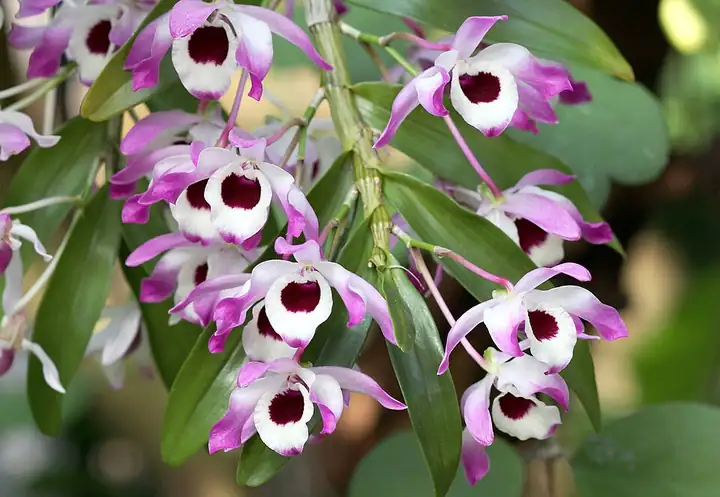
Dendrobium orchid
Dendrobium spp. and hybrids · Orchid family (Orchidaceae)
When to plant: Any time of year, since it grows indoors. Repot about every two years, when the bark breaks down, into the smallest pot that fits.
| Hardiness zones | 9 to 12 |
|---|---|
| Sun | part shade |
| Water | moderate |
| Life cycle | perennial |
| Frost | Tender: killed by frost |
Will it grow in your window?
Pick the window it sits in. This is the same check Sow & Tell runs for every plant in your house.
It wants bright, indirect light.
Pick a window above and this will tell you whether the spot suits it.
Watering: water when the top inch is dry — about every 7 days, stretching to every 12 from November to February.
Summering outside? Bring it in before nights drop below 52°F.
About Dendrobium orchid
Dendrobiums are a huge genus of about 1,600 tree-dwelling orchids from India and China to Australia, with jointed, cane-like stems and sprays of 7-15 flowers in almost every color (NC State). The common kinds split into hard-cane types, such as the phalaenopsis-type D. bigibbum hybrids with long-lasting flowers, and soft-cane types, such as D. nobile hybrids, which need a dry, cool rest to bloom. They want about twice the light of a moth orchid, so they are a step up in difficulty indoors (Clemson, Wisconsin Horticulture).
Hardy outdoors only in zones 9-12 (NC State); it is grown indoors everywhere and can summer outdoors in bright, light shade once nights stay above about 52 F, Clemson's minimum night temperature.
When to plant
Any time of year, since it grows indoors. Repot about every two years, when the bark breaks down, into the smallest pot that fits.
Usually bought as a blooming nursery plant in bark mix; older plants can be divided at repotting (NC State, UF/IFAS).
Growing it indoors
- Light: It needs about twice the light of a moth orchid: a west window or a south window softened by a sheer curtain, with no hot midday sun; too little light means no flowers (Clemson, NC State).
- Water: While it is growing, water about once a week (twice in small or clay pots) and let the mix dry slightly in between, but never fully dry unless it is resting (Clemson, NC State). Too much water while it rests, or too little while it grows, can kill it, and overwatering is the most common killer of orchids (NC State, Clemson).
- Humidity: It wants 40-60 percent humidity or more with good air movement; a humidifier or pebble tray helps in winter (Clemson, NC State).
- Temperature: Clemson gives 52 F as the minimum night temperature, with days 10-15 degrees warmer; keep it away from cold windows in extreme cold.
- Feeding: Feed an orchid fertilizer weekly at a dilute rate during the growing season, or monthly at the label rate; plants in bark need a higher-nitrogen feed such as 30-10-10, and flush the pot with plain water once a month (NC State, Clemson).
- Repotting: Repot when the bark breaks down, about every two years, into the smallest pot that fits its small root system (UF/IFAS, NC State).
- More plants: Divide older plants at repotting time (UF/IFAS); the NC State and Clemson pages we opened don't describe other home methods.
If something looks wrong
| What you see | Likely cause | What to do |
|---|---|---|
| Healthy canes but no flowers | Too little light, or no dry rest for soft-cane types | Move it to a brighter west or curtained south window, and hold back water in late fall and early winter for nobile types (Clemson, NC State). |
| Very dark green, soft leaves | Light too low | Give it more light, short of hot midday sun (Clemson). |
| Shriveled canes and brown, mushy roots | Overwatering or a pot that stays wet | Repot into fresh bark in a small clay pot and water only when the mix has dried slightly (Clemson, NC State). |
| White cottony tufts or brown bumps on canes and leaf undersides | Mealybugs or scale | Dab them with an alcohol-dipped swab, or wash the plant and use an orchid-safe soap or oil spray (UF/IFAS, Clemson). |
Soil
A bark-based orchid mix in the smallest pot that fits; clay pots drain best and keep the tall canes from tipping (NC State, Clemson).
Pot in a bark-based orchid mix in the smallest pot that fits, ideally clay with good drainage holes (NC State, Clemson).
Feeding
- Spring and summer, during the growing season: orchid fertilizer (higher nitrogen such as 30-10-10 for plants in bark). Weekly at a dilute rate or monthly at the label rate, flushing the pot with plain water once a month to clear salts (Clemson, NC State).
- After flowering, through the rest period: none, or much less. Cut back water and fertilizer until new growth begins (Clemson).
Overwatering, especially while it rests, is the most common way to kill it (NC State, Clemson).
Harvest
Many bloom in fall and winter, in sprays whose individual flowers last about 3-4 weeks on hard-cane types and less on soft-cane types (Clemson, NC State). Soft-cane kinds bloom after water is held back in late fall and early winter; after flowering, cut back water and fertilizer until new growth starts (NC State, Clemson).
Varieties (6)
NC State Extension names 6 species and hybrid groups; most dendrobiums sold are hybrids within these groups.
| Variety | Type | Zones | Notes |
|---|---|---|---|
| Antelope dendrobiums (D. antennatum and hybrids) | Hard-cane | 9+typical for dendrobium orchid | Hard-cane types with long-lasting flowers. Sources: [1] |
| Dendrobium bigibbum var. superbum (phalaenopsis type) | Hard-cane | 9+typical for dendrobium orchid | Widely sold, with hundreds of hybrids; long-lasting flowers. Also sold as D. phalaenopsis. Sources: [1] |
| Dendrobium anosmum | Soft-cane | 9+typical for dendrobium orchid | A soft-cane species. Sources: [1] |
| Dendrobium aphyllum | Soft-cane | 9+typical for dendrobium orchid | A soft-cane species. Sources: [1] |
| Dendrobium nobile and hybrids | Soft-cane | 9+typical for dendrobium orchid | Popular soft-cane type; flowers along the canes after a dry winter rest. Hold back water in late fall and early winter to bring it into bloom. Sources: [1] |
| Dendrobium gracilicaule | Species | 9+typical for dendrobium orchid | About 18 in tall, with fragrant green-to-yellow flowers spotted red outside and a soft yellow lip. Sources: [1] |
Pests to watch for
Diseases and problems
Root and crown rot, Leaf spots, Bacterial soft rot, Mosaic viruses
In the kitchen
Safety: Not listed as poisonous in the sources we opened (NC State gives no toxicity, and the ASPCA has no dendrobium entry).
Pets: Not listed by the ASPCA (no Dendrobium entry on its plant lists).
Sources
- plants.ces.ncsu.edu
- hgic.clemson.edu
- hort.extension.wisc.edu
- gardeningsolutions.ifas.ufl.edu
- extension.missouri.edu
- aspca.org
Photo: Photo: Maja Dumat, CC BY 2.0, via Wikimedia Commons (CC BY 2.0). Photo resized for the web.

Planting dates and advice are general guidance; check with your local Cooperative Extension office for your area.