
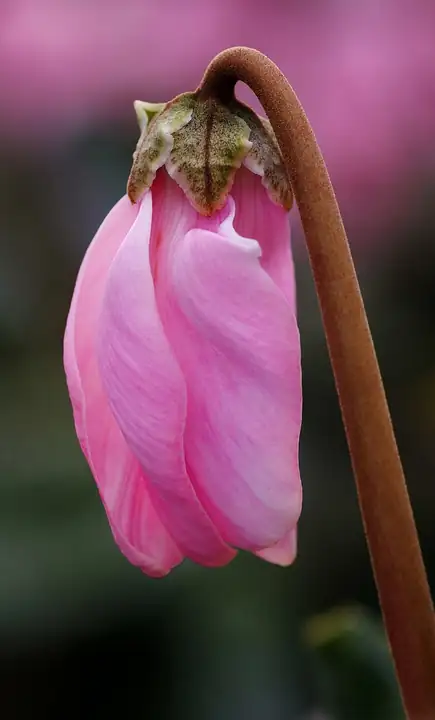
Cyclamen (florist's)
Cyclamen persicum · Primrose family (Primulaceae)
When to plant: Buy it in bud or bloom. If you keep it through its summer rest, freshen the mix when growth restarts in September.
| Hardiness zones | 9 to 11 |
|---|---|
| Sun | part shade |
| Water | moderate |
| Life cycle | tender perennial (grown as an annual) |
| Frost | Tender: killed by frost |
Will it grow in your window?
Pick the window it sits in. This is the same check Sow & Tell runs for every plant in your house.
It wants bright, indirect light.
Pick a window above and this will tell you whether the spot suits it.
Watering: water when the top inch is dry — about every 7 days, stretching to every 12 from November to February.
Summering outside? Bring it in before nights drop below 50°F.
About Cyclamen (florist's)
Florist's cyclamen is a winter-blooming tuber from the pine woods and rocky slopes of the eastern Mediterranean, bred into a mounded pot plant with silver-marbled heart-shaped leaves and swept-back flowers in white, pink, red, magenta and purple (NC State). It is sold in bloom from Christmas through Valentine's Day and wants what few houses have: cool nights near 50 F and bright indirect light. It is a perennial that goes dormant in summer, but Clemson says getting it to rebloom indoors is hard enough that most people treat it as a seasonal plant and buy a new one.
Winter hardy outdoors only in zones 9-11 (NC State); it is grown indoors everywhere and a dormant tuber can spend summer outdoors in a shady spot once nights stay above about 50 F, coming back in before fall frost.
When to plant
Buy it in bud or bloom. If you keep it through its summer rest, freshen the mix when growth restarts in September.
Bought as a nursery plant in bud or bloom; seed takes 9-15 months to make a flowering plant and dividing the tuber usually rots it, so Clemson recommends buying new plants.
Growing it indoors
- Light: Bright indirect light keeps it compact and flowering; in low light the plant weakens, the blooms shrink and the leaves pale, and in mid-September a plant coming out of dormancy can take a sunnier spot (NC State, Clemson).
- Water: Keep the mix moist but never soggy, watering when it feels dry to the touch, and always water along the edge of the pot or from below so the crown and tuber stay dry, because a wet tuber rots (Clemson, NC State). Reduce watering when the leaves yellow and it goes dormant in late spring, but don't let the pot dry out completely over summer.
- Humidity: NC State asks for moderate humidity; keep it away from heat vents, which dry the pot out too fast (Clemson).
- Temperature: It wants 60-65 F by day and about 50 F at night, and buds fail to form above 70 F, so a cool bright porch or bedroom suits it better than a warm living room (Clemson, MU Extension).
- Feeding: Don't feed a plant in full bloom; feed monthly with a liquid houseplant fertilizer from mid-September, when new leaves appear after dormancy, until it blooms (Clemson).
- Repotting: Neither Clemson nor NC State covers repotting; a plant you keep over summer can stay in its pot through dormancy and be freshened with new mix when growth restarts in September, keeping the top of the tuber above the surface.
- More plants: Seed must be fresh, germinates erratically in 20-30 days and takes 9-15 months to reach bloom; dividing the tuber is hard because it rots, so buying a new plant is the practical route (NC State, Clemson).
If something looks wrong
| What you see | Likely cause | What to do |
|---|---|---|
| Leaves and flower stems collapsing, tuber soft and brown | Tuber rot from watering onto the crown or overwatering | Water only from below or along the pot edge, let the mix dry a bit, and discard a mushy tuber (Clemson, NC State). |
| Yellow leaves in a warm room, buds that never open | Too warm, over 70 F, or heat-vent air | Move it to the coolest bright spot in the house, with nights near 50 F (Clemson, MU Extension). |
| Leaves yellowing and dropping in late spring | Normal summer dormancy | Cut back watering, set the pot in a shady spot, keep it from drying out completely, and resume light, water and monthly feeding in mid-September (Clemson, NC State). |
| New leaves and buds curled, stunted and distorted | Cyclamen mites, which are too small to see | They are hard to control; isolate the plant and discard a heavily infested one so they don't spread (Clemson). |
Soil
A rich, well-drained potting mix in a pot with a drainage hole, with the top of the tuber sitting just above the mix so water never pools on it (NC State, Clemson).
Pot in a rich, well-drained potting mix with the top of the tuber above the surface, in a container with a drainage hole (NC State, Clemson).
Feeding
- In bloom, winter: none. Don't feed a plant in full bloom; just keep it cool, bright and evenly watered from below (Clemson).
- Mid-September to bloom, once new leaves appear after summer dormancy: liquid houseplant fertilizer. Feed monthly at label strength while the new leaves grow in, until the buds open (Clemson).
Warmth is the usual failure, not hunger: buds won't form above 70 F, and water on the crown rots the tuber (Clemson).
Harvest
Blooms from early winter into spring for about 3 months (NC State); pull each spent flower stem off at the crown with a firm tug to keep new buds coming (Clemson).
Varieties (7)
NC State names 7 cultivars and forms; florist's cyclamen is mostly sold by color and flower form (single, double, fringed, frilled) rather than by name (Clemson).
| Variety | Type | Notes |
|---|---|---|
| Persian Delight | Bicolor | White petals with a purple center. Sources: [1] |
| Tilebarn Karpathos | Red | Deep red flowers with twisted petals. Sources: [1] |
| Ashwood Silver Leaf | Silver-leaved | Variable silver foliage under pale pink flowers with a deep blotch. Sources: [1] |
| Silver Leaf | Silver-leaved | Grown as much for its silver leaves as its flowers. Sources: [1] |
| Turkish Delights | Silver-leaved | Small, round, dark green leaves patterned in silver, with dark lavender-pink blooms. Sources: [1] |
| Album (f. albidum) | White | Pure white flowers, the classic white form. Sources: [1] |
| Blanc Pur | White | White flowers. Sources: [1] |
Pests to watch for
Cyclamen mite, Aphids, Mealybugs, Twospotted spider mite, Thrips
Diseases and problems
Root and crown rot, Tuber rot, Impatiens necrotic spot
In the kitchen
Safety: The tuber is the toxic part: it holds triterpenoid saponins, and NC State says eating it raw can cause severe diarrhea and possibly death, though the bitter taste keeps most people from eating much; leaves and stems cause vomiting and diarrhea, and handling can irritate skin. Keep it away from toddlers and never use it as a remedy.
Pets: Toxic to dogs, cats and horses (ASPCA, Cyclamen spp.): terpenoid saponins cause drooling, vomiting and diarrhea, and a large meal of tubers can cause heart rhythm problems, seizures and death.
Sources
Photo: Photo: Masaki Ikeda, Public domain, via Wikimedia Commons. Photo resized for the web.

Planting dates and advice are general guidance; check with your local Cooperative Extension office for your area.