
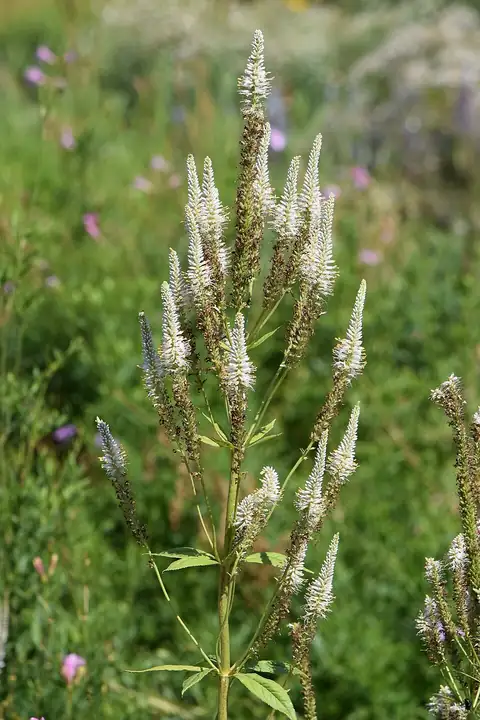
Culver's root
Veronicastrum virginicum · Plantain family (Plantaginaceae)
When to plant: Plant or divide it in early spring or late fall (Penn State); it is slow to establish and grows slowly the first year, then fills out (NC State, Penn State).
| Hardiness zones | 3 to 8 |
|---|---|
| Sun | full sun to part shade |
| Water | moderate |
| Life cycle | perennial |
| Frost | Hardy: takes frost |
About Culver's root
Culver's root is a tall native prairie and meadow wildflower with whorls of narrow leaves and slender, candelabra-like spikes of tiny white to pale lavender flowers in summer. It is native from Vermont and Ontario south to Georgia, Louisiana and Oklahoma, across the central and eastern U.S. (Lady Bird Johnson Wildflower Center, NC State). Bees of many kinds, wasps, hoverflies and butterflies work the flowers, and the common name honors a Dr. Culver who prescribed the root as a laxative (Wildflower Center, Penn State).
Hardy in zones 3-8 (NC State). It is a native plant of conservation concern in 13 states, threatened in Massachusetts and New York and endangered in Vermont (Penn State).
When to plant
Plant or divide it in early spring or late fall (Penn State); it is slow to establish and grows slowly the first year, then fills out (NC State, Penn State).
From seed, sow outdoors in fall or give the tiny seed about three months of cold, moist chilling and sow it on the surface, since it needs light to sprout (Wildflower Center). When dividing, keep a bud on each piece of root (Wildflower Center). We found no sourced day count to first bloom.
Soil
Average to rich, medium-moist to moist soil from sand to clay; it handles occasionally wet ground and some poorer soils (NC State, Penn State).
Work in compost if the soil is very poor; it likes average to rich, moist soil and copes with clay or sand (NC State, Penn State).
Feeding
- Early spring, just before new shoots come up, only if a soil test or weak growth shows a need: complete slow-release fertilizer such as 12-6-6. Without a soil test, Clemson suggests 1-2 lb per 100 sq ft of bed for perennials; keep it off emerging leaves and water it in.
Look for: a balanced or all-purpose fertilizer at the label rate. Skip high-phosphorus "bloom boosters" unless a soil test shows low phosphorus: most garden soils already have enough, and the extra can wash into streams.
Too much shade makes the tall stems lean and flop (Penn State). It grows slowly its first year, so don't give up on it; water during dry spells while it settles in.
Harvest
Each spike blooms for about a month, sometime between June and September depending on where you live (June-July in Pennsylvania). Cut spent spikes back to the leafy base after bloom for fresh leaves and sometimes a second round of flowers in fall. Spikes make good cut flowers and last about a week in water (NC State, Penn State).
Varieties (3)
Extension and botanical-garden sources we could open document 3 cultivars.
| Variety | Type | Season and days | Zones | Notes |
|---|---|---|---|---|
| Diana | Cultivar | 3–8typical for culver's root | Pure white flowers on a more compact plant than the species. Sources: [3] | |
| Fascination | Cultivar | June to August | 3–8 | About 5 ft with strong upright stems; lavender to light violet-blue spikes with smaller side spikes. Rated an excellent choice in the Chicago Botanic Garden's Culver's root evaluation. Sources: [3][4] |
| Lavendelturm (Lavender Towers) | Cultivar | June to August | 4–8 | About 5 ft with strong stems; lavender to purple spikes in a candelabra form. Also rated an excellent choice in the Chicago Botanic Garden evaluation. Sources: [3][5] |
In the kitchen
Safety: Not a food or home-remedy plant. The root is a strong purgative and emetic (Wildflower Center); 1800s doctors warned the fresh root caused violent vomiting and purging and could cause miscarriage (King's American Dispensatory). Don't eat any part of it.
Pets: Not listed by the ASPCA.
Sources
- plants.ces.ncsu.edu
- wildflower.org
- extension.psu.edu
- chicagobotanic.org
- chicagobotanic.org
- henriettes-herb.com
- aspca.org
- aspca.org
- hgic.clemson.edu
Photo: Photo: Krzysztof Ziarnek, Kenraiz / Wikimedia Commons, CC BY-SA 4.0 (CC BY-SA 4.0). Photo resized for the web.

Planting dates and advice are general guidance; check with your local Cooperative Extension office for your area.