
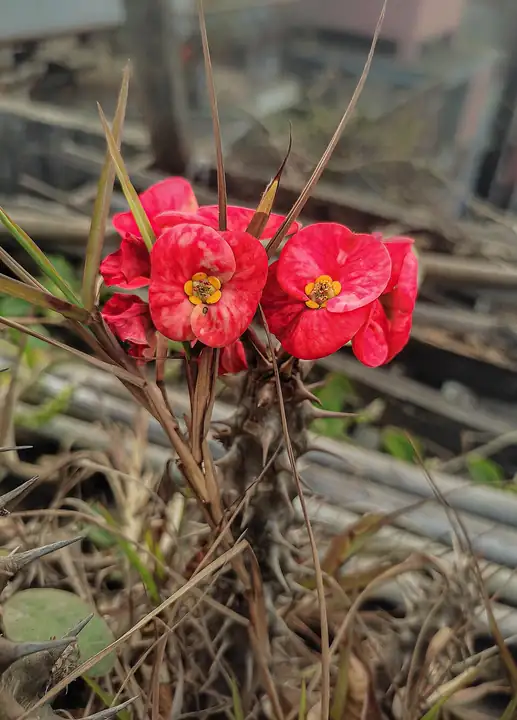
Crown of thorns
Euphorbia milii · Spurge family (Euphorbiaceae)
When to plant: Any time of year, since it grows indoors. Repot in spring or summer, and only when it outgrows its pot.
| Hardiness zones | 9 to 11 |
|---|---|
| Sun | full sun |
| Water | low |
| Life cycle | perennial |
| Frost | Tender: killed by frost |
Will it grow in your window?
Pick the window it sits in. This is the same check Sow & Tell runs for every plant in your house.
It wants bright, direct light.
Pick a window above and this will tell you whether the spot suits it.
Watering: let it dry out between waterings — about every 10 days, stretching to every 18 from November to February.
Summering outside? Bring it in before nights drop below 35°F.
About Crown of thorns
Crown of thorns is a spiny, shrubby succulent from Madagascar, a cousin of poinsettia, with gray zigzag stems armed with sharp spines, bright green leaves on the new growth and small flowers wrapped in long-lasting red, pink, yellow or white bracts (NC State, UF/IFAS). In a sunny window it can bloom nearly all year and stays under 2 ft, and it shrugs off dry winter air (NC State, Wisconsin Horticulture). Its milky latex irritates skin and is dangerous in the eyes, so it is a gloves-on plant.
Hardy outdoors only in zones 9-11, where it is a small shrub (NC State, UF/IFAS); it is grown indoors everywhere and can summer outdoors in sun, eased into the light gradually, once nights stay well above 35 F, coming in well before frost (Wisconsin Horticulture).
When to plant
Any time of year, since it grows indoors. Repot in spring or summer, and only when it outgrows its pot.
Usually bought as a nursery plant or started from a tip cutting whose sap has been left to dry before it is stuck (NC State, UF/IFAS).
Growing it indoors
- Light: Give it the sunniest window you have; it tolerates part shade but blooms less, and lamps on at night can cut flowering, since it blooms best with long, dark nights (Wisconsin Horticulture, NC State).
- Water: Water deeply, then let the mix dry before the next drink; many modern hybrids want water a little more often than the species (Wisconsin Horticulture). Cold, soggy mix rots the roots, so use a pot with a drainage hole and water less in winter (NC State).
- Humidity: It tolerates low humidity and does well in heated homes in northern winters (Wisconsin Horticulture).
- Temperature: It survives down to about 35 F (Wisconsin Horticulture; NC State says it won't take less), but keep it in a warm, bright room and bring summer plants in well before frost.
- Feeding: Feed lightly with a balanced fertilizer in spring and summer only; too much gives soft growth and few flowers, and it is sensitive to boron, so skip fertilizers with added micronutrients (Wisconsin Horticulture).
- Repotting: Repot only when it outgrows the pot, in spring or summer, into a fast-draining cactus-type mix; most kinds stay compact and still bloom in a small pot (Wisconsin Horticulture).
- More plants: Take 3-6 in tip cuttings, dip the cut ends in cold water or powdered charcoal to stop the latex, let them dry 2-3 days, and root them in a barely moist, well-drained mix; roots form in 5-8 weeks in warmth (Wisconsin Horticulture, NC State).
If something looks wrong
| What you see | Likely cause | What to do |
|---|---|---|
| Leaves dropping, leaving bare spiny stems | Normal leaf drop as stems age or before a winter rest, or a dry or hot spell | Keep it in sun and water normally; it regrows leaves on the new growth (NC State, Wisconsin Horticulture). |
| Few or no flowers | Too little sun, too much fertilizer, or light at night | Move it to the sunniest window, feed lightly, and keep it out of rooms lit late into the night (Wisconsin Horticulture). |
| Soft, brown or rotting stems at the base | Too much water, especially in a cool room | Cut out rotting parts at once, let the mix dry and water less; restart from healthy tip cuttings if the base is gone (Wisconsin Horticulture). |
| White cottony tufts along the stems | Mealybugs, the most common pest | Dab them off with a cotton swab dipped in rubbing alcohol and check again weekly (Wisconsin Horticulture names mealybugs; the swab method is UF/IFAS's advice for orchid pests). |
Soil
A fast-draining mix such as cactus mix with extra perlite, pumice, sand or gravel and a little compost (Wisconsin Horticulture).
Pot in a fast-draining mix such as cactus mix with extra perlite, pumice, sand or gravel and a little compost (Wisconsin Horticulture).
Feeding
- Spring and summer, during active growth: balanced fertilizer without added micronutrients. Feed lightly; it is sensitive to boron, so avoid fertilizers with micronutrients (Wisconsin Horticulture).
- Fall and winter: none. Stop feeding when growth slows (Wisconsin Horticulture feeds only in spring and summer).
Overfeeding gives soft, lush growth and few flowers, and wet, cold mix rots the roots (Wisconsin Horticulture, NC State).
Varieties (15)
| Variety | Type | Zones | Notes |
|---|---|---|---|
| Mini-Bell | Dwarf | 9–11typical for crown of thorns | A dwarf type that stays small in a pot. Sources: [2] |
| Short and Sweet | Dwarf | 9–11typical for crown of thorns | A dwarf type that stays small in a pot. Sources: [2] |
| Gabriella | German selection | 9–11typical for crown of thorns | A German-bred selection. Sources: [2] |
| Somona | German selection | 9–11typical for crown of thorns | A German-bred selection. Sources: [2] |
| Rosalie | Giant (California hybrid) | 9–11typical for crown of thorns | One of the large-flowered giant crown-of-thorns hybrids bred in California. Sources: [2] |
| Saturnus | Giant (California hybrid) | 9–11typical for crown of thorns | A giant crown-of-thorns hybrid from California breeding. Sources: [2] |
| Vulcanus | Giant (California hybrid) | 9–11typical for crown of thorns | A giant crown-of-thorns hybrid from California breeding. Sources: [2] |
| Century | Hybrid | 9–11typical for crown of thorns | Yellow flowers with pale pink edges. Sources: [1] |
| Crimson Splash | Hybrid | 9–11typical for crown of thorns | Large white flowers splashed with crimson. Sources: [1] |
| Full of Money | Hybrid | 9–11typical for crown of thorns | Flowers in pink, red and yellow. Sources: [1] |
| Pink Jewel | Hybrid | 9–11typical for crown of thorns | Flowers open cream to light pink and age to vivid pink. Sources: [1] |
| Red Hot | Hybrid | 9–11typical for crown of thorns | Vibrant red flowers. Sources: [1] |
| Cherokee | Tall | 9–11typical for crown of thorns | Bright red flowers on a tall plant, up to 6 ft outdoors. Sources: [1] |
| Peppermint Candy | Variegated leaf | 9–11typical for crown of thorns | Green-and-white variegated leaves with bright red flowers. Sources: [1] |
| White Lightning | Variegated leaf | 9–11typical for crown of thorns | White-and-green variegated leaves with a pinkish tinge. Sources: [1] |
Pests to watch for
Diseases and problems
Root and crown rot, Stem rot, Leaf spots, Gray mold (Botrytis)
In the kitchen
Safety: The milky latex in every part contains irritating diterpene esters: it can cause mild to severe skin rashes, can damage the cornea or cause temporary blindness if it gets in the eyes, and blisters the lips and mouth if the plant is chewed (NC State rates it low severity; Wisconsin Horticulture). Wear gloves and eye protection, prune with a knife, and mind the sharp spines around children.
Pets: Not listed by the ASPCA (no crown-of-thorns or Euphorbia milii entry on its plant lists); NC State lists it as a problem for dogs, cats and horses because the latex irritates the mouth and stomach, and the spines can injure pets.
Sources
- plants.ces.ncsu.edu
- hort.extension.wisc.edu
- gardeningsolutions.ifas.ufl.edu
- gardeningsolutions.ifas.ufl.edu
- aspca.org
- aspca.org
- aspca.org
Photo: Photo: Tanvir Rahat, CC BY-SA 4.0, via Wikimedia Commons (CC BY-SA 4.0). Photo resized for the web.

Planting dates and advice are general guidance; check with your local Cooperative Extension office for your area.