
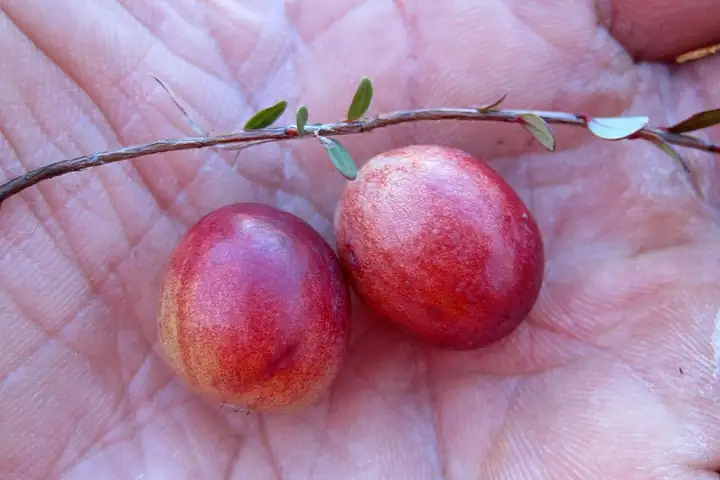
Cranberry (American)
Vaccinium macrocarpon · Heath family (Ericaceae)
| Hardiness zones | 3 to 7 |
|---|---|
| Sun | full sun |
| Water | high |
| Life cycle | perennial |
| Frost | Hardy: takes frost |
| Soil pH | 4.0–5.2 |
About Cranberry (American)
The American cranberry is a native, low evergreen that spreads by trailing runners and bears tart red berries in fall. Farms grow it in sandy beds that can be flooded, but a home bed can work if the soil is very acid, sandy and evenly moist. NC State calls it a high-maintenance plant that dislikes heat and drought.
NC State lists zones 3-7 and notes it is intolerant of heat and drought.
Planting
Commercial beds are started from unrooted cuttings (University of Maine); rooted plants are hard to transplant (NC State). In year one the vines send out foot-long runners, by year two they cover the bed, a first crop comes in year three and a fair-to-good crop in year four (University of Maine).
Soil
Very acid, sandy soil over a layer that slows drainage; Maine growers put at least 4 inches of coarse sand over peat, clay or packed loam and keep it moist but not waterlogged (University of Maine). High pH causes yellow, chlorotic leaves (NC State).
Build the bed on a base that slows drainage (peat, clay or packed loam) and top it with at least 4 inches of coarse sand at a pH of about 4.0-5.0 (University of Maine).
Feeding
- First year: every 2-3 weeks after planting, until mid-August: nitrogen fertilizer, applied in small doses. Light, frequent feedings; Maine's commercial rate is only 5-10 lb of nitrogen per acre each time, so use very little and follow a soil test.
Look for: an acid-forming fertilizer: ammonium sulfate (21-0-0) or an azalea fertilizer. These plants need acid soil and use nitrogen as ammonium; nitrate fertilizers and manure composts raise the pH.
Keep new beds moist but not soggy; standing puddles hurt root growth (University of Maine). A pH that is too high turns leaves yellow (NC State).
Harvest
Berries ripen red from late summer to mid-fall (NC State); the fresh crop is in season from October through December (Penn State). Pick firm, glossy, fully red berries.
Cranberries give one harvest each fall; a new bed gives some fruit in its third fall and a fair to good crop in the fourth.
Varieties (19)
| Variety | Type | Season and days | Zones | Notes |
|---|---|---|---|---|
| Grygleski Hybrid 1 | Grower selection (Wisconsin) | Early coloring | 3–7typical for cranberry | Large berries that color early. Crops regularly. Bred by a Wisconsin cranberry grower; parents unknown. Often called GH-1. Sources: [8] |
| Ben Lear | Native selection | Early | 3–7typical for cranberry | Large berries that color early and deeply. Moderate yields; stores poorly and needs careful management. Found in the wild in Wisconsin in 1901. Sources: [8][9] |
| Early Black | Native selection | Early; best picked before the end of September | 3–7typical for cranberry | Berries color early. Grows on many soil types but yields less than newer types; more prone to fruit rot than Howes or Stevens. One of the old native selections from Cape Cod, Massachusetts. Sources: [9][10] |
| Howes | Native selection | Late; can be picked into late October | 3–7typical for cranberry | Glossy, well-colored berries of very good quality. Berries resist frost; better rot resistance than Early Black. An old native Cape Cod selection, valued for late-season fresh fruit. Sources: [9][10] |
| McFarlin | Native selection | 3–7typical for cranberry | Good fruit quality. Frost-resistant berries; about as productive as Howes. Grown in Wisconsin and the Pacific Northwest; a parent of Stevens and Pilgrim. Sources: [8][9][10] | |
| Searles | Native selection | 3–7typical for cranberry | Fruit quality rated poor to fair. Perhaps the most productive of the old cultivated cranberries. Once the main variety in Wisconsin. Sources: [9] | |
| Crimson Queen | Rutgers hybrid | Blooms 2-3 days before Stevens | 3–7typical for cranberry | Large, deeply colored berries. Establishes quickly with vigorous growth; out-yields Stevens. From the second cycle of Rutgers crosses (U.S. Plant Patent 18,252). Sources: [11][12] |
| Demoranville | Rutgers hybrid | 3–7typical for cranberry | Large, deeply colored berries of high overall quality. Establishes quickly with vigorous growth; steady high yields in New Jersey and Wisconsin trials. U.S. Plant Patent 18,911. Sources: [11][13] | |
| Haines | Rutgers hybrid | Midseason | 3–7typical for cranberry | Large, round berries with even, moderate color. Steady high yields and less fruit rot than Stevens. Recommended for all cranberry-growing areas. Sources: [14] |
| Mullica Queen | Rutgers hybrid | About 3-5 days earlier than Stevens | 3–7typical for cranberry | Medium color. Coarse vines with high yield potential and many flower buds. Unrelated to Stevens and Ben Lear, which gives breeders new genes to work with. Sources: [11][15] |
| Scarlet Knight | Rutgers hybrid | Colors early | 3–7typical for cranberry | Large, round, dark red berries (about 2.4 g) that are sweeter and less acidic than most. High yields (about 300 barrels per acre); uniform color and long shelf life. A Stevens × (Franklin × Ben Lear) cross; U.S. Plant Patent 22,541. Sources: [11][16] |
| Vasanna | Rutgers hybrid | Midseason | 3–7typical for cranberry | Large berries of varied shape with moderate color. Very high yields (over 500 barrels per acre in British Columbia and Wisconsin) and low fruit rot. Introduced in 2019. Especially suited to peat soils and mild ocean climates. Sources: [17] |
| Welker | Rutgers hybrid | Early to midseason | 3–7typical for cranberry | Uniform, moderately to highly colored berries about 2 g each. Very high yield potential; bears heavily within about 3 years. Early bloom means rot control must be timely. Recommended for mild ocean climates such as Oregon, Washington and British Columbia. Named for USDA scientist William Welker. Sources: [18] |
| Franklin | USDA hybrid (1950) | 3–7typical for cranberry | Good color. High resistance to false blossom disease. One of the first USDA hybrids and a parent of several Rutgers varieties. Sources: [9][11] | |
| Pilgrim | USDA hybrid (1950) | Late coloring | 3–7typical for cranberry | Large berries that color late. Yields well and resists false blossom disease, but stores poorly and needs good management. A Prolific × McFarlin cross from the USDA breeding program. Sources: [8][9][11] |
| Stevens | USDA hybrid (1950) | Midseason | 3–7typical for cranberry | Large berries with fair color. Vigorous, forgiving vines with steady yields year to year; keeps well and resists fruit rot better than Early Black. A McFarlin × Potter's Favorite cross released in 1950; the main Wisconsin variety as of 2007 and the standard new varieties are compared against. Sources: [8][9][10][11] |
| Wilcox | USDA hybrid (1950) | 3–7typical for cranberry | Small berries with poor color. High yields in Wisconsin trials. Sources: [9][11] | |
| HyRed | Wisconsin hybrid | Very early: flowers and ripens about 2 weeks before Stevens | 3–7typical for cranberry | Berries over 1.5 g with much deeper red color than Stevens; sugar and acid similar to standard types. Vigorous vines with yields on par with standard varieties. A Stevens × Ben Lear cross bred at UW-Madison (McCown and Zeldin); patented in 2003. Sources: [8][19][20][21] |
| Sundance | Wisconsin hybrid | 3–7typical for cranberry | Larger berries, useful for sweetened dried cranberries. Developed at UW-Madison with the cranberry industry; patented in 2011. Sources: [20][21][22] |
Diseases and problems
Iron chlorosis
In the kitchen
Cranberries are rich in natural pectin and acid, so they gel easily in sauces, jams, conserves, salsas and chutneys; they can also be canned, frozen or dried, and keep about a month in the refrigerator (Penn State).
Keeping it: Fresh cranberries keep about two weeks in the fridge, and up to four in the crisper. Bags can go straight into the freezer for up to a year.
Safety: Cranberry is generally considered safe in food amounts, but very large amounts can cause stomach upset and diarrhea, especially in young children (NCCIH). Evidence on an interaction with warfarin is mixed, so people on warfarin should ask their doctor; food amounts seem fine in pregnancy and breastfeeding, but larger doses are not well studied (NCCIH).
Pets: Not listed as toxic by the ASPCA
Sources
- plants.ces.ncsu.edu
- extension.umaine.edu
- extension.psu.edu
- nccih.nih.gov
- plantsservices.sc.egov.usda.gov
- aspca.org
- aspca.org
- s3.wp.wsu.edu
- asset.library.wisc.edu
- umass.edu
- breeding.rutgers.edu
- research.rutgers.edu
- research.rutgers.edu
- research.rutgers.edu
- research.rutgers.edu
- research.rutgers.edu
- research.rutgers.edu
- research.rutgers.edu
- patents.google.com
- news.cals.wisc.edu
- pasdept.wisc.edu
- pasdept.wisc.edu
Photo: Photo: Rob Routledge, Sault College, Bugwood.org / Wikimedia Commons, CC BY 3.0 US (CC BY 3.0 US). Photo resized for the web.

Planting dates and advice are general guidance; check with your local Cooperative Extension office for your area.