
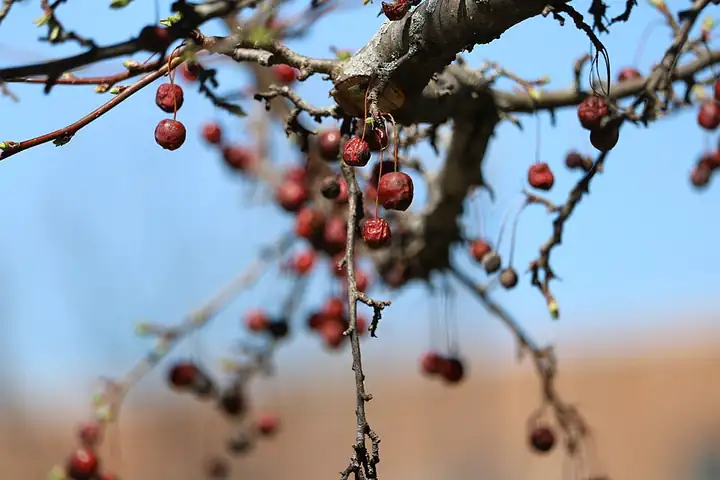
Flowering crabapple
Malus species and hybrids (ornamental crabapples) · Rose family (Rosaceae)
When to plant: Container trees can go in any time the ground can be worked, but fall is the best season in the South because roots keep growing through mild weather (Clemson).
| Hardiness zones | 3 to 9 |
|---|---|
| Sun | full sun |
| Water | moderate |
| Life cycle | perennial |
| Frost | Hardy: takes frost |
About Flowering crabapple
Flowering crabapples are small trees grown for clouds of white, pink or red spring blossoms and small fruits that often hang on into winter. Bees and butterflies visit the flowers. Many older cultivars suffer from apple scab, fire blight and cedar-apple rust, so choosing a disease-resistant cultivar matters more than anything else.
Crabapples as a group grow in zones 3-9 (NC State) and do best where winters are cold and summers cool; humid summers bring more disease.
When to plant
Container trees can go in any time the ground can be worked, but fall is the best season in the South because roots keep growing through mild weather (Clemson).
Plant container or balled-and-burlapped trees. Dig the hole no deeper than the root ball and at least twice as wide, keep the top roots level with the soil, and mulch 2-4 inches without touching the trunk. Many are grafted: keep the graft union above the soil line (NC State).
Soil
Moist but well-drained, humus-rich, slightly acidic soil; adapts to many soils and handles drought once established (NC State, NDSU).
Test the soil first. Loosen a wide planting area and mix 10-20 percent compost into the native soil you dig out; don't use uncomposted bark, and don't dig deeper than the root ball (Clemson).
Feeding
- Spring to early summer, after the tree is established, and only if a soil test or pale leaves and weak twig growth show a need: slow-release nitrogen fertilizer with a ratio near 3-1-1 or 3-1-2 (3-0-1 or 3-0-2 if the soil test shows enough phosphorus). Spread it evenly from just outside the trunk flare to the dripline and water it in. Clemson cites 2-4 lb of slow-release nitrogen per 1,000 sq ft per year, split into a spring and a late-summer feeding; follow your soil test.
Look for: mostly nitrogen, in spring as growth starts. Spring feeding grows the new shoots and leaves that carry flowers and fruit; feeding after midsummer pushes soft growth that may not harden before winter.
First-year watering matters far more than fertilizer: water daily for the first 1-2 weeks, every 2-3 days until week 12, then weekly, using about 1-1.5 gallons per inch of trunk diameter, until the tree is established, roughly 1.5 years per inch of trunk (UMN). Don't count on rain unless it was over an inch. Keep the graft union above the soil, and thin crowded branches so air moves through (NC State). Too much fertilizer can burn roots and push soft growth that pests and cold injure (Clemson).
Harvest
Blooms in spring, about late April-May (Purdue); no deadheading needed. Prune to thin dense, twiggy growth and open the crown to air (NC State).
Varieties (17)
| Variety | Type | Season and days | Zones | Notes |
|---|---|---|---|---|
| Donald Wyman | Disease-resistant | 3–9typical for flowering crabapple | Scab resistant; high fire blight and mildew resistance. Sources: [4][5] | |
| Prairifire | Disease-resistant | Late April-May | 4+ | 15-20 ft tall and wide; reddish-purple new leaves, dark pink-red flowers, small purple-red fruit that lasts into winter, orange-red fall color. Resists scab, fire blight, rust and mildew. Sources: [3][5][11] |
| Profusion | Disease-resistant | 3–9typical for flowering crabapple | High scab and fire blight resistance; moderate mildew resistance. Sources: [5] | |
| Red Jewel | Disease-resistant | 3–9typical for flowering crabapple | High resistance to scab, fire blight and powdery mildew. Sources: [5] | |
| Sugar Tyme | Disease-resistant | 3–9typical for flowering crabapple | Moderate-high scab resistance; high fire blight and mildew resistance. Sources: [5] | |
| Indian Magic | Moderately resistant | 3–9typical for flowering crabapple | Moderate scab resistance; high fire blight and mildew resistance. Sources: [5] | |
| Hopa | Older cultivar | 3–9typical for flowering crabapple | Old pink-flowered cultivar from South Dakota; susceptible to apple scab. Shown for identification; not a good pick where scab is common. Sources: [2] | |
| Radiant | Pink | 3–9typical for flowering crabapple | Minnesota cultivar with pink to rose-pink flowers. Sources: [2] | |
| Thunderchild | Purple-leaf | 3–9typical for flowering crabapple | Purple leaves, rose-pink flowers; disease resistant. Canadian cultivar. Sources: [2] | |
| Centurion | Rose-pink | 3–9typical for flowering crabapple | Rose-pink flowers. Sources: [2] | |
| Red Baron | Rust-resistant | 3–9typical for flowering crabapple | Listed as resistant to cedar-apple rust. Sources: [4] | |
| Adams | Scab-resistant | 3–9typical for flowering crabapple | Listed as scab resistant. Sources: [4] | |
| Callaway | Scab-resistant | 3–9typical for flowering crabapple | Listed as scab resistant. Sources: [4] | |
| Dolgo | Scab-resistant | 3–9typical for flowering crabapple | Listed as scab resistant. Sources: [4] | |
| Spring Snow | White, fruitless | 3–9typical for flowering crabapple | White flowers; sterile, so no messy fruit. Sources: [2] | |
| David | White-flowered | 3–9typical for flowering crabapple | White flowers, red fruit; scab resistant. Sources: [2][4] | |
| Snowdrift | White-flowered | 3–9typical for flowering crabapple | Fairly scab resistant but low fire blight resistance. Sources: [5] |
Pests to watch for
Aphids, Japanese beetle, Twospotted spider mite, Roundheaded appletree borer, Annual cicadas (dog-day cicadas), Winter moth
Diseases and problems
Apple scab, Fire blight, Cedar apple rust, Powdery mildew, Frogeye leaf spot, Winter injury, Mechanical damage (mower, trimmer and tie wounds), Girdling roots
In the kitchen
Some crabapples make good jelly (NDSU), and the flowers are edible (NC State).
Safety: Like apple seeds, the seeds contain cyanogenic glycosides (ASPCA); don't eat seeds or chew stems and leaves.
Pets: Toxic to dogs, cats and horses (ASPCA 'Apple', which includes crabapples): stems, leaves and seeds contain cyanide, and wilting leaves are the most dangerous. Signs include brick-red gums, dilated pupils, hard breathing, panting and shock.
Sources
- plants.ces.ncsu.edu
- ndsu.edu
- arboretum.purdue.edu
- portal.ct.gov
- pnwhandbooks.org
- extension.rutgers.edu
- aspca.org
- hgic.clemson.edu
- hgic.clemson.edu
- extension.umn.edu
- extension.okstate.edu
Photo: Photo: Dan Keck / Wikimedia Commons, CC0 (CC0). Photo resized for the web.

Planting dates and advice are general guidance; check with your local Cooperative Extension office for your area.