
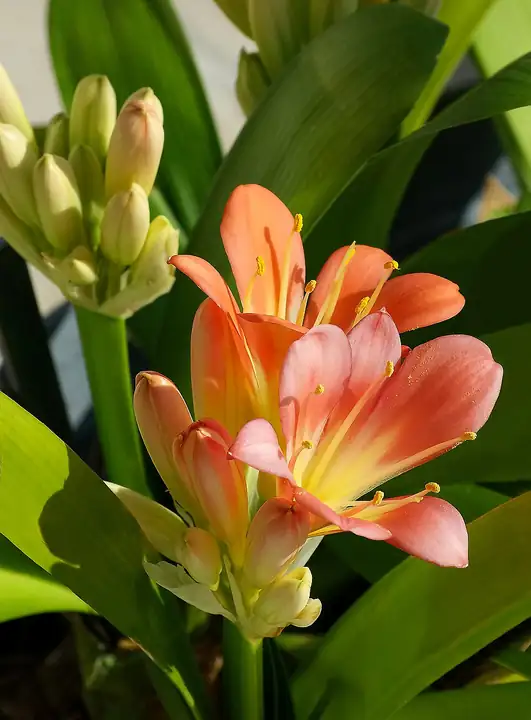
Clivia (bush lily)
Clivia miniata (also called bush lily or Natal lily) · Amaryllis family (Amaryllidaceae)
When to plant: Any time of year: it can be divided and repotted in any season, but it blooms best crowded, so repot only when it is badly root-bound.
| Hardiness zones | 9 to 11 |
|---|---|
| Sun | part shade |
| Water | low |
| Life cycle | perennial |
| Frost | Tender: killed by frost |
Will it grow in your window?
Pick the window it sits in. This is the same check Sow & Tell runs for every plant in your house.
It wants bright, indirect light.
Pick a window above and this will tell you whether the spot suits it.
Watering: water when the top inch is dry — about every 7 days, stretching to every 12 from November to February.
Summering outside? Bring it in before nights drop below 36°F.
About Clivia (bush lily)
Clivia is an evergreen from the forests of southern Africa with arching, strap-shaped, glossy dark leaves and, in late winter or spring, a thick stalk topped with 12-20 orange to scarlet trumpets with yellow throats (NC State, Wisconsin Horticulture). It is a slow, long-lived plant that likes to be crowded in its pot and needs a cool, dry rest each fall and winter to bloom. It was named in 1828 for Lady Charlotte Clive, Duchess of Northumberland, who first flowered it in England (Wisconsin Horticulture).
Hardy outdoors only in zones 9-11 (NC State; Wisconsin Horticulture says 9-10); it is grown indoors everywhere and can summer outdoors in shade, then stay out into fall for the cool nights it needs, coming in before freezing weather (Wisconsin Horticulture).
When to plant
Any time of year: it can be divided and repotted in any season, but it blooms best crowded, so repot only when it is badly root-bound.
Usually bought as a mature plant, since seedlings take years to flower, or started by dividing off offsets from an older clump (NC State, Wisconsin Horticulture).
Growing it indoors
- Light: Bright, diffused light from a north window or a shaded east or west window; morning sun is fine (NC State), but it rarely flowers in deep shade and hot sun burns the leaves (Wisconsin Horticulture).
- Water: During growth, water regularly and let the mix dry to the touch in between; during the fall-winter rest give only enough to keep the leaves from wilting, then water more once the flower stalk shows (Wisconsin Horticulture). Overwatering causes root and crown rot, and water early in the day so the leaves dry (NC State).
- Temperature: It needs cool nights below 50 F for its rest and tolerates about 36 F, but never freezing (Wisconsin Horticulture); after the rest, warm room temperatures are fine.
- Feeding: Feed a half-strength fertilizer monthly during the growing season and none at all during the fall-winter rest (Wisconsin Horticulture).
- Repotting: Repot only when the roots are badly crowded, since it blooms best slightly root-bound and can stay in one pot for up to five years; it can be divided and repotted at any time of year (NC State, Wisconsin Horticulture).
- More plants: Separate offsets, which appear once a plant is 3-4 years old, when they have 3-4 leaves; or sow fresh seed at 80-85 F, which takes several weeks to sprout and 3-5 years to flower (Wisconsin Horticulture, NC State).
If something looks wrong
| What you see | Likely cause | What to do |
|---|---|---|
| Healthy leaves but no flower stalk | No cool, dry rest, too little light, or a plant too young to bloom | From fall give it 6-8 weeks of nights below 50 F with little water and no feeding, in bright indirect light; plants need about 12 mature leaves before they bloom (Wisconsin Horticulture). |
| Flower stalk stays short and the flowers open down among the leaves | Rest ended too warm or too early | Keep it cool until the stalk shows, then move it to room temperature and water more (Wisconsin Horticulture). |
| White cottony tufts deep between the leaf bases | Mealybugs, often missed until the infestation is heavy | Check between the leaf bases often and dab mealybugs off with a swab dipped in rubbing alcohol (Wisconsin Horticulture names the pest; the swab method is UF/IFAS's advice for orchid pests). |
| Soft, rotting base and yellowing leaves | Crown or root rot from overwatering | Let it dry out, water less and early in the day, and repot in fresh mix if the roots are mushy (NC State, Wisconsin Horticulture). |
Soil
A well-drained potting mix; it does best kept slightly root-bound (Wisconsin Horticulture, NC State).
Pot in a well-drained potting mix in a pot just big enough; it blooms best slightly root-bound (Wisconsin Horticulture, NC State).
Feeding
- Spring and summer, during growth: houseplant fertilizer at half strength. Monthly (Wisconsin Horticulture).
- Fall and winter rest, about 6-8 weeks: none. No fertilizer and very little water while nights are below 50 F (Wisconsin Horticulture).
- When the flower stalk appears: none until growth resumes. Move it to room temperature and water more; resume monthly half-strength feeding with the new season's growth (Wisconsin Horticulture).
Skipping the cool, dry rest or keeping the mix wet is why most clivias don't bloom or rot (Wisconsin Horticulture, NC State).
Harvest
Blooms late winter to spring after a fall and winter rest of about 6-8 weeks with nights below 50 F, very little water and no fertilizer; bring it back to room temperature and normal watering when the flower stalk appears (Wisconsin Horticulture, NC State). The cluster opens in succession over several weeks; cut the stalk at its base afterward unless you want the red berries, which take almost a year to ripen.
Varieties (8)
NC State and Wisconsin Horticulture name 6 cultivars, the yellow form and the best-known hybrid.
| Variety | Type | Zones | Notes |
|---|---|---|---|
| Clivia x cyrtanthiflora | Hybrid | 9–11typical for clivia | A cross of C. miniata and C. nobilis raised in Ghent, Belgium, in the late 1850s. Sources: [2] |
| Gardenia | Named cultivar | 9–11typical for clivia | A named Clivia miniata cultivar; Wisconsin Horticulture gives no description. Sources: [2] |
| Longwood Sunrise | Orange-flowered | 9–11typical for clivia | Orange flowers with a yellow eye. Sources: [1] |
| Citrina | Yellow-flowered | 9–11typical for clivia | The yellow-flowered form of Clivia miniata. Sources: [2] |
| Golden Dragon | Yellow-flowered | 9–11typical for clivia | Yellow flowers. Sources: [1] |
| Good Hope | Yellow-flowered | 9–11typical for clivia | Yellow flowers. Sources: [1] |
| Longwood Debutante | Yellow-flowered | 9–11typical for clivia | Pale yellow flowers with a green throat. Sources: [1] |
| Longwood Fireworks | Yellow-flowered | 9–11typical for clivia | Pale yellow flowers with swept-back petals and long stamens. Sources: [1] |
Pests to watch for
Diseases and problems
Root and crown rot, Crown rot, Rust
In the kitchen
Safety: Low-severity poison (NC State): it contains lycorine and other alkaloids, most concentrated in the thick base, and eating it causes vomiting, drooling and diarrhea; large amounts can bring convulsions, low blood pressure, tremors and heart rhythm problems. Wisconsin Horticulture notes a large amount must be eaten to cause symptoms. Keep it away from small children.
Pets: Toxic to dogs, cats and horses (ASPCA, listed as Kaffir lily and clivia lily): lycorine and other alkaloids cause vomiting, drooling and diarrhea, and large amounts can cause convulsions, low blood pressure, tremors and heart arrhythmias; the bulbous base is the most poisonous part.
Sources
Photo: Photo: JLPC, CC BY-SA 3.0, via Wikimedia Commons (CC BY-SA 3.0). Photo resized for the web.

Planting dates and advice are general guidance; check with your local Cooperative Extension office for your area.