
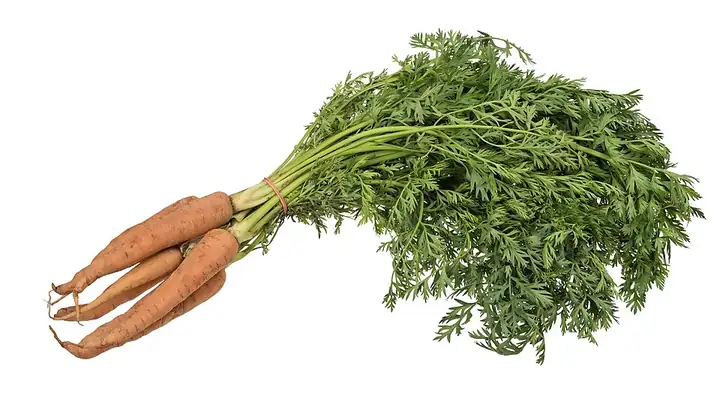
Carrot
Daucus carota subsp. sativus · Carrot family (Apiaceae)
When to plant: Sow seeds outdoors up to 3 weeks before the last frost and again in fall, 9 to 10 weeks before the first fall frost.
| Hardiness zones | 2 to 11 |
|---|---|
| Sun | full sun |
| Water | moderate |
| Life cycle | biennial |
| Frost | Half-hardy: takes a light frost |
| Soil pH | 6.0–7.0 |
| Spacing | 2 to 4 inches |
| Days to harvest | 60 to 80 days |
| Soil temperature to plant | at least 40°F |
About Carrot
Carrots are cool-season root crops, sown directly in spring and again in midsummer for fall. They are biennials that store sugar in the root, which is why a well-grown carrot tastes so sweet.
Grown as a cool-season annual in every zone; time it for the cool weather of spring or fall.
When to plant
Timing is counted from your average last spring frost (and first fall frost). Sow & Tell works out the actual dates for your ZIP code.
- Sow seeds outdoors: up to 3 weeks before the last frost
- Fall planting: 9 to 10 weeks before the first fall frost
Days count from seeding; seed can take up to 3 weeks to come up in cool soil. Make two or three sowings 3 weeks apart, and thin seedlings to 2 to 4 inches when they are 3 to 4 inches tall.
Soil
Deep, loose, light sandy loam free of rocks and clods, which fork the roots.
Use loose, stone-free sandy loam with pH 6 to 7; follow a soil test and use no more than 1 inch of compost per 100 sq ft.
Feeding
- about 6 weeks after the seedlings come up: nitrogen fertilizer such as 21-0-0. Use about 1/4 cup per 10 ft of row, beside the plants, and water it in.
Look for: a little nitrogen, such as 21-0-0, kept light. Root crops are grown for their roots: too much nitrogen makes big leafy tops and small roots. The phosphorus and potassium they need go in before planting, as a soil test says.
Too much nitrogen gives leafy tops and small roots, and rocky, heavy or packed soil makes forked roots.
Harvest
Harvest any time roots reach usable size; brush soil from the top to check the shoulder width, then pull one and taste. Water first so roots slide out easily.
Pull roots once they size up (about 70 to 100 days from seed); sow every 4 weeks through midsummer for a season-long supply. Carrots can stay in the ground after light frosts, and under heavy mulch can be dug as needed through winter.
Varieties (34)
| Variety | Type | Season and days | Notes |
|---|---|---|---|
| Little Finger | Baby (Nantes type) | Small and sweet. A miniature Nantes carrot with roots about 4 inches long. Wisconsin lists it as a baby/specialty carrot; handy for containers and shallow beds. Sources: [16][17][18][19] | |
| Minicor | Baby (Nantes type) | Baby carrot; baby Nantes roots are only about 1/2 to 3/4 inch thick and 2 1/2 to 3 inches long. Sources: [17] | |
| Short 'n Sweet | Baby/short | Short, stubby carrot grouped with the baby types. Listed by Texas A&M among baby carrots and recommended for Wisconsin gardens. Sources: [18][19] | |
| Cupar | Chantenay | High-yielding Chantenay type with big roots about 3 inches wide and 8 inches long. Sources: [20][21] | |
| Hercules | Chantenay | 65 days | Cone-shaped roots 6 to 7 inches long that store well. Handles rocky and heavy soils. Sources: [20][21][22][23] |
| Red Cored Chantenay | Chantenay | 68 to 70 days | Short, thick, tapered root 4 to 6 inches long with heavy shoulders and a reddish core. A good choice for heavy clay or shallow soil where long carrots struggle. Sources: [17][18][24][25][26] |
| Royal Chantenay | Chantenay | 65 to 70 days | Stubby, broad-shouldered root that is a bit longer and more cylindrical than older Chantenay strains, with deep reddish-orange flesh. Suited to heavy or shallow soils. Chantenay types store well. Sources: [25][27][28][29] |
| Danvers 126 | Danvers | 75 days | Moderately tapered, blunt root 6 to 8 inches long with broad shoulders. Open-pollinated and handles high temperatures. Grown both for fresh eating and for processing; Danvers types store well. Sources: [24][25][29][30] |
| Danvers Half Long | Danvers | Classic cone-shaped Danvers root up to about 7 inches long, deep orange with a lighter center. Danvers roots are best when young and get fibrous as they age. Listed by Texas A&M as a fresh-market carrot and recommended in Wisconsin. Danvers types grow best in sandy soil and store well. Sources: [18][19][26][29] | |
| A-Plus | Imperator | 71 days | Long Imperator-type hybrid. Sources: [17][31][32] |
| Imperator 58 | Imperator | 75 days | Imperator types are generally less sweet and more fibrous than other types. Long, slim, tapered root that can reach about 10 inches; deep orange with a lighter core. Needs deep, loose, sandy soil to size up. The long commercial type seen in grocery stores; keeps well in storage. Sources: [19][25][26][29] |
| Orlando Gold | Imperator | Long, tapered Imperator-class carrot. Recommended in both South Carolina and Wisconsin. Sources: [17][30] | |
| Mokum | Nantes | Early · 54 to 60 days | Very sweet with a tender texture. Early Nantes-type hybrid. Sources: [18][21][33][34][35] |
| Nantes Half Long | Nantes | 70 days | Nantes types are known for sweet flavor and a small core. Cylindrical, blunt-tipped Nantes root about 6 to 7 inches long; bright orange. Listed by Texas A&M for fresh use and on Wisconsin's recommended list. Sources: [18][19][25][26][29] |
| Naval | Nantes | Early · 72 days | Long, smooth roots with strong, healthy tops. Matures early. Sources: [20][21][36] |
| Negovia | Nantes | Sweet and crunchy. Big, smooth, uniform, dark orange roots. Sources: [20][21] | |
| Nelson | Nantes | Nantes-class carrot: cylindrical and blunt-tipped. Recommended in Wisconsin's root-crop guide and cultivar list. Sources: [17][18][19] | |
| Pioneer | Nantes | 67 days | Nantes-type hybrid recommended for Utah and Wisconsin. Sources: [17][32] |
| Scarlet Nantes | Nantes | Early · 68 days | Sweet; it consistently earned the top rating in older University of Minnesota variety trials. Blunt-ended, cylindrical roots about 6 to 7 inches long with even reddish-orange color and a small core. Reaches usable size early. Georgia Extension suggests it for sandy soil or raised beds. Nantes types keep less well than Danvers or Imperator types, so enjoy them fresh. Sources: [17][18][27][28][29] |
| Yaya | Nantes | Early · 56 days | Early carrot with roots about 5 to 6 inches long. Sources: [21][22][37][38] |
| Gold King | Processing type | 68 days | Texas A&M lists it as a processing carrot. Sources: [19][25] |
| Atlas | Round (ball) | 70 days | Small, ball-shaped roots about 1 to 2 inches long. Good for shallow soil and containers. Sources: [16][27] |
| Thumbelina | Round (ball) | 55 to 70 days | Short, round carrot. Round carrots are a good fit for heavy soil, containers, or a quick fall crop; they do not store as long as full-size types. Sources: [18][25][27][29] |
| Cosmic Purple | Specialty color (purple) | 70 days | Sweet and a little spicy. Purple skin over an orange interior, sometimes with a yellow core. Roots 6 to 7 inches long. Sources: [18][31] |
| Purple Haze | Specialty color (purple) | Tapered root about 7 to 8 inches long with purple skin and an orange core, so slices show a purple ring. An All-America Selections vegetable winner in 2006. Also on Wisconsin's recommended list. Sources: [16][18][39] | |
| Apache | On the recommended carrot lists for both South Carolina and Wisconsin. Sources: [18][30] | ||
| Bengala | Main season | Main-season carrot recommended after North Dakota trials. Sources: [21][40] | |
| Bolero | 75 days | Georgia Extension suggests Bolero for gardeners who want a carrot that stores well. Sources: [27] | |
| Goldfinger | 69 days | A short carrot. Georgia Extension notes it does well in both heavy and sandy soils. Sources: [27] | |
| Kuroda (New Kuroda) | Carrot recommended for Wisconsin and North Dakota gardens. Sources: [18][21] | ||
| Laguna | 65 days | Carrot recommended in Kentucky and North Dakota. Sources: [21][37] | |
| Napoli | Early · 55 days | Early hybrid carrot, also used as a baby carrot. Sources: [19][21][34][35][40] | |
| Sugarsnax | 68 days | Carrot recommended for Kentucky and Wisconsin gardens. Also written Sugar Snax. Sources: [18][37] | |
| Tendersweet | Carrot recommended for Kansas gardens. Sources: [34] |
Good neighbors
Extension sources suggest sowing quick radishes with slow carrots to save space; pull the radishes before they crowd the carrots.
Pests to watch for
Carrot rust fly, Cutworms, Aphids, Grasshoppers, Tarnished plant bug, Wireworms, Leafhoppers, Carrot weevil, Mole crickets, Mice (house mice and deer mice), Garden symphylan, Rabbits, Voles, Groundhog (woodchuck)
Diseases and problems
Aster yellows, Leaf blights, Root rots, Hail and wind damage, Bolting (going to seed), Herbicide injury, Powdery mildew, Damping-off, White mold, Southern blight, Common scab, Cucumber mosaic
In the kitchen
Eaten raw as snacks and in salads, or roasted, steamed and added to soups and stews.
Keeping it: Cut off the tops and refrigerate carrots in a plastic bag for 2 weeks or more; in cold, humid storage they keep for months.
Pets: Listed as non-toxic to dogs, cats and horses (ASPCA, 'Carrot Flower', garden carrot); the plant contains psoralens that can irritate skin.
Sources
- extension.umn.edu
- extension.usu.edu
- extension.colostate.edu
- yardandgarden.extension.iastate.edu
- warren.cce.cornell.edu
- extension.umn.edu
- extension.umd.edu
- aspca.org
- mda.state.mn.us
- mda.state.mn.us
- legis.iowa.gov
- se-eppc.org
- ag.purdue.edu
- wvdnr.gov
- eddmaps.org
- plants.ces.ncsu.edu
- barron.extension.wisc.edu
- florence.extension.wisc.edu
- aggie-horticulture.tamu.edu
- ndsu.edu
- ndsu.edu
- extension.msstate.edu
- fieldreport.caes.uga.edu
- extension.msstate.edu
- agrilifeextension.tamu.edu
- extension.umd.edu
- site.extension.uga.edu
- conservancy.umn.edu
- milwaukee.extension.wisc.edu
- hgic.clemson.edu
- cucurbitbreeding.wordpress.ncsu.edu
- extension.usu.edu
- ndsu.edu
- bookstore.ksre.ksu.edu
- agrilifeextension.tamu.edu
- ndsu.edu
- publications.mgcafe.uky.edu
- ndsu.edu
- all-americaselections.org
- ndsu.edu
Photo: Photo: Evan-Amos, Public domain, via Wikimedia Commons. Photo resized for the web.

Planting dates and advice are general guidance; check with your local Cooperative Extension office for your area.