
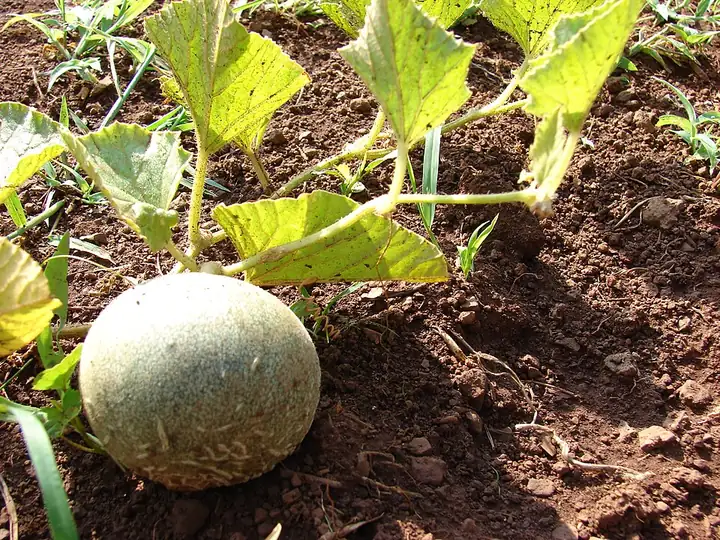
Cantaloupe (muskmelon)
Cucumis melo · Gourd family (Cucurbitaceae)
When to plant: Start seeds indoors 2 to 4 weeks before the last frost, set out plants 2 to 3 weeks after the last frost and sow seeds outdoors 2 to 3 weeks after the last frost.
| Hardiness zones | 3 to 11 |
|---|---|
| Sun | full sun |
| Water | moderate |
| Life cycle | annual |
| Frost | Tender: killed by frost |
| Soil pH | 6.0–6.5 |
| Spacing | 18 to 24 inches |
| Days to harvest | 68 to 85 days |
| Soil temperature to plant | at least 65°F |
About Cantaloupe (muskmelon)
Cantaloupes, also called muskmelons, are netted, orange-fleshed melons that tell you when they are ripe by slipping off the vine. They need warm soil, full sun and a hot summer for the best sugar.
Grown as a warm-season annual in every zone; it is killed by frost, so plant it out after the danger of frost has passed.
When to plant
Timing is counted from your average last spring frost (and first fall frost). Sow & Tell works out the actual dates for your ZIP code.
- Start seeds indoors: 2 to 4 weeks before the last frost
- Set out plants: 2 to 3 weeks after the last frost
- Sow seeds outdoors: 2 to 3 weeks after the last frost
Days count from seeding or transplanting depending on variety; fruit ripens 35 to 45 days after pollination. Set transplants out once nights stay above 50F; rows 5 to 6 feet apart.
Soil
Well-drained sandy loam rich in organic matter; cut back watering as fruit ripens for sweeter melons.
Follow a soil test and keep soil pH 6.0 to 6.5; without a test, about 3 lb of 5-10-10 per 100 sq ft, and no more than 1 inch of compost.
Feeding
- when vines start to run (send out runners), before flowering: a lower-nitrogen fertilizer such as 5-10-15 or 6-12-12. Use the bag's rate for vegetables, scatter it beside the plants (not against the stems) and water it in.
Look for: lower nitrogen, more phosphorus and potassium, such as 5-10-15 or 6-12-12. Now the plant should put its energy into flowers and fruit. Extra nitrogen at this stage grows leaves instead and can make blossoms drop; phosphorus helps only if your soil is short of it (a soil test tells you). - after bloom, when fruit is forming on the vine: a lower-nitrogen fertilizer such as 5-10-15 or 6-12-12. Use the bag's rate for vegetables, scatter it beside the plants (not against the stems) and water it in.
Look for: lower nitrogen, more phosphorus and potassium, such as 5-10-15 or 6-12-12. Now the plant should put its energy into flowers and fruit. Extra nitrogen at this stage grows leaves instead and can make blossoms drop; phosphorus helps only if your soil is short of it (a soil test tells you).
Too much nitrogen gives big vines but less fruit, and soil below pH 6.0 gives yellow plants that set little fruit.
Harvest
Pick at 'full slip,' when the stem separates easily from the fruit with a gentle twist. The netting turns coarse, the skin between it turns from green to yellow, and the melon smells sweet.
Each melon is picked once at half- to full-slip, and melons on a vine don't all ripen together, so check every other day early on and daily at peak season. Planting at different times spreads the harvest out.
Varieties (39)
| Variety | Type | Season and days | Notes |
|---|---|---|---|
| Minnesota Midget | Compact muskmelon (heirloom) | 60 to 70 days | Softball-size fruit with fine, dense netting on short vines of 3 to 4 feet. Resists fusarium wilt. Bred at the Minnesota Agricultural Experiment Station. The short vines suit small gardens. Sources: [10][11][12] |
| Accolade | Eastern type | Cornell lists resistance to Fusarium wilt races 0, 1 and 2 and powdery mildew races 1, 2, 3 and 5. Sources: [12] | |
| Lilliput | Eastern type (hybrid) | Cornell lists resistance to Fusarium wilt races 0, 1 and 2 and powdery mildew races 1 and 2. Recommended by Clemson for South Carolina. Sources: [4][12] | |
| Aphrodite | Eastern-type muskmelon, hybrid | A larger Athena type, with oval fruit of about 6 to 9 pounds that ripens a few days earlier. Resists fusarium wilt and powdery mildew. Sources: [12][13][14] | |
| Athena | Eastern-type muskmelon, hybrid | Oval fruit of about 4 to 6 pounds. Cornell lists resistance to fusarium wilt, powdery mildew and scab. Clemson notes it is a popular commercial melon that also does very well in home gardens. Sources: [4][12][14][15] | |
| Goddess | Eastern-type muskmelon, hybrid | Early melon of about 6 to 8 pounds. Cornell lists resistance to fusarium wilt and powdery mildew. Sources: [12][14][15] | |
| Gold Star | Eastern-type muskmelon, hybrid | Early, prolific plant with medium, oval, heavily netted and ribbed fruit. Resists fusarium wilt. Sources: [11][12][16] | |
| Sugar Cube | Eastern-type muskmelon, hybrid | Small, round fruit of about 2 pounds. Cornell lists resistance to fusarium wilt, powdery mildew and three viruses. A good personal-size melon. Sources: [12][14] | |
| Superstar | Eastern-type muskmelon, hybrid | Large, well-netted, slightly flattened fruit of about 6 to 8 pounds with deep ribs. Resists fusarium wilt. Adapted to the northeastern U.S. Sources: [11][12][14] | |
| Charentais | French cantaloupe (Charentais type) | 72 to 90 days | Small fruit of about 2 to 3 pounds with deep orange flesh. Unlike American muskmelons, the fruit is not netted and does not slip from the vine when ripe; it may split. Oklahoma State recommends 'Charmel' as a Charentais variety. Sources: [10][16][17] |
| Charmel | French Charentais type | Oklahoma State lists it as its French Charentais choice. Sources: [16] | |
| Rocky Ford | Heirloom | Cornell lists it as a Rocky Ford heirloom type, with a green-fleshed form also available. Sources: [12] | |
| Delicious 51 | Muskmelon | Thick, golden, crisp and juicy flesh. Round or slightly oval, well-netted fruit. Resists fusarium wilt; Cornell also lists powdery mildew. Bred by Henry Munger at Cornell. Sources: [11][12] | |
| Edisto 47 | Muskmelon | Large fruit of 3 to 5 pounds, ripening a few days after Edisto. Resistant to downy mildew, powdery mildew and Alternaria. Introduced in 1965. Sources: [11][13] | |
| Honey Rock | Muskmelon | Early, medium-size oval melon with heavy netting. Resists fusarium wilt. Adapted to the northeastern U.S. and southern Canada. Sources: [12][13] | |
| Iroquois | Muskmelon | Round to slightly oval fruit with thick, orange flesh. Resists fusarium wilt. Adapted to the Northeast and Midwest (1944). Sources: [12][13] | |
| Mission | Muskmelon | 80 days | Rugged vine with round, medium-large fruit without sutures and a small seed cavity. Ripens 5 to 6 days before Top Mark. Recommended in several Texas A&M lists. Sources: [11][18][19][20] |
| Perlita | Muskmelon | 85 days | Non-hybrid muskmelon. Recommended for Texas gardens. Sources: [18][19][21] |
| Planters Jumbo | Muskmelon | 86 days | Vigorous vines with round-oval netted fruit. Resists downy and powdery mildew. Sources: [12][13] |
| Sweet Granite | Muskmelon | Sweet orange flesh. Early melon with moderate netting. Bred at the University of New Hampshire (1966) for northern gardens. Sources: [11] | |
| TAM Uvalde | Muskmelon | 85 days | Non-hybrid muskmelon. Recommended for Texas gardens. Sources: [18][19][21] |
| Trifecta | Muskmelon | Cornell-bred melon with downy and powdery mildew resistance. Sources: [12] | |
| Hale's Best | Muskmelon (heirloom) | 82 days | Oval, netted fruit of about 4 to 5 pounds. Cornell lists powdery mildew resistance for the 'Hale's Best 45' strain. An heirloom still recommended across Texas. Sources: [12][14][18][21][22] |
| Classic | Muskmelon (hybrid) | Large fruit with distinct ribs, sutures and coarse netting. Resistant to Fusarium wilt and powdery mildew. Introduced in 1978. Oklahoma State lists it for home gardens. Sources: [13][16] | |
| Hannah's Choice | Muskmelon (hybrid) | Cornell lists resistance to Fusarium wilt races 0, 1 and 2, powdery mildew, and papaya ringspot, watermelon mosaic and zucchini yellow mosaic viruses. Sources: [12] | |
| Sugar Rush | Muskmelon (hybrid) | Cornell lists resistance to Fusarium wilt races 0, 1 and 2 and powdery mildew races 1 and 2. Recommended by Georgia Extension. Sources: [12][15] | |
| Mainstream | Muskmelon (open-pollinated) | Small, compact, high-yielding plant with fruit high in vitamin C. Resistant to powdery and downy mildew, with some resistance to cucumber beetles. Sources: [11][20] | |
| Ambrosia | Muskmelon, hybrid | 86 days | Sweet, firm and juicy, with light salmon flesh. Round, heavily netted fruit of about 4 to 5 pounds with very thick flesh and a small seed cavity. Cornell lists downy and powdery mildew resistance. Sources: [4][12][13][14][15][18][22] |
| Burpee Hybrid | Muskmelon, hybrid | Early, medium-large fruit with heavy netting and thick orange flesh. Listed as resistant to fusarium wilt; Cornell also lists powdery mildew. An older hybrid from 1955. Sources: [4][12][13][16] | |
| Magnum 45 | Muskmelon, hybrid | 80 days | Well-netted fruit about 6 by 5 inches with deep orange flesh and a small seed cavity. Resists fusarium wilt race 1. Sources: [11][16][18][19][21] |
| Park's Whopper | Muskmelon, hybrid | Cornell lists resistance to downy mildew, fusarium wilt and powdery mildew. Sources: [4][12] | |
| Sarah's Choice | Muskmelon, hybrid | Oval fruit of about 3 pounds. Cornell lists resistance to fusarium wilt and powdery mildew. Sources: [12][14] | |
| Saticoy | Muskmelon, hybrid | Home and market hybrid with resistance to fusarium wilt and both powdery and downy mildew. Adapted to the eastern and midwestern U.S. Sources: [11][16] | |
| Wrangler | Muskmelon, hybrid | Oval fruit of about 4 to 5 pounds. Cornell lists resistance to fusarium wilt and powdery mildew. Sources: [12][14] | |
| Caravelle | Western shipping type | 80 days | Round melon that forms heavy netting even under hot, stressful conditions. On Texas A&M's East Texas and statewide lists. Sources: [11][18][20] |
| Solid Gold | Western shipping type | Sutureless fruit covered in heavy, rope-like netting, with dark, firm orange flesh. Resistant to powdery mildew races 1 and 2 and Fusarium wilt races 1 and 2. Introduced in 1987. Sources: [11][16] | |
| Top Mark | Western shipping type | Vigorous, dark green vine that sets fruit well. Fruit is ribless with good netting, a small seed cavity and salmon flesh, about 5.5 by 6.6 inches. Resistant to powdery mildew. Introduced in 1963. Sources: [13] | |
| Primo | Western shipping type (hybrid) | 77 days | Firm, dark orange flesh. Resistant to powdery mildew races 1 and 2; Cornell also lists Fusarium wilt resistance. Introduced in 1989. Sources: [11][12][18] |
| Israeli | 90 days | Listed by Texas A&M for East Texas and on its statewide list. Sources: [18][20] |
Good neighbors
UMN and Illinois Extension note Blue Hubbard squash can be used as a trap crop to lure cucumber beetles away from other vine crops.
Pests to watch for
Cucumber beetles, Aphids, Squash bug, Squash vine borer, Twospotted spider mite, Whiteflies, Root-knot nematodes, Pickleworm, Pillbugs and sowbugs, Squash beetle, Mole crickets, Mice (house mice and deer mice), Raccoon, Strawberry sap beetle, Seedcorn maggot, Melonworm, Blister beetles
Diseases and problems
Bacterial wilt, Powdery mildew, Downy mildew, Alternaria leaf blight, Gummy stem blight, Fusarium wilt, Poor pollination, Ozone injury, Sunscald, Frost and freeze injury, Angular leaf spot, Verticillium wilt, Mosaic viruses, Anthracnose, Damping-off, Southern blight, Sooty mold, Cucumber mosaic, Zucchini yellow mosaic, Squash mosaic, Watermelon mosaic, Curly top, Tomato and tobacco ringspot
In the kitchen
Eaten fresh in slices, fruit salads and smoothies.
Keeping it: Keep whole melons at room temperature for up to about a week, or chill them a bit longer. Refrigerate cut melon in a covered container and eat within about 5 days.
Pets: Not listed as toxic by the ASPCA
Sources
- extension.umn.edu
- extension.psu.edu
- extension.psu.edu
- hgic.clemson.edu
- extension.illinois.edu
- extension.usu.edu
- extension.unh.edu
- extension.colostate.edu
- extension.umn.edu
- extension.sdstate.edu
- cucurbit.info
- vegetables.cornell.edu
- cucurbitbreeding.wordpress.ncsu.edu
- yardandgarden.extension.iastate.edu
- fieldreport.caes.uga.edu
- extension.okstate.edu
- extension.umd.edu
- agrilifeextension.tamu.edu
- agrilife.org
- aggie-horticulture.tamu.edu
- aggie-horticulture.tamu.edu
- agrilifeextension.tamu.edu
Photo: Photo: Forest & Kim Starr, CC BY 3.0 US, via Wikimedia Commons (CC BY 3.0 US). Photo resized for the web.

Planting dates and advice are general guidance; check with your local Cooperative Extension office for your area.