
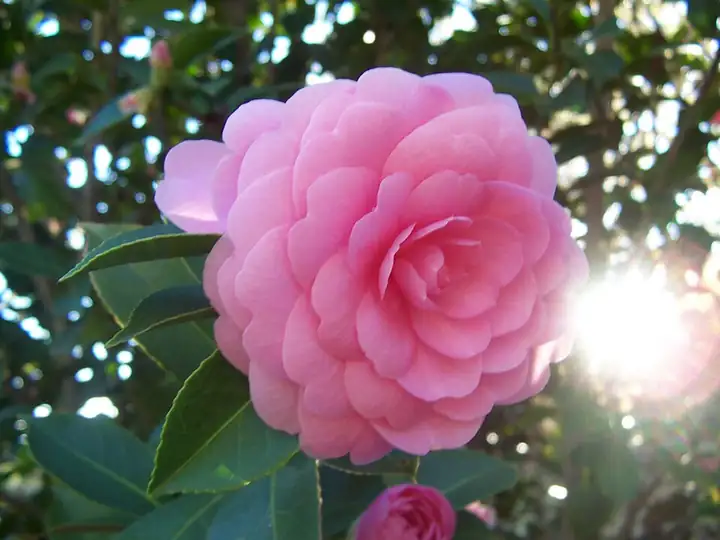
Camellia
Camellia japonica, C. sasanqua and hybrids · Tea family (Theaceae)
When to plant: Plant shallowly, in October-November or March to mid-April, and mulch 2-3 inches (Clemson).
| Hardiness zones | 7 to 9 |
|---|---|
| Sun | part shade |
| Water | moderate |
| Life cycle | perennial |
| Frost | Hardy: takes frost |
| Soil pH | 5.5–6.5 |
About Camellia
Camellias are slow-growing evergreen shrubs that bloom when little else does: sasanquas in late fall and winter, and japonicas from late winter into spring. The flowers range from simple singles to formal doubles in white, pink and red. They are a classic Southern shrub for zones 7-9.
Clemson and NC State list zones 7-9; C. reticulata is frost-sensitive.
When to plant
Plant shallowly, in October-November or March to mid-April, and mulch 2-3 inches (Clemson).
Water faithfully while plants establish; dry spells cause bud drop. Shelter from full sun and drying wind.
Soil
Well-drained, slightly acid soil rich in organic matter (Clemson); NC State gives about 5.5-6.5 for japonica. Sasanquas do not tolerate alkaline soil.
Plant shallowly in well-drained, slightly acid soil rich in organic matter (Clemson).
Feeding
- Spring: azalea-camellia fertilizer. Light applications only, following the label and a soil test (Clemson).
Look for: an acid-forming fertilizer: ammonium sulfate (21-0-0) or an azalea fertilizer. These plants need acid soil and use nitrogen as ammonium; nitrate fertilizers and manure composts raise the pH.
Heavy feeding isn't needed; camellias grow slowly. Avoid alkaline soil (NC State).
Harvest
Sasanquas bloom late fall and winter; japonicas bloom about February-April, with some starting in October (NC State). Camellias need little pruning; Clemson says heavy cutting is safe from mid-February to May 1. Cut blooms for floating in a bowl.
Varieties (21)
| Variety | Type | Season and days | Zones | Notes |
|---|---|---|---|---|
| Debbie | Camellia hybrid | 7–9typical for camellia | Sources: [1] | |
| Dr. Clifford Parks | Camellia hybrid | 7–9typical for camellia | Sources: [1] | |
| Shishi-Gashira | Fall-blooming camellia | Late fall to winter | 7–9typical for camellia | Low, 4-5 ft; drought tolerant. Sources: [1] |
| Black Tie | Japonica camellia (C. japonica) | Late winter to spring | 7–9 | Sources: [2] |
| Grace Albritton | Japonica camellia (C. japonica) | Late winter to spring | 7–9 | Sources: [2] |
| Kramer's Supreme | Japonica camellia (C. japonica) | Late winter to spring | 7–9 | Sources: [2] |
| Lady Clare | Japonica camellia (C. japonica) | Late winter to spring | 7–9 | Sources: [2] |
| Magic City | Japonica camellia (C. japonica) | Late winter to spring | 7–9 | Sources: [2] |
| Morning Glow | Japonica camellia (C. japonica) | Late winter to spring | 7–9 | Sources: [2] |
| Nuccio's Gem | Japonica camellia (C. japonica) | Late winter to spring | 7–9 | Sources: [2] |
| Otome | Japonica camellia (C. japonica) | Late winter to spring | 7–9 | Sources: [2] |
| Pink Perfection | Japonica camellia (C. japonica) | Late winter to spring | 7–9typical for camellia | Formal double pink. Sources: [1] |
| White By The Gate | Japonica camellia (C. japonica) | Late winter to spring | 7–9 | Sources: [2] |
| Cleopatra | Sasanqua camellia (C. sasanqua) | Late fall to winter | 7–9 | Medium bluish-pink semi-double. Sources: [3] |
| Daydream | Sasanqua camellia (C. sasanqua) | Late fall to winter | 7–9 | White; upright habit. Sources: [3] |
| Green's Blues | Sasanqua camellia (C. sasanqua) | Late fall to winter | 7–9 | Dark red double. Sources: [3] |
| Kanjiro | Sasanqua camellia (C. sasanqua) | Late fall to winter | 7–9 | Hot pink double. Sources: [3] |
| Leslie Ann | Sasanqua camellia (C. sasanqua) | Late fall to winter | 7–9 | Large white flowers edged pink. Sources: [3] |
| Moon Mist | Sasanqua camellia (C. sasanqua) | Late fall to winter | 7–9 | Light pink single. Sources: [3] |
| Setsugekka | Sasanqua camellia (C. sasanqua) | Late fall to winter | 7–9 | Silvery white. Sources: [3] |
| Yuletide | Sasanqua camellia (C. sasanqua) | Late fall to winter | 7–9 | Bright red single flowers. Sources: [1][3] |
Pests to watch for
Diseases and problems
Camellia petal blight, Dieback and canker, Root rot, Leaf gall, Leaf spot
In the kitchen
Safety: The ASPCA lists camellia as non-toxic. (Tea comes from a related species, Camellia sinensis, not these garden camellias.)
Pets: Not toxic to dogs, cats or horses (ASPCA)
Sources
Photo: Photo: Fir0002, CC BY-SA 3.0, via Wikimedia Commons (CC BY-SA 3.0). Photo resized for the web.

Planting dates and advice are general guidance; check with your local Cooperative Extension office for your area.