
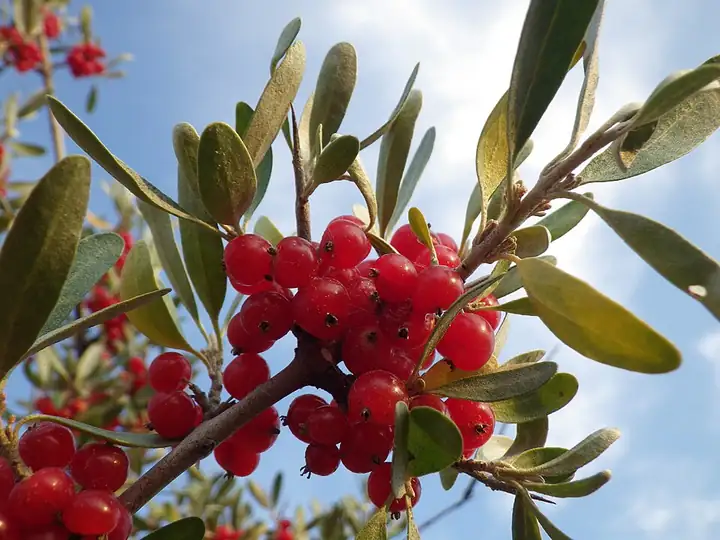
Buffaloberry (silver buffaloberry)
Shepherdia argentea · Oleaster family (Elaeagnaceae)
When to plant: Plant nursery seedlings in spring after frost, 4-6 feet apart, and keep weeds out for the first 2 years (USDA NRCS).
| Hardiness zones | 2 to 9 |
|---|---|
| Sun | full sun |
| Water | low |
| Life cycle | perennial |
| Frost | Hardy: takes frost |
| Soil pH | 6.8–7.2 |
| Spacing | 48 to 72 inches |
About Buffaloberry (silver buffaloberry)
Silver buffaloberry is a thorny, silver-leaved native shrub of the northern Plains, grown for tart red berries that make good jelly and for windbreaks and wildlife cover. It is extremely cold- and drought-hardy and fixes its own nitrogen. You need both a male and a female plant for fruit.
NDSU rates it for zone 2 and NC State lists zones 3-9. It is native from the Canadian prairies south to California, Arizona, New Mexico and Oklahoma, in areas with about 13-23 inches of rain a year (USDA NRCS).
When to plant
Plant nursery seedlings in spring after frost, 4-6 feet apart, and keep weeds out for the first 2 years (USDA NRCS).
Plants are thorny and spread by root suckers (USDA NRCS), and in the wild they first set seed at 4-6 years old (US Forest Service).
Soil
Most well-drained soils, including poor, alkaline and slightly salty ones; it handles brief flooding but not long waterlogging (USDA NRCS; US Forest Service; Lady Bird Johnson Wildflower Center).
Prepare a weed-free site in full sun; buffaloberry fixes its own nitrogen and grows in poor, alkaline or slightly salty soils.
Feeding
Look for: mostly nitrogen, in spring as growth starts. Spring feeding grows the new shoots and leaves that carry flowers and fruit; feeding after midsummer pushes soft growth that may not harden before winter.
Don't plant it where thorny root suckers will be a nuisance, and remember you need a male plant near the females for fruit.
Harvest
Berries ripen red-orange (rarely yellow) in late summer and can hang on into the next spring; they get sweeter after a light frost. Shake the branches over a sheet to harvest; for jelly, pick slightly underripe for more pectin (USDA NRCS).
Buffaloberry ripens one crop by late summer, and uneaten berries can hang on until the next spring. Harvest by shaking branches over a sheet.
Varieties (1)
USDA NRCS documents one named release of silver buffaloberry, 'Sakakawea'. Plants are otherwise sold as unnamed seedlings.
| Variety | Type | Season and days | Zones | Notes |
|---|---|---|---|---|
| Sakakawea | Silver buffaloberry (NRCS release) | Late summer | 2–9typical for buffaloberry | Grown from seed collected in Canada in 1954. About 12-20 percent of the plants bear yellow fruit instead of red. Released by the USDA NRCS Plant Materials Center in Bismarck, North Dakota. Male and female plants are separate, so plant several. NRCS says the berries taste better after a light frost. Sources: [1] |
Pests to watch for
Diseases and problems
White heart rot, Leaf spot, Powdery mildew, Rust
In the kitchen
Mostly cooked into jelly, jam, pies and sauce; raw berries are sour (USDA NRCS; NC State; US Forest Service).
Keeping it: The berries hang on the shrub into winter, so you can pick as you need them; after picking, cook them soon or freeze the juice.
Safety: The berries contain saponins that can irritate the digestive system, though small amounts carry little risk (USDA NRCS). The branches are thorny.
Pets: Not listed as toxic by the ASPCA
Sources
- plants.sc.egov.usda.gov
- plants.sc.egov.usda.gov
- fs.usda.gov
- plants.ces.ncsu.edu
- ndsu.edu
- wildflower.org
- plantsservices.sc.egov.usda.gov
- aspca.org
- aspca.org
Photo: Photo: Matt Lavin / Wikimedia Commons, CC BY-SA 2.0 (CC BY-SA 2.0). Photo resized for the web.

Planting dates and advice are general guidance; check with your local Cooperative Extension office for your area.