
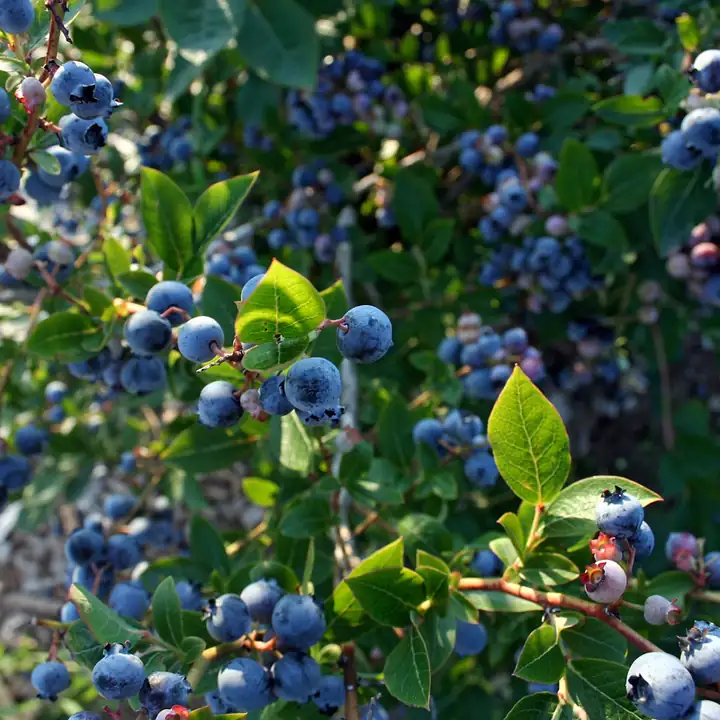
Blueberry
Vaccinium corymbosum (highbush), V. virgatum (rabbiteye) and hybrids · Heath family (Ericaceae)
When to plant: Set out plants up to 6 weeks before the last frost.
| Hardiness zones | 3 to 9 |
|---|---|
| Sun | full sun |
| Water | moderate |
| Life cycle | perennial |
| Frost | Hardy: takes frost |
| Soil pH | 4.5–5.5 |
| Spacing | 48 to 60 inches |
About Blueberry
Blueberries are long-lived shrubs that can bear for decades once they are happy. Their one big demand is truly acid soil; in the wrong soil they slowly yellow and starve.
Northern highbush blueberries are hardy in zones 3-8 (NC State) and need 800-1,200 chill hours; rabbiteye and southern highbush types need far fewer chill hours and are grown into central Florida (UF/IFAS), but rabbiteyes are damaged below about 5-10 F.
When to plant
Timing is counted from your average last spring frost (and first fall frost). Sow & Tell works out the actual dates for your ZIP code.
- Set out plants: up to 6 weeks before the last frost
Plant bare-root bushes in late winter to early spring (potted plants in spring or late fall). Remove flowers the first year; expect a small crop in year 3 and 1-2 pounds per bush by year 4. Space rabbiteyes about 6 feet apart. Water is essential the first two years.
Soil
Acid, well-drained soil high in organic matter (3% or more) that still holds moisture; do not plant where the pH is above 6.0 unless you lower it first.
Blueberries need acid soil with a pH of about 4.5-5.5: test first, work in elemental sulfur several months ahead (Oregon suggests 2-5 lb per 100 sq ft on clay loam, 1-3 lb on sandy soil), and mix in 2-4 inches of sawdust or bark (or 4-6 inches of peat moss).
Feeding
- First year: late April, late May and late June (or at bud break, bloom and after fruit set): ammonium nitrogen fertilizer such as ammonium sulfate (21-0-0) or urea (46-0-0), or an azalea fertilizer. Use small amounts: about 1 ounce of ammonium sulfate per plant each time (Oklahoma), scattered evenly around the bush, not in a pile, and watered in.
Look for: an acid-forming fertilizer: ammonium sulfate (21-0-0) or an azalea fertilizer. These plants need acid soil and use nitrogen as ammonium; nitrate fertilizers and manure composts raise the pH. - Later years: split into 2-3 small feedings from bloom through early summer: ammonium sulfate (21-0-0), urea (46-0-0), or an azalea fertilizer. Increase slowly with age (Oklahoma suggests about 2 ounces of ammonium sulfate per feeding for plants 4 years and older); follow a soil test.
Look for: an acid-forming fertilizer: ammonium sulfate (21-0-0) or an azalea fertilizer. These plants need acid soil and use nitrogen as ammonium; nitrate fertilizers and manure composts raise the pH.
Avoid nitrate fertilizers, fresh manure and yard or manure composts (they raise pH); pinch off flowers the first year or two so the bush grows roots first.
Harvest
Berries color before they are sweet: pick highbush every 5-7 days, and wait 3-6 days after rabbiteye berries turn blue. Ripe berries roll off with almost no tug.
Blueberries give one crop a year, picked in several rounds, starting mid-May to early July in North Carolina depending on type and location. Pick highbush every 5-7 days, and let rabbiteye berries hang 3-6 days after they turn blue.
Varieties (60)
| Variety | Type | Season and days | Zones | Notes |
|---|---|---|---|---|
| St. Cloud | Cold-hardy highbush | Early | 3–5 | Medium, dark blue, firm berries that are sweet and crisp. Bush about 5 feet tall and 4 feet wide. A University of Minnesota release (1990). UMN's commercial guide also lists it for zones 3, 4 and 5 only. Sources: [6][7] |
| Superior | Cold-hardy highbush | Late | 3+ | Medium berries with a sweet-tart flavor. Bush about 5 feet tall and 4 feet wide. A University of Minnesota release (2009); extends the northern season. Sources: [6] |
| Pink Popcorn | Cold-hardy highbush (pink fruit) | Early to midseason | 3+ | Medium berries that ripen cream to pink instead of blue; bush about 4 feet tall and wide. UMN lists it as self-pollinating, though it says planting two varieties gives more and larger berries. Released by the University of Minnesota in 2014. Sources: [6] |
| Sunshine Blue | Compact hybrid | Mid to late season | 5–10 | Medium, medium-blue, sweet berries. Compact, ornamental bush about 3 feet tall. UF/IFAS calls it an older southern highbush; Oregon State groups it with the half-highs. Clemson says it grows well in USDA zones 5 to 10. Sources: [3][8][9] |
| Top Hat | Dwarf (container type) | Midseason to late | 3–8 | Small to medium berries with a wild-blueberry taste; best for baking. Tiny bush only about 2 feet tall, suited to pots and edging. Does not need a second variety for pollination. UW-Madison Extension rates it hardy only to zone 5, so zones 3-4 are uncertain. Sources: [10][11][12] |
| Chippewa | Half-high | Midseason | 3–7 | Medium to large, sky-blue berries that are firm and very sweet. Compact, upright bush about 4 to 4.5 feet tall. A University of Minnesota release (1996). Sources: [6][7][8] |
| Northblue | Half-high | Midseason | 3–7 | Large, dark blue, firm berries with good flavor. Upright bush about 3 feet tall; UMN reports 3 to 9 pounds per bush. A University of Minnesota release (1983). Half-highs are hardy to roughly -35 to -45 F, especially under snow cover. Sources: [6][7][8] |
| Northcountry | Half-high | 3–7 | Sweet with very good flavor. Compact bush to about 3.5 feet with medium berries under half an inch; low to medium yields. Sources: [7][8] | |
| Northland | Half-high | Early-midseason to midseason | 3–7 | Medium, dark blue berries with a mild, sweet flavor. Vigorous, spreading bush about 4 feet tall that sends up many shoots; can yield up to 12 pounds per bush. Sources: [6][7][8] |
| Northsky | Half-high | Early-midseason to midseason | 3–7 | Small to medium, sky-blue berries that are sweet and mild. Very compact bush about 2 to 3 feet tall; yields are small. UMN rates it good in zone 4 and fair in zone 3. UMN rates it good in zone 4 and fair in zone 3. Sources: [6][7][8] |
| Polaris | Half-high | Early | 3–8 | Medium, firm, crisp berries with an intense flavor. Compact, upright bush about 4 feet tall and wide. A University of Minnesota release (1996). Sources: [6][7][8] |
| Ozarkblue | Highbush (University of Arkansas release) | Midseason in Arkansas; very late in the Pacific Northwest | 6–8 | Good flavor. Open bush with medium to large, firm berries; yields are high but can be erratic. Arkansas lists it with southern highbush types; Oregon State groups it with northern highbush. Oklahoma State lists it as southern highbush; the Midwest Blueberry Production Guide gives 4-9. 800 chill hours Sources: [5][8][13] |
| Aurora | Northern highbush | Very late | 4–7 | Mild flavor. Stocky, spreading bush with medium to large, dark blue, firm berries and high yields. Sources: [7][8] |
| Berkeley | Northern highbush | Midseason to late | 3–7 | Mild flavor. Vigorous, open, spreading bush with very large, light blue, soft berries; prone to fruit rot. Sources: [7][8] |
| Bluecrop | Northern highbush | Midseason | 4–7 | Large, firm, light blue berries with a mild, sweet, classic blueberry flavor. Vigorous, upright bush about 5 feet tall and wide; a steady, heavy producer that can overbear if not pruned. Rutgers calls it the most popular highbush variety. UMN rates it good in zone 4 and fair in zone 3. UMN rates it good in zone 4 and fair in zone 3. 800–1000 chill hours Sources: [6][7][8][10][11] |
| Bluegold | Northern highbush | Early to midseason | 4–7 | Very good flavor. Vigorous but low, squat bush with large, firm, light blue berries. Sources: [7][8] |
| Blueray | Northern highbush | Early to midseason | 3–8 | Large, aromatic berries with very good flavor. Spreading bush. Susceptible to mummy berry. 800–1000 chill hours Sources: [1][7][10][11] |
| Bluetta | Northern highbush | Early | 4–7 | Compact bush with medium, light blue berries and a poor picking scar; too soft for shipping. Low to medium yields. Sources: [7][8] |
| Brigitta Blue | Northern highbush | Late | 4–8 | Good flavor, slightly tart. Very vigorous, upright bush with large, light blue, firm berries that store and ship very well; yields vary. Listed in the guide as 'Brigitta'. Sources: [7][8] |
| Chandler | Northern highbush | Late | 4–7 | Very large berries with excellent flavor. Slightly spreading, sturdy bush with a long picking season and moderate yields. Lush fall growth can invite bacterial blight. Its long harvest suits home gardens better than commercial farms. 800–1000 chill hours Sources: [7][8][11] |
| Darrow | Northern highbush | Late | 5–7 | Excellent flavor, slightly tart. Vigorous, upright bush with large to very large light blue berries that resist cracking; high yields. Sources: [7][8] |
| Draper | Northern highbush | Early-midseason to midseason | 5–7 | Large, flavorful, light blue berries with a crisp texture. Young plants send up many long shoots that need pruning. Ripe fruit may drop early in some northern areas. 800–1000 chill hours Sources: [1][7][8][11] |
| Duke | Northern highbush | Early | 4–7 | Large, firm, light blue berries with a mild flavor. Big, upright, high-yielding bush. Prone to root rot and struggles when soil pH and fertility are off. 800–1000 chill hours Sources: [1][7][8][10][11] |
| Earliblue | Northern highbush | Early | 5–7 | Sweet and aromatic with good flavor. Vigorous, upright bush with medium to large light blue berries; medium yields. Sources: [7][8] |
| Elliott | Northern highbush | Very late | 4–7 | Firm, small to medium berries with a tart flavor. Upright bush that bears young and needs hard pruning. Fruit can crack or soften. One of the last highbush varieties to ripen, which stretches the season. Listed in the guide as 'Elliot'. 800–1000 chill hours Sources: [1][7][8][10][11] |
| Hardyblue | Northern highbush | Late | 4–7 | Very sweet with excellent flavor. Vigorous, upright bush with small, dark blue, soft berries. Listed by Oregon State as 1613-A (Hardyblue). Sources: [7][8] |
| Jersey | Northern highbush | Late to very late | 4–7 | Small to medium, sweet berries with a classic taste that store well. Very vigorous, large, upright bush; can set more fruit than it can size up. 800–1000 chill hours Sources: [7][8][10][11] |
| Legacy | Northern highbush | Late midseason to late | 6–8 | Firm, sweet, aromatic berries with excellent flavor that keep well. Very vigorous bush with a drooping habit that stays partly evergreen; high yields over a long harvest. Oregon State lists it as northern highbush and advises avoiding it in very cold regions. NC State groups it with highbush and southern highbush types for the sandhills and coastal plain, where harvest starts around June 1. Oklahoma State classes it as southern highbush; Virginia Tech gives 5-8. 700–900 chill hours Sources: [1][5][8][10][11] |
| Liberty | Northern highbush | Late | 4–7 | Very good flavor. Vigorous, upright bush with medium to large, bright blue, firm berries and high yields. Sources: [7][8] |
| Nelson | Northern highbush | Late | 4–7 | Large, firm berries with good flavor. Upright bush with good cold tolerance. 800–1000 chill hours Sources: [7][11] |
| Olympia | Northern highbush | Midseason to late | 4–8typical for Northern highbush | Very sweet with excellent flavor. Vigorous, spreading bush with medium, dark blue, soft, thin-skinned berries that resist cracking. Oregon State says its northern highbush cultivars are adapted to zones 4 to 8. Sources: [4][8] |
| Patriot | Northern highbush | Early | 3–7 | Very large, firm berries with a tart, aromatic flavor. Short, upright bush about 4 feet tall; copes with heavier soils and has some root rot resistance. Can get bacterial blight in the Northwest. UMN rates it good in zone 4 and fair in zone 3. UMN rates it good in zone 4 and fair in zone 3. 800–1000 chill hours Sources: [6][7][8][10][11] |
| Reka | Northern highbush | Midseason | 4–8 | Good flavor. Very vigorous upright bush with very high yields of medium to large dark blue berries; good for processing. Sources: [7][8] |
| Spartan | Northern highbush | Early | 5–7 | Very large, light blue berries with excellent flavor. Upright, open bush that blooms late but ripens early. Resists mummy berry but does poorly in heavy soil. 800–1000 chill hours Sources: [7][8][11] |
| Toro | Northern highbush | Midseason | 4–7 | Good flavor. Stocky, spreading bush with very large, firm, light blue berries and high yields. Sources: [7][8] |
| Alapaha | Rabbiteye | Early | 6–9 | Good flavor. Medium, firm berries. Blooms 7 to 10 days after Climax, which helps it escape late frosts. Clemson suggests Vernon as a pollinizer. 450–500 chill hours Sources: [5][9][13] |
| Austin | Rabbiteye | Early | 6–9 | Medium to large berries. Productive bush. Rabbiteyes need a second rabbiteye variety that blooms at the same time. Clemson suggests Climax or Premier as partners. 500 chill hours Sources: [3][5][9] |
| Baldwin | Rabbiteye | Late | 7–9typical for Rabbiteye | Very vigorous bush with moderate yields of large, very dark blue berries of good quality. Clemson suggests Brightwell, Powderblue or Centurion (spelled Centurian by Clemson) as pollinizers. Virginia Tech gives rabbiteye blueberry as zones 7 to 9. 450–500 chill hours Sources: [9][14] |
| Brightwell | Rabbiteye | Midseason | 7–9 | Medium to large berries. Fruit can split in wet weather. Rabbiteyes need a second rabbiteye variety that blooms at the same time. Clemson suggests Austin or Premier as partners. Does well in north Florida. 400 chill hours Sources: [3][5][9] |
| Climax | Rabbiteye | Early (late May to early June in Gainesville, FL) | 7–9 | Small to medium berries. Ripens its crop over a short window. Rabbiteyes need a second rabbiteye variety that blooms at the same time. Clemson suggests Premier or Austin as partners. NC State's plant toolbox gives 6b-9b. 450 chill hours Sources: [1][3][5][9] |
| Columbus | Rabbiteye | Late | 7–9 | Very good flavor. Very good yields of light blue berries. 600 chill hours Sources: [13][14] |
| Ochlockonee | Rabbiteye | Very late | 6–9 | Good flavor. Vigorous, upright, very productive bush; berries larger than Tifblue with good color and firmness, and may resist rain splitting. Clemson suggests Powderblue as a pollinizer; rabbiteyes need another rabbiteye variety for cross-pollination. Virginia Tech gives 7-10. 650–700 chill hours Sources: [3][5][8][9][13] |
| Onslow | Rabbiteye | Late | 7–9typical for Rabbiteye | Productive, vigorous bush with large, firm, medium blue berries; may tolerate somewhat higher soil pH than other blueberries. Plant with another rabbiteye variety for cross-pollination. Virginia Tech gives rabbiteye blueberry as zones 7 to 9. 500–600 chill hours Sources: [3][9][14] |
| Pink Lemonade | Rabbiteye | 6–8 | Good flavor. Upright, ornamental bush with medium berries that ripen light to dark pink. USDA-ARS says it suits zone 6 and milder regions. Sources: [8][14] | |
| Powderblue | Rabbiteye | Midseason to late | 7–9 | Medium, light blue berries. Productive bush. Rabbiteyes need a second rabbiteye variety that blooms at the same time. Clemson suggests Tifblue or Brightwell as partners. 600 chill hours Sources: [1][3][5][9] |
| Premier | Rabbiteye | Early to early-midseason | 7–9 | Medium to large berries. Rabbiteyes need a second rabbiteye variety that blooms at the same time. Clemson suggests Austin or Alapaha as partners. NC State's plant toolbox gives 7a-10b. 550 chill hours Sources: [1][5][9] |
| Tifblue | Rabbiteye | Midseason to late | 7–9 | Small to medium berries that are tart unless picked fully ripe. Rabbiteyes need a second rabbiteye variety that blooms at the same time. Powderblue is a common partner. Does well in north Florida and the Panhandle. 650 chill hours Sources: [1][3][5][9] |
| Vernon | Rabbiteye | Early | 6–9 | Good flavor. Large, very firm berries with good color. Blooms about a week after Climax but ripens before it. Clemson suggests Alapaha as a pollinizer. 450 chill hours Sources: [5][9] |
| Emerald | Southern highbush | Early (in Florida, mostly mid-April to early May) | 5–9typical for Southern highbush | Large, high-quality berries. Vigorous, spreading bush. Its flowers are easily hurt by February and March freezes. Best from Gainesville to Sebring, Florida. Crops better with a second variety nearby. Virginia Tech gives southern highbush as zones 5 to 9/10. Sources: [3][14] |
| Farthing | Southern highbush | About the same time as Star in Florida | 5–9typical for Southern highbush | Vigorous, dense, compact bush with large, firm, dark berries; yields well above Star. Sets so many flower buds that dormant pruning helps prevent overcropping. UF/IFAS lists it for north-central and central Florida. Virginia Tech gives southern highbush as zones 5 to 9/10. Sources: [3][14] |
| Jewel | Southern highbush | Very early (mid-April in Florida) | 5–9typical for Southern highbush | Medium to large berries of excellent quality that taste tart until fully ripe. Very vigorous bush. Quite prone to leaf rust and somewhat prone to Phytophthora root rot. Best from Gainesville to Sebring, Florida. Virginia Tech gives southern highbush as zones 5 to 9/10. Sources: [3][14] |
| Norman | Southern highbush | Early June in Arkansas | 5–9typical for Southern highbush | Medium-sized berries with excellent firmness and picking scar. University of Arkansas release from 2016. Virginia Tech gives southern highbush as zones 5 to 9/10. 500–600 chill hours Sources: [14][15] |
| O'Neal | Southern highbush | Early | 7–9 | Large berries with excellent flavor. Harvest starts around mid-May in the North Carolina sandhills and coastal plain. Virginia Tech gives 5-9 and the Midwest guide 5-10. 500–600 chill hours Sources: [1][5][11] |
| Rebel | Southern highbush | Early | 5–9typical for Southern highbush | Productive bush with large berries of good to excellent color and firmness; berries can turn bland if left on the bush too long. Clemson suggests Suziblue as a pollinizer. Virginia Tech gives southern highbush as zones 5 to 9/10. 400–450 chill hours Sources: [9][14] |
| Springhigh | Southern highbush | 5 to 10 days ahead of midseason varieties in Florida | 5–9typical for Southern highbush | Vigorous, upright bush with very large berries and good survival; flower thrips can make berries soft. UF/IFAS lists it for north-central and central Florida. Virginia Tech gives southern highbush as zones 5 to 9/10. Sources: [3][14] |
| Star | Southern highbush | Early (about half the crop ripe by late April in Florida) | 7–9 | Large, firm berries with a small stem scar. Bush of medium vigor. Best in north Florida and southeast Georgia; does poorly south of Ocala. The Midwest Blueberry Production Guide gives 6-10. Sources: [1][3][14] |
| Suziblue | Southern highbush | Midseason | 5–9typical for Southern highbush | Very good flavor. Vigorous bush with large berries and very good firmness. Clemson suggests Rebel as a pollinizer. Virginia Tech gives southern highbush as zones 5 to 9/10. up to 400 chill hours Sources: [9][14] |
| Sweetcrisp | Southern highbush | Early, with Emerald and Jewel in Florida | 5–9typical for Southern highbush | Sweet with a crisp, crunchy bite. Vigorous, spreading bush with very firm berries that keep a long time; berries run smaller than Emerald and yields are below average. UF/IFAS lists it for north Florida and south Georgia. Virginia Tech gives southern highbush as zones 5 to 9/10. Sources: [3][14] |
| Windsor | Southern highbush | Early (about half ripe by late April in Florida) | 5–9typical for Southern highbush | Very large berries with excellent flavor. Vigorous bush with stout, semi-spreading stems. Best from north-central Florida south to Hardee County. Virginia Tech gives southern highbush as zones 5 to 9/10. Sources: [3][14] |
| Summit | Southern highbush (University of Arkansas release) | Midseason | 6–8 | Excellent flavor. Large berries. The Midwest Blueberry Production Guide gives 6-10. 600 chill hours Sources: [5][13] |
Pests to watch for
Spotted wing drosophila, Whiteflies, Stink bugs, Katydids, Mice (house mice and deer mice), Blueberry maggot, Strawberry sap beetle, Rose chafer, Birds, Winter moth, Dogwood borer
Diseases and problems
Mummy berry, Stem blight, Twig blight, Botrytis gray mold, Black walnut toxicity, Soil pH problems, Iron chlorosis, Frost and freeze injury, Powdery mildew, Tomato and tobacco ringspot
In the kitchen
Eaten fresh, baked, frozen or dried.
Keeping it: Refrigerate unwashed blueberries in a ventilated container for up to a week; rinse them just before eating.
Pets: Not listed as toxic by the ASPCA
Sources
- content.ces.ncsu.edu
- plants.ces.ncsu.edu
- ask.ifas.ufl.edu
- extension.oregonstate.edu
- extension.okstate.edu
- extension.umn.edu
- publications.mgcafe.uky.edu
- extension.oregonstate.edu
- hgic.clemson.edu
- njaes.rutgers.edu
- extension.umd.edu
- uwyo.edu
- uaex.uada.edu
- pubs.ext.vt.edu
- aaes.uada.edu
Photo: Photo: Gordana Adamovic-Mladenovic, CC BY 2.0, via Wikimedia Commons (CC BY 2.0). Photo resized for the web.

Planting dates and advice are general guidance; check with your local Cooperative Extension office for your area.