
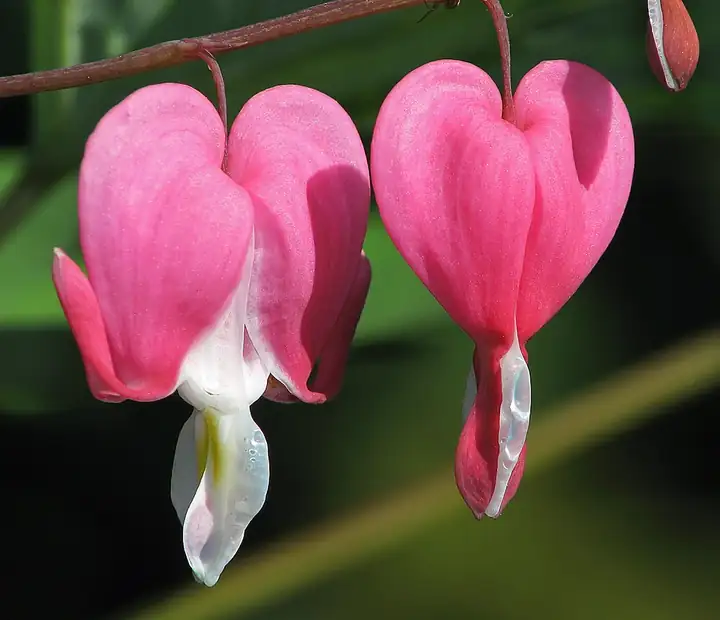
Bleeding heart
Lamprocapnos spectabilis (old-fashioned bleeding heart, formerly Dicentra spectabilis); native Dicentra eximia, D. formosa and D. cucullaria · Poppy family (Papaveraceae)
When to plant: Plant or divide in late fall or very early spring (Wisconsin).
| Hardiness zones | 3 to 9 |
|---|---|
| Sun | part shade |
| Water | moderate |
| Life cycle | perennial |
| Frost | Hardy: takes frost |
| Spacing | 12 to 36 inches |
About Bleeding heart
Bleeding hearts are spring perennials for shade with arching sprays of heart-shaped pink or white flowers. The Asian old-fashioned bleeding heart goes dormant by midsummer; native fringed bleeding heart (Dicentra eximia) stays low and blooms from late spring into fall and feeds bees, butterflies and hummingbirds. All parts are poisonous.
NC State lists zones 3-9 (Wisconsin: 2-8). Old-fashioned bleeding heart dies back early in hot, dry summers; native fringed bleeding heart keeps its leaves and blooms longer (Wisconsin). It self-sows but not invasively (Wisconsin).
When to plant
Plant or divide in late fall or very early spring (Wisconsin).
Seed needs a cold, moist period and is slow; self-sown seedlings bloom in 2-3 years if left alone. Mark the spot, since plants disappear in summer.
Soil
Rich, moist, well-drained humus soil; roots rot in soggy or wet winter soil, and summer drought hastens dormancy (NC State, Wisconsin).
Plant in rich, humusy, well-drained soil; it adapts to clay or sand if moisture is steady (Wisconsin, NC State).
Feeding
Look for: a balanced or all-purpose fertilizer at the label rate. Skip high-phosphorus "bloom boosters" unless a soil test shows low phosphorus: most garden soils already have enough, and the extra can wash into streams.
Soggy soil rots the roots, and summer drought makes plants go dormant early (Wisconsin).
Harvest
Cut flowering stems for vases; they can last up to 2 weeks (Wisconsin). Cutting back hard after bloom may delay dormancy and bring more flowers; remove stems once they die back (Wisconsin). Wear gloves.
Varieties (5)
NC State and Wisconsin Extension document 5 bleeding heart varieties.
| Variety | Type | Season and days | Zones | Notes |
|---|---|---|---|---|
| Dolly Sods | Fringed bleeding heart (Dicentra eximia) | 3–9typical for bleeding heart | Named selection of the native eastern species. Sources: [2] | |
| Luxuriant | Fringed bleeding heart hybrid (Dicentra) | 3–9typical for bleeding heart | Deep pink small flowers over bluish-green leaves that last all season; 12-18 in tall; hardy to zone 3 (Wisconsin). Sources: [2][3] | |
| Alba | Old-fashioned bleeding heart (Lamprocapnos spectabilis) | Spring | 3–9typical for bleeding heart | Pure white flowers; comes true from seed. Handles summer heat better than the pink form (NC State, Wisconsin). Sources: [1][3] |
| Gold Heart | Old-fashioned bleeding heart (Lamprocapnos spectabilis) | Spring | 3–9typical for bleeding heart | Bright golden-green leaves with rose-pink flowers. Sources: [1][3] |
| Valentine ('Hordival') | Old-fashioned bleeding heart (Lamprocapnos spectabilis) | Spring | 3–9typical for bleeding heart | Red and white flowers on dark purple stems with deep green leaves. Sources: [3] |
Pests to watch for
In the kitchen
Safety: All parts are poisonous if eaten (NC State rates the severity low): isoquinoline alkaloids can cause trembling, staggering, vomiting, diarrhea, convulsions and labored breathing. The foliage can cause a skin rash, so wear gloves (NC State).
Pets: Not listed by the ASPCA. NC State lists bleeding heart as poisonous to cats and dogs, and the USDA Forest Service notes native Dutchman's breeches makes grazing cattle stagger.
Sources
Photo: Photo: Darkone, CC BY-SA 2.5, via Wikimedia Commons (CC BY-SA 2.5). Photo resized for the web.

Planting dates and advice are general guidance; check with your local Cooperative Extension office for your area.