
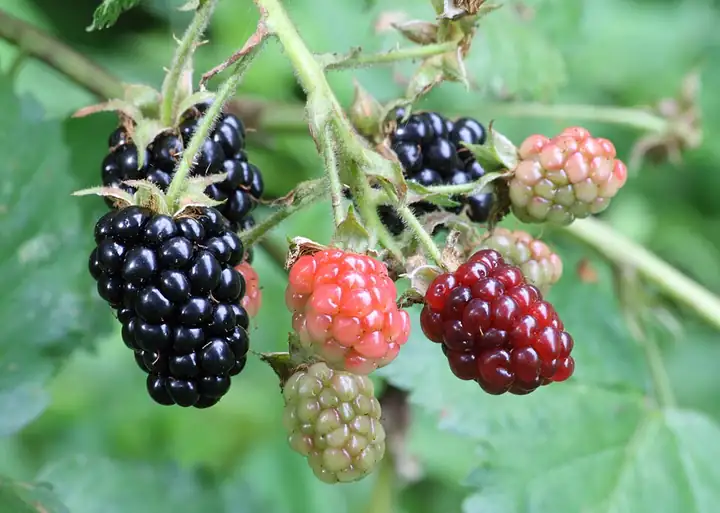
Blackberry
Rubus subgenus Rubus (cultivated erect, semi-erect and trailing hybrids) · Rose family (Rosaceae)
When to plant: Set out plants 4 to 6 weeks before the last frost.
| Hardiness zones | 5 to 9 |
|---|---|
| Sun | full sun |
| Water | moderate |
| Life cycle | perennial |
| Frost | Hardy: takes frost |
| Soil pH | 5.8–6.8 |
| Spacing | 24 to 48 inches |
About Blackberry
Blackberries are vigorous cane fruits, thorny or thornless, that bear heavily in early to mid summer. Like raspberries, canes fruit in their second year and are then removed.
Hardy erect types like 'Navaho' survive about -14 F (Oklahoma State), while semi-erect and trailing types need milder winters (Illinois Extension); several varieties do well as far south as north and central Florida (UF/IFAS).
When to plant
Timing is counted from your average last spring frost (and first fall frost). Sow & Tell works out the actual dates for your ZIP code.
- Set out plants: 4 to 6 weeks before the last frost
Plant in early spring, about 4 to 6 weeks before the last frost (Clemson). Spacing is for erect types; semi-trailing types need 6-8 feet. The first crop comes the year after planting. Keep new plants 600 feet from wild blackberries, which carry disease.
Soil
Well-drained soil with good air drainage; supply water whenever rain is under 1 inch a week while berries develop.
Test the soil a few months before planting and aim for a pH of about 6.0-6.8; mix compost into the soil and use raised beds where drainage is poor.
Feeding
- Early spring when growth starts (Oklahoma: at bloom): balanced fertilizer or nitrogen fertilizer, as a soil test directs. For the first year or two spread it in a 12-inch circle around each plant; later spread it along the row (Oklahoma suggests about 0.4 oz of nitrogen per plant).
Look for: mostly nitrogen, in spring as growth starts. Spring feeding grows the new shoots and leaves that carry flowers and fruit; feeding after midsummer pushes soft growth that may not harden before winter. - Right after harvest: balanced fertilizer or nitrogen fertilizer, as a soil test directs. Repeat the spring amount to help grow strong new canes for next year's crop.
Look for: mostly nitrogen, in spring as growth starts. Spring feeding grows the new shoots and leaves that carry flowers and fruit; feeding after midsummer pushes soft growth that may not harden before winter.
Do not overwater, which can kill the roots, and do not plant in shade.
Harvest
Pick when the berries lose their glossy shine and turn slightly dull black; they are very perishable, so pick often, even daily.
Most blackberries (floricane types) give one summer crop lasting three weeks or more, and berries spoil fast, so pick often, even daily. Primocane types also fruit in late summer and fall on new canes, and canes kept over winter bear again the next season; this double crop works best in cooler areas such as the NC mountains, since summer heat cuts flowering, and mowing canes to the ground each winter gives just the fall crop.
Varieties (42)
| Variety | Type | Season and days | Zones | Notes |
|---|---|---|---|---|
| Loganberry | Blackberry-raspberry hybrid | Early among the hybrids | 6–9 | Excellent but distinctive. Medium, deep red, conical berries that are hard to pick; canes are prone to disease. Listed as 'Logan'. Sources: [7][8] |
| Tayberry | Blackberry-raspberry hybrid | Early to midseason among the hybrids | Excellent, with a unique tartness. Glossy reddish-purple berries that are very hard to pick and easily damaged by hot weather; low yields. Sources: [7] | |
| Prime-Ark Horizon | Erect, primocane-fruiting | Early summer crop on old canes; very late crop on new canes | 6–8 | Acceptable, with light aroma and some tartness. Large, firm berries with high yields and excellent storage. Maryland describes it as mostly thornless; Arkansas Extension lists it as thorny. University of Arkansas release from 2020; Arkansas expects a chilling need around 300 hours. 300 chill hours Sources: [9][10][11] |
| Rosborough | Moderately upright | 5–9typical for blackberry | Sweeter than Brazos. Large, attractive berries. Recommended for Arizona's low desert. Sources: [12] | |
| Apache | Thornless erect | Mid-late to late | 6–8 | Sweet; a consumer favorite in Utah taste tests. Large berries that store well and high yields. Resists anthracnose and rosette. Some berries show white drupelets. University of Arkansas release, 1999. The most winter-hardy thornless erect type in Utah trials. 800–900 chill hours Sources: [5][10][11][13][14][15] |
| Arapaho | Thornless erect | Early to midseason | 6–8 | Good flavor with some tartness. Medium, firm berries with small seeds. Resists anthracnose and rosette (double blossom); can have leaf disease problems. University of Arkansas release, 1993. Consumers liked it in Utah taste tests. Good for jams and jellies. Sources: [5][10][13][15][16] |
| Caddo (Sweet-Ark Caddo) | Thornless erect | Early, a few days after Ponca | 6–8 | Sweet and low in acid with an aromatic flavor. Medium-large to large, firm berries (8 grams or more) with high yield potential and good storage. University of Arkansas release from 2018. 400 chill hours Sources: [9][10][11][14] |
| Natchez | Thornless erect | Early, with a long season | 6–8typical for Thornless blackberry (erect/semi-erect) | Fairly sweet; rated only fair in Oregon. Large to very large, firm berries on very vigorous canes; high yields. Susceptible to orange rust; short shelf life. University of Arkansas release, 2007. Maryland describes the canes as semi-erect. Poor winter hardiness at cooler, higher sites. Maryland Extension: thornless blackberries are hardy in zones 6 to 8, but winter injury may occur in 6b and colder. 300 chill hours Sources: [7][9][10][11][14] |
| Navaho | Thornless erect | Mid-late, long picking season | 6–9 | Very sweet; Arkansas rates its flavor among the very best. Small to medium, firm berries that keep well. Resists anthracnose and rosette, but is highly susceptible to orange rust. University of Arkansas release, 1989. Good cold hardiness in Utah trials. Oregon State gives 'zone 5 or 6-9'; Maryland Extension says it also does well in zones 9 and 10. 800–900 chill hours Sources: [5][7][8][10][11][13][14] |
| Osage | Thornless erect | Early to midseason | 6–8typical for Thornless blackberry (erect/semi-erect) | Very sweet and low in acid. Medium berries, a bit smaller than Ouachita, that store very well. University of Arkansas release, 2013. Maryland Extension: thornless blackberries are hardy in zones 6 to 8, but winter injury may occur in 6b and colder. 350–400 chill hours Sources: [9][10][11][14] |
| Ouachita | Thornless erect | Early to midseason | 6–9 | Good flavor, though less sweet than Apache or Navaho. Medium to large, firm berries on very upright canes; high yields and keeps well. Resists rosette. Fruit can sunburn. University of Arkansas release, 2003, and widely adapted; a Southeast standard. Winter survival was low in Utah. Oregon State gives 'zone 5 or 6-9', so zone 5 is marginal. 400–500 chill hours Sources: [5][7][8][10][11][13][14] |
| Ponca (Sweet-Ark Ponca) | Thornless erect | Early | 6–8 | Very sweet (about 10 to 13 percent sugars) with low acid; the sweetest Arkansas release so far. Medium, firm berries that hold up well after picking; some susceptibility to cane and leaf rust. May set a small crop at the base of new canes. University of Arkansas release from 2019. 400 chill hours Sources: [9][10][11][14] |
| Sweet-Ark Immaculate | Thornless erect | Midseason | 6–8 | Usually sweet with good flavor. Bushy plants with high yield potential; medium to large berries that stay firm in cold storage. Yields drop after winters near -15°F. The newest Sweet-Ark release from the University of Arkansas (2023 per the breeding program). Sources: [9][10] |
| Von | Thornless erect | Mid to late season | 6–8 | Sweet and low in acid (about 9 to 10 percent sugars). Medium to large, uniform berries that store well for a late variety; high yields once established, which takes a while. Resistant to orange rust. 800 chill hours Sources: [10][11][14] |
| Prime-Ark Freedom | Thornless erect, primocane-fruiting | Very early summer crop on old canes; mid-July to August crop on new canes | 5–9 | Sweet, better than Natchez. Very large, long berries on very upright canes; small seeds. No orange rust seen. Soft; does not store or ship well. University of Arkansas; first thornless primocane-fruiting blackberry (released 2013-14). Fall crop suffers in hot summers. Early bloom can be hit by spring freezes. Best for home and pick-your-own. 100 chill hours Sources: [8][9][10][11][14][17] |
| Prime-Ark Traveler | Thornless erect, primocane-fruiting | Early June crop on old canes; late July to August crop on new canes | 6–8typical for Thornless blackberry (erect/semi-erect) | Very good, sweet, low-acid flavor. Medium-large, firm berries that keep well. No orange rust or anthracnose seen in trials. University of Arkansas release, 2016. Firmer than Freedom. Tipping new canes twice raises the fall crop. The fall crop is too late for Maine. Maryland Extension: thornless blackberries are hardy in zones 6 to 8, but winter injury may occur in 6b and colder. 300–400 chill hours Sources: [9][10][11][14][18][19] |
| Celestial | Thornless semi-erect | Mid to late season over a long window | 6–8 | Exceptionally aromatic. Small to medium, shiny berries on very vigorous canes that need extra training; more heat tolerant than other Oregon-bred types. Released in 2023; an offspring of Eclipse. Sources: [10] |
| Chester Thornless | Thornless semi-erect | Late; the latest floricane type | 6–8 | Tart; rated fair to average. Small to medium, firm berries with tough skin; very high yields. Resists cane blight; susceptible to red berry mite. Released in 1985 from a cooperative program in Illinois, Ohio and Maryland. Hardier than most thornless types. Needs a trellis. Listed as 'Chester'. Sources: [7][10][13][14][15][19] |
| Doyle's Thornless | Thornless semi-erect | Mid to late season | 6–8typical for Thornless blackberry (erect/semi-erect) | Poor to fair. Small to medium berries with noticeably large seeds; heavy producer in Utah but not a taste-test favorite. Maryland Extension: thornless blackberries are hardy in zones 6 to 8, but winter injury may occur in 6b and colder. Sources: [7][10][13] |
| Eclipse | Thornless semi-erect | Midseason (early in Oregon) | 6–8 | Good flavor. Medium, uniform berries, firmer than Chester or Triple Crown; lower yields in Oregon trials. Sources: [10] |
| Galaxy | Thornless semi-erect | Midseason | 6–8 | Good flavor. Firm, attractive berries around 8 grams; moderate yields. Sources: [10] |
| Hull | Thornless semi-erect | Midseason to late | 6–8 | Good and sweet. Berries soften quickly once ripe; can get sunscald and uneven drupelet fill. Good winter survival in Utah trials. USDA Beltsville release from 1981. Also sold as Hull Thornless. Sources: [7][10][13][14] |
| Loch Ness | Thornless semi-erect | Early to midseason | 6–8typical for Thornless blackberry (erect/semi-erect) | Fair. Medium, oblong berries; moderately vigorous and prone to sunburn. Maryland Extension: thornless blackberries are hardy in zones 6 to 8, but winter injury may occur in 6b and colder. Sources: [7][10][13] |
| Triple Crown | Thornless semi-erect | Mid to late summer | 6–9 | Sweet, low-acid and aromatic, with a pleasant aftertaste. Large, glossy black berries and very high yields (over 30 lb per plant reported in Oregon). Too soft to store or ship well. Released in 1996 by USDA-ARS (Beltsville, Md.) with Arkansas and Oregon State. Needs a trellis. Best for home or pick-your-own. Oregon State gives 'zones 5 or 6-9', so zone 5 is marginal. 800 chill hours Sources: [7][8][10][11][13][14][20] |
| Twilight | Thornless semi-erect | Early to midseason | 6–8 | Good, similar to Triple Crown. Very firm berries with thick skin that store well; high yields in Oregon. Sources: [10] |
| Sweetie Pie | Thornless semi-erect to trailing | Mid to late season | 6–8 | High sugar and high quality. Semi-soft berries with short shelf life; needs a trellis. Good heat tolerance. From the USDA station in Poplarville, Mississippi. Sources: [10] |
| Black Diamond | Thornless trailing | Good flavor. Large, firm, uniform black berries and high yields. Oregon State rates it suitable for small farms and home gardens. Trailing types need a trellis and mild winters. Sources: [7][21] | ||
| Columbia Star | Thornless trailing | Midseason | 6–9 | Outstanding flavor. Very vigorous, with large, firm, uniform berries and high yields; outstanding for processing. Trailing types are the least cold hardy and grow best west of the Cascades. Oregon State gives 'zone 5 or 6-9', so zone 5 is marginal. Sources: [7][8] |
| Thornless Evergreen | Thornless trailing | Late (August to September in Oregon) | Mild but good. Small, soft black berries; reliable and productive. Gets gray mold after fall rains. An old Northwest cultivar grown since the mid-1900s, mostly for processing. 'Thornless Evergreen' is a form of cutleaf (evergreen) blackberry, a weedy blackberry in the Pacific Northwest: birds spread its seeds, cane tips root where they touch soil, and seedlings or regrowth can be thorny. Pick all the fruit, keep cane tips off the ground, and don't plant it near wild areas. [22][23][24][25][26][27][28][29] Sources: [7][29] | |
| Brazos | Thorny erect | 5–9typical for blackberry | Tart. Large, attractive berries and heavy yields. Recommended for Arizona's low desert. Sources: [12] | |
| Chickasaw | Thorny erect | Midseason | 5–9typical for blackberry | Large berries and high yields. Resists anthracnose and orange rust. University of Arkansas release. 500 chill hours Sources: [5][16] |
| Darrow | Thorny erect | Early, long harvest | 5–9typical for blackberry | Sweet, old-fashioned blackberry flavor. Large to medium, glossy berries on vigorous canes. Susceptible to viruses. Bred in New York. Hardy in Iowa; an old Midwest and South standby. Sources: [14][19][30] |
| Illini Hardy | Thorny erect | Late | 5–9typical for blackberry | Good, but less flavorful than Darrow; least favored in Utah taste tests. Medium berries on vigorous, very thorny canes; heavy yields. Resists Phytophthora. Bred in Illinois for northern growers. Had the best winter survival in Utah trials and is hardy in Iowa and most of northern Illinois. Sources: [13][19][30][31] |
| Kiowa | Thorny erect | Early to midseason, long picking period | 6–9 | Very large berries (largest in Utah trials) that handle and store well. Moderately susceptible to rosette. University of Arkansas release. Georgia Extension calls it maybe the best home garden variety there. Least winter-hardy in Utah; suited to mild winters. Virginia Tech gives 6-8. 200–300 chill hours Sources: [5][8][13][14][16] |
| Shawnee | Thorny erect | Midseason | 5–9typical for blackberry | Good flavor. Medium to large berries; resistant to anthracnose. Sources: [14][16] |
| Prime-Ark 45 | Thorny erect, primocane-fruiting | Summer crop on old canes; early September to frost on new canes | Good, mildly sweet flavor. Large, firm berries on very thorny, upright canes. University of Arkansas release, 2011. Canes can be mowed to the ground each winter for a fall crop. 300 chill hours Sources: [7][9][11][14][21] | |
| Prime-Jan | Thorny erect, primocane-fruiting | Late August to frost on new canes | 5–9typical for blackberry | Fair. Large, soft to medium-firm, seedy berries with moderate yields. Patented as USPP 15,788. Sources: [7][13][14] |
| Prime-Jim | Thorny erect, primocane-fruiting | Late August to frost on new canes | 5–9typical for blackberry | Fair. Large, soft to medium-firm, seedy berries; outyielded Prime-Jan in Utah. Patented as USPP 16,989. Sources: [7][13][14] |
| Marion | Thorny trailing | Midseason (Oregon) | 6–9 | Excellent, intense, aromatic flavor; famous for pies and jam. Medium, soft, dark purple-black berries on long trailing canes that need a trellis. Thorny and not very winter hardy. Released in 1956 by the USDA-ARS and Oregon State breeding program; by the 1980s the world's leading blackberry. Trailing canes can be damaged below about 13 F. Not advised for cold-winter areas like Utah. Sources: [7][8][13][21][29] |
| Newberry | Thorny trailing | Early to midseason | Excellent, though not like Boysen. Large, blocky, reddish-purple to dark purple berries with firmer skin than Boysen; very high yields. Best winter survival of the trailing types tested in Utah, though yields varied. Sources: [7][13] | |
| Obsidian | Thorny trailing | Very early (third week of June in Oregon) | Excellent flavor. Large, firm black berries with very high yields. Poor winter survival in northern Utah. Sources: [7][13] | |
| Boysen | Thorny trailing (blackberry-raspberry hybrid) | 6–9 | Very good, distinctive flavor. Large, soft, lumpy, reddish-purple berries on trailing canes; high yields. Grown like trailing blackberries. An early Oregon industry mainstay; good for home gardens. Needs mild winters. Sources: [7][8][21][29] |
Pests to watch for
Spotted wing drosophila, Japanese beetle, Stink bugs, Aphids, Twospotted spider mite, Opossum, Striped skunk, Strawberry clipper (strawberry bud weevil), Green June beetle (fig-eater)
Diseases and problems
Orange rust, Anthracnose, Double blossom (rosette), Crown gall, Cane blight, Black walnut toxicity, Verticillium wilt, Gray mold (Botrytis), Tomato and tobacco ringspot
In the kitchen
Eaten fresh, in pies and cobblers, or made into jam.
Keeping it: Refrigerate unwashed blackberries and use them within a few days; rinse them just before eating.
Pets: Not listed as toxic by the ASPCA
Sources
- content.ces.ncsu.edu
- hgic.clemson.edu
- extension.okstate.edu
- extension.illinois.edu
- uaex.uada.edu
- gardeningsolutions.ifas.ufl.edu
- ir.library.oregonstate.edu
- extension.oregonstate.edu
- aaes.uada.edu
- extension.umd.edu
- uaex.uada.edu
- extension.arizona.edu
- extension.usu.edu
- uthort.tennessee.edu
- pubs.ext.vt.edu
- fieldreport.caes.uga.edu
- uaex.uada.edu
- uaex.uada.edu
- extension.umaine.edu
- ars.usda.gov
- extension.oregonstate.edu
- app.leg.wa.gov
- nwcb.wa.gov
- nwcb.wa.gov
- app.leg.wa.gov
- ecfr.gov
- fs.usda.gov
- blogs.cdfa.ca.gov
- ars.usda.gov
- yardandgarden.extension.iastate.edu
- extension.illinois.edu
Photo: Photo: Ragesoss, CC BY-SA 3.0, via Wikimedia Commons (CC BY-SA 3.0). Photo resized for the web.

Planting dates and advice are general guidance; check with your local Cooperative Extension office for your area.