
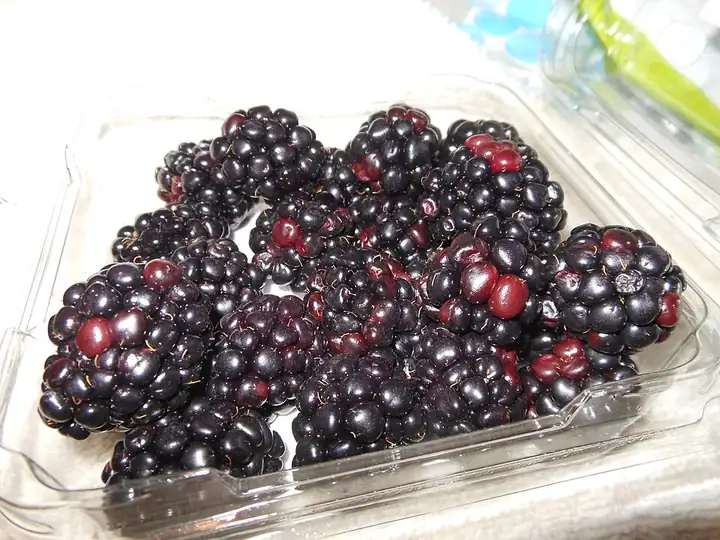
Black raspberry (blackcap)
Rubus occidentalis · Rose family (Rosaceae)
When to plant: Set out plants from 4 weeks before to 2 weeks after the last frost.
| Hardiness zones | 4 to 8 |
|---|---|
| Sun | full sun |
| Water | moderate |
| Life cycle | perennial |
| Frost | Hardy: takes frost |
| Soil pH | 5.8–6.5 |
| Spacing | 30 to 48 inches |
About Black raspberry (blackcap)
Black raspberries are native brambles with arching canes and small, seedy, very aromatic berries. Unlike red raspberries they grow in clumps (hills) instead of spreading by root suckers. They catch viruses easily from wild brambles, so start with clean plants and keep them away from wild patches and red raspberries.
NC State lists zones 4-8. They are less cold hardy than red raspberries (Ohio State): not reliable in northern Iowa (Iowa State) and grown only on protected sites in southern Maine and New Hampshire (UNH).
When to plant
Timing is counted from your average last spring frost (and first fall frost). Sow & Tell works out the actual dates for your ZIP code.
- Set out plants: from 4 weeks before to 2 weeks after the last frost
Plant in early spring, which works better than fall (Ohio State). Space plants 2.5 to 4 feet apart in rows 6 to 12 feet apart (Ohio State; Iowa State; UNH). Buy certified virus-free plants, remove wild brambles within 600 feet (UNH), and keep black raspberries as far from red ones as you can, ideally upwind, because aphids carry viruses between them (Ohio State). Avoid spots where tomatoes, potatoes or eggplant grew (Ohio State).
Soil
Well-drained sandy loam with organic matter; use raised beds where drainage is poor, because brambles get root rot (Ohio State).
Follow a soil test and aim for a pH of about 5.8-6.5; mix organic matter into well-drained soil (Ohio State).
Feeding
- Early spring, as growth starts: balanced fertilizer such as 10-10-10. Spread 2 to 3 pounds per 100 feet of row along the row and water it in (Ohio State).
Look for: mostly nitrogen, in spring as growth starts. Spring feeding grows the new shoots and leaves that carry flowers and fruit; feeding after midsummer pushes soft growth that may not harden before winter. - May: balanced fertilizer such as 10-10-10. Repeat with 2 to 3 pounds per 100 feet of row (Ohio State).
Look for: mostly nitrogen, in spring as growth starts. Spring feeding grows the new shoots and leaves that carry flowers and fruit; feeding after midsummer pushes soft growth that may not harden before winter.
Don't let canes grow untopped: pinch new canes at about 2 to 4 feet tall so they branch, and cut out canes that fruited right after harvest (Ohio State; UNH).
Harvest
Berries go from red to black-purple when ripe (NC State) and pull away easily from the core (UNH). They spoil fast, so pick every day or two in early summer and chill them right away.
Black raspberries give one crop a year, in early to midsummer, on second-year canes that then die. Pinch new canes when they reach about 24-30 inches so they branch and carry more fruit the next year.
Varieties (15)
| Variety | Type | Season and days | Zones | Notes |
|---|---|---|---|---|
| Niwot | Everbearing (primocane-fruiting) | Summer crop on older canes plus a fall crop from late August or September | Large, firm, fairly seedy berries of good quality. Tall, trailing canes whose tips root where they touch soil, so they need staking or a trellis. Yields are low. From Colorado; one of the few black raspberries that fruit on first-year canes (Ohio State's 'Ohio's Treasure' is another). The fall crop may not ripen before frost in northern areas such as northern Maine. Sources: [3][9][10][11] | |
| Allen | Summer-bearing (floricane) | Early to midseason | 4–8typical for black raspberry | Large, attractive berries with a mild flavor. Vigorous and productive in Ohio. The USDA collection notes describe a smaller, less hardy plant with firm, juicy fruit. Bred in New York from Bristol x Cumberland; named for a grower who tested it. Sources: [1][12] |
| Black Hawk | Summer-bearing (floricane) | Late | 4–8typical for black raspberry | Medium to large, glossy berries (up to about 3/4 inch) with good, sweet flavor. Vigorous, productive and fairly hardy; resists anthracnose and tolerates heat. Minnesota rates its hardiness fair to poor. Released by the Iowa station in 1955. Also written Blackhawk. Sources: [1][2][6][10][13] |
| Bristol | Summer-bearing (floricane) | Early | 4–8typical for black raspberry | Medium-large to large, firm, glossy berries with good to excellent flavor. Vigorous, upright, productive canes. Very prone to anthracnose but tolerates mildew; Minnesota rates its hardiness fair to poor. An old standard from the New York station (1934). A USDA DNA study found the Bristol plants in the national collection match Munger. Sources: [1][2][6][9][10][14][15] |
| Cumberland | Summer-bearing (floricane) | Large, juicy, firm berries that are sweet and rich and hold their size late in the season. Hardy and productive with trailing canes, but prone to anthracnose, streak and rosette, which ended its long run as a leading variety. An heirloom from Pennsylvania, introduced in 1896 and one of the oldest black raspberries still grown (UGA). Sources: [16][17] | ||
| Dundee | Summer-bearing (floricane) | 4–8typical for black raspberry | Large, glossy berries with small drupelets; mildly tart-sweet and of very good quality. Tall, vigorous, productive canes. Bred at the New York station and introduced in 1927; a parent of Jewel. Sources: [18][19] | |
| Earlysweet | Summer-bearing (floricane) | Early | 4–8typical for black raspberry | Firm, glossy berries with good flavor. Vigorous plants. UMaine writes the name as Early Sweet. Sources: [3] |
| Haut | Summer-bearing (floricane) | Early; ripens over a long season | 4–8typical for black raspberry | Medium, round berries that are very sweet and aromatic. Vigorous, well-branched and spiny. Some resistance to gray mold (Botrytis), but prone to orange rust and anthracnose. University of Maryland release (1987). Ohio State spells it Hault and calls it vigorous and productive with good flavor. Sources: [1][20] |
| Huron | Summer-bearing (floricane) | Midseason | 4–8typical for black raspberry | Bright black, fairly firm berries of fair to good quality. Vigorous and productive, with few spines. New York station release (1965), valued for all-around merit rather than any single standout trait. Sources: [21] |
| Jewel | Summer-bearing (floricane) | Early to midseason (mid-summer) | 5–8 | Large, firm, glossy berries with good to excellent flavor; less seedy than many black raspberries. Vigorous, upright canes; among the hardiest black raspberries. Better disease resistance than most, including anthracnose, but a little prone to powdery mildew. The most widely grown black raspberry (Penn State). Bred at the New York station in Geneva and released in 1973; Bristol is a parent. Oregon State lists zones 5-8; Minnesota says it bears well there only with extra winter protection. Sources: [1][4][6][9][10][11][15][17][19][22][23] |
| Mac Black | Summer-bearing (floricane) | Late; ripens about 7-14 days after most black raspberries | 4–8typical for black raspberry | Medium to large berries with good flavor; fairly soft, with larger seeds than most. Vigorous, stocky, upright canes. Productive but lower-yielding in Oregon trials. Bred in Michigan. Useful to stretch the black raspberry season later into summer. Also written MacBlack. Sources: [1][9][10][11] |
| Munger | Summer-bearing (floricane) | Late | 4–8typical for black raspberry | Small to medium, firm, juicy blue-black berries with a mild, sweet taste. Very vigorous, upright, hardy plant with stocky canes. Can be machine harvested. Grown from a Shaffer seedling in western Ohio around 1890 and introduced in 1897. A leading processing black raspberry in Oregon (Oregon State). Sources: [11][24] |
| New Logan | Summer-bearing (floricane) | Early; about 10 days before Cumberland | Large, firm berries. Heavy yielding, with many flowers and easy picking. A Pennsylvania black raspberry from the 1920s. Sources: [25] | |
| Plum Farmer | Summer-bearing (floricane) | Early midseason | 4–8typical for black raspberry | Large, handsome berries that ship well and are easy to pick. Tall, vigorous, hardy and very productive, but prone to streak, anthracnose and rosette. An heirloom found in Ohio and introduced from New York in 1895; once a top commercial variety there. Sources: [26] |
| Shuttleworth | Summer-bearing (floricane) | Very early | 4–8typical for black raspberry | Large, glossy, firm berries of high quality, with large seeds. Strong, productive canes. Found and introduced in Silver Creek, New York, in 1933. Sources: [27] |
Pests to watch for
Raspberry cane borer, Japanese beetle, Spotted wing drosophila, Aphids, Twospotted spider mite
Diseases and problems
Anthracnose, Orange rust, Mosaic viruses, Verticillium wilt, Crown gall, Cane blight, Gray mold (Botrytis)
In the kitchen
Eaten fresh; NC State rates the flavor excellent.
Keeping it: Black raspberries spoil fast: chill them right after picking in a shallow container, keep them dry, and eat within 1-2 days. Rinse only right before eating.
Safety: No toxic parts were noted in the sources we checked.
Pets: Not listed by the ASPCA
Sources
- cfaes.osu.edu
- extension.umn.edu
- extension.umaine.edu
- extension.unh.edu
- plants.ces.ncsu.edu
- yardandgarden.extension.iastate.edu
- plantsservices.sc.egov.usda.gov
- aspca.org
- extension.psu.edu
- extension.umaine.edu
- extension.oregonstate.edu
- npgsweb.ars-grin.gov
- npgsweb.ars-grin.gov
- npgsweb.ars-grin.gov
- uthort.tennessee.edu
- npgsweb.ars-grin.gov
- fieldreport.caes.uga.edu
- npgsweb.ars-grin.gov
- npgsweb.ars-grin.gov
- npgsweb.ars-grin.gov
- npgsweb.ars-grin.gov
- extension.umn.edu
- extension.oregonstate.edu
- npgsweb.ars-grin.gov
- npgsweb.ars-grin.gov
- npgsweb.ars-grin.gov
- npgsweb.ars-grin.gov
Photo: Photo: Lanthanum57 / Wikimedia Commons, CC BY-SA 3.0 (CC BY-SA 3.0). Photo resized for the web.

Planting dates and advice are general guidance; check with your local Cooperative Extension office for your area.