
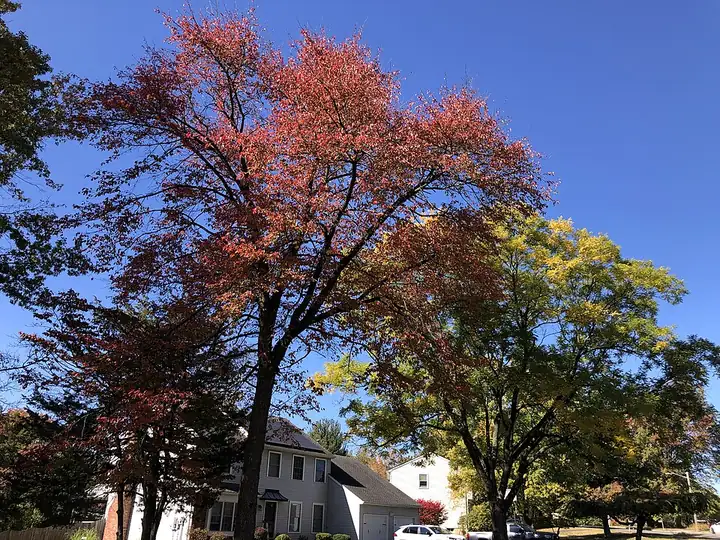
Black gum (tupelo)
Nyssa sylvatica · Tupelo family (Nyssaceae)
When to plant: Container trees can go in any time the ground can be worked, but fall is the best season in the South because roots keep growing through mild weather (Clemson).
| Hardiness zones | 4 to 9 |
|---|---|
| Sun | full sun |
| Water | moderate |
| Life cycle | perennial |
| Frost | Hardy: takes frost |
About Black gum (tupelo)
Black gum, also called black tupelo or sour gum, is a native tree with glossy leaves that turn brilliant scarlet, orange and purple in fall. Its small spring flowers are a prized bee plant for tupelo honey, and female trees bear blue-black fruit that migrating songbirds eat. It has a long taproot, so plant it young in its permanent spot.
Zones 4-9 (NC State).
When to plant
Container trees can go in any time the ground can be worked, but fall is the best season in the South because roots keep growing through mild weather (Clemson).
Plant container or balled-and-burlapped trees. Dig the hole no deeper than the root ball and at least twice as wide, keep the top roots level with the soil, and mulch 2-4 inches without touching the trunk. The long taproot makes it hard to move later. You need a female and a male tree for fruit (NC State).
Soil
Moist, acidic soil of clay, loam or sand; it tolerates poor drainage, flooding and some drought, but not alkaline soil (NC State).
Test the soil first. Loosen a wide planting area and mix 10-20 percent compost into the native soil you dig out; don't use uncomposted bark, and don't dig deeper than the root ball (Clemson).
Feeding
- Spring to early summer, after the tree is established, and only if a soil test or pale leaves and weak twig growth show a need: slow-release nitrogen fertilizer with a ratio near 3-1-1 or 3-1-2 (3-0-1 or 3-0-2 if the soil test shows enough phosphorus). Spread it evenly from just outside the trunk flare to the dripline and water it in. Clemson cites 2-4 lb of slow-release nitrogen per 1,000 sq ft per year, split into a spring and a late-summer feeding; follow your soil test.
Look for: mostly nitrogen, in spring as growth starts. Spring feeding grows the new shoots and leaves that carry flowers and fruit; feeding after midsummer pushes soft growth that may not harden before winter. - Late summer to early fall, the second half of the year's split feeding (only if a soil test calls for it): slow-release nitrogen fertilizer, same as spring. Apply the rest of the year's amount over the root zone and water in. Don't feed a drought-stressed tree in summer (Clemson).
Look for: mostly nitrogen, in spring as growth starts. Spring feeding grows the new shoots and leaves that carry flowers and fruit; feeding after midsummer pushes soft growth that may not harden before winter.
First-year watering matters far more than fertilizer: water daily for the first 1-2 weeks, every 2-3 days until week 12, then weekly, using about 1-1.5 gallons per inch of trunk diameter, until the tree is established, roughly 1.5 years per inch of trunk (UMN). Don't count on rain unless it was over an inch. Plant it young in its permanent spot; the long taproot makes it hard to move. NC State notes watering and feeding speed up its slow growth. Too much fertilizer can burn roots and push soft growth that pests and cold injure (Clemson).
Varieties (9)
NC State documents these cultivars.
| Variety | Type | Zones | Notes |
|---|---|---|---|
| Fire Starter ('JFS-Red') | Fall color | 4–9typical for black gum | Named for fall color. Sources: [1] |
| Red Rage | Fall color | 4–9typical for black gum | Bright red fall color with little leaf spot. Sources: [1] |
| Wildfire | Fall color | 4–9typical for black gum | Bronze-red new growth. Sources: [1] |
| Miss Scarlet | Female | 4–9typical for black gum | Female tree with lots of fruit. Sources: [1] |
| Zydeco Twist | Unusual | 4–9typical for black gum | Contorted, twisting growth. Sources: [1] |
| Afterburner ('David Odom') | Upright | 4–9typical for black gum | Pyramid about 35 ft tall and 20 ft wide; bright red, long-lasting fall color. Sources: [1] |
| Green Gable | Upright | 4–9typical for black gum | Upright branching with red fall color. Sources: [1] |
| Sheri's Cloud | Variegated | 4–9typical for black gum | Variegated leaves. Sources: [1] |
| Autumn Cascades | Weeping | 4–9typical for black gum | Weeping female tree. Sources: [1] |
Pests to watch for
Diseases and problems
Leaf spot, Canker, Rust, Girdling roots
In the kitchen
The fruit is sour but edible raw or cooked and can be made into preserves (NC State).
Pets: We found no ASPCA listing for black gum.
Sources
Photo: Photo: Famartin / Wikimedia Commons, CC BY-SA 4.0 (CC BY-SA 4.0). Photo resized for the web.

Planting dates and advice are general guidance; check with your local Cooperative Extension office for your area.