
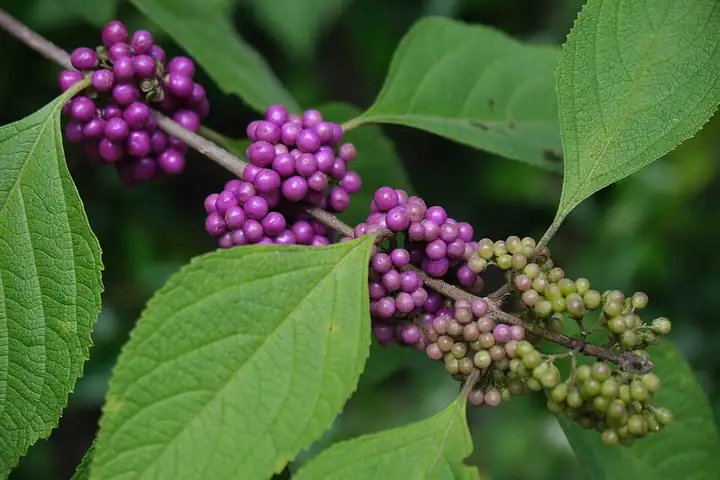
American beautyberry
Callicarpa americana; the Asian beautyberries C. dichotoma (purple beautyberry), C. japonica (Japanese beautyberry), C. bodinieri and their hybrids are non-native groups · Mint family (Lamiaceae; formerly placed in Verbenaceae)
When to plant: Plant container shrubs in spring or fall and water deeply until they're established, at least two growing seasons (UMN).
| Hardiness zones | 6 to 10 |
|---|---|
| Sun | full sun to part shade |
| Water | moderate |
| Life cycle | perennial |
| Frost | Hardy: takes frost |
| Spacing | 36 to 72 inches |
About American beautyberry
American beautyberry is a loose, arching native shrub grown for its tight clusters of glossy purple berries that wrap the stems in late summer and fall, after small pink to lavender flowers in early summer. It's native from Maryland and Virginia south to Florida and west to Missouri, Oklahoma and Texas, and its berries feed more than 40 kinds of songbirds plus quail, raccoons and other wildlife (NC State, NRCS). The Asian beautyberries sold as purple or Japanese beautyberry are not native: they reseed, NC State tags Japanese beautyberry as weedy and says Alabama lists it as invasive, and Clemson calls the Asian kinds potentially invasive.
American beautyberry is hardy in zones 6-10 (NC State; Clemson says 7-11); the Asian species take zones 5-8. Asian beautyberries are on Alabama's invasive plant list (advisory).
When to plant
Plant container shrubs in spring or fall and water deeply until they're established, at least two growing seasons (UMN).
Space 3-6 ft apart; berries are heaviest in sun and when several plants grow together (NC State, Clemson). Volunteer seedlings transplant easily (NRCS).
Soil
Almost any well-drained soil, from sand to clay, acid or alkaline; best in moist, rich soil, and it handles some drought once settled (NC State, wildflower.org).
Test the soil before planting; established shrubs in decent soil need little or no fertilizer (Clemson).
Feeding
- Spring to early summer after new growth starts, only if a soil test shows a need: slow-release complete fertilizer in a 3:1:2 ratio, or what the soil test calls for. Spread evenly from the trunk out to the drip line and water it in; a typical soil-test rate for shrubs is about 2 lb of 12-6-6 per 100 sq ft (Clemson). Follow a soil test.
Look for: mostly nitrogen, in spring as growth starts. Spring feeding grows the new shoots and leaves that carry flowers and fruit; feeding after midsummer pushes soft growth that may not harden before winter.
Water is what new shrubs need most: daily for the first 2 weeks, every 2-3 days through week 12, then weekly until the roots spread (at least two growing seasons), using about a quarter to a third of the nursery pot's volume each time (UMN). Too much nitrogen pushes leaves at the expense of flowers, and beautyberry fruits only on new growth, so don't skip the late-winter pruning (Clemson, NC State).
Harvest
Small flowers open June to July on new growth, and berries color up from late August, staying into early winter after the leaves drop (NC State, Clemson). Because it blooms on new wood, prune in late winter: cut back hard, even to about a foot tall, on vigorous plants, or just thin older stems (NC State, Clemson).
Varieties (15)
| Variety | Type | Zones | Notes |
|---|---|---|---|
| Alba | American beautyberry (native) | 6–10typical for american beautyberry | White berries. Sources: [1] |
| Lactea | American beautyberry (native) | 6–10typical for american beautyberry | White berries and attractive foliage. Sources: [1][2] |
| Russell Montgomery | American beautyberry (native) | 6–10typical for american beautyberry | White berries. Sources: [1][2] |
| Welch's Pink | American beautyberry (native) | 6–10typical for american beautyberry | Pink berries. Sources: [1] |
| Profusion | Bodinier beautyberry (C. bodinieri, non-native) | 6–10typical for american beautyberry | Heavy crops of violet berries, even on young plants. Asian beautyberries reseed and are on Alabama's invasive plant list (advisory). Sources: [2] |
| Pearl Glam ('NCCX2') | Hybrid beautyberry (non-native) | 5–8 | Vigorous and upright, 4-5 ft, with white flowers, purple-violet berries and purple leaves all season; zones 5-8. Clemson calls it Purple Glam; NC State lists it as Pearl Glam 'NCCX2'. Sources: [2][4] |
| Purple Pearls ('NCCX1') | Hybrid beautyberry (non-native) | 5–8 | Upright, 4-5 ft, with pink flowers, violet-purple berries and dark purple-black leaves all season; zones 5-8. Sources: [2] |
| Augustata | Japanese beautyberry (C. japonica, non-native) | 6–10typical for american beautyberry | Narrow leaves. Asian beautyberries reseed and are on Alabama's invasive plant list (advisory). Sources: [2][3] |
| Leucocarpa | Japanese beautyberry (C. japonica, non-native) | 6–10typical for american beautyberry | White berries and light green leaves. Asian beautyberries reseed and are on Alabama's invasive plant list (advisory). Sources: [2][3] |
| Luxurians | Japanese beautyberry (C. japonica, non-native) | 6–10typical for american beautyberry | Larger than the species, with big fruit clusters. Asian beautyberries reseed and are on Alabama's invasive plant list (advisory). NC State also lists a 'Luxurians' under purple beautyberry. Sources: [2][3] |
| Albifructus | Purple beautyberry (C. dichotoma, non-native) | 6–10typical for american beautyberry | White berries. Asian beautyberries reseed and are on Alabama's invasive plant list (advisory). Sources: [2][4] |
| Duet | Purple beautyberry (C. dichotoma, non-native) | 6–10typical for american beautyberry | Variegated leaves and white berries. Asian beautyberries reseed and are on Alabama's invasive plant list (advisory). Sources: [2][4] |
| Early Amethyst | Purple beautyberry (C. dichotoma, non-native) | 6–10typical for american beautyberry | Small purple berries. Asian beautyberries reseed and are on Alabama's invasive plant list (advisory). Sources: [2][4] |
| Issai | Purple beautyberry (C. dichotoma, non-native) | 6–10typical for american beautyberry | Mounded shrub with plenty of violet-blue berries. Asian beautyberries reseed and are on Alabama's invasive plant list (advisory). Sources: [2][4] |
| Spring Gold | Purple beautyberry (C. dichotoma, non-native) | 6–10typical for american beautyberry | New leaves come out bright golden yellow. Asian beautyberries reseed and are on Alabama's invasive plant list (advisory). Sources: [4] |
Pests to watch for
Diseases and problems
Leaf spots, Black mold
In the kitchen
NC State lists the berries as edible but mild-tasting; they're mostly made into jelly. Leave plenty for the birds.
Safety: NC State and the USDA list no toxicity. Crushed leaves were an old folk mosquito repellent, and USDA scientists found repellent compounds in them, but there is no registered beautyberry repellent product (USDA ARS).
Pets: Not listed by the ASPCA.
Sources
- plants.ces.ncsu.edu
- hgic.clemson.edu
- plants.ces.ncsu.edu
- plants.ces.ncsu.edu
- wildflower.org
- plants.sc.egov.usda.gov
- plants.sc.egov.usda.gov
- ars.usda.gov
- extension.umn.edu
- aspca.org
- aspca.org
- extension.rutgers.edu
- hgic.clemson.edu
- eddmaps.org
Photo: Photo: Alex Abair / Wikimedia Commons, CC BY 4.0 (CC BY 4.0). Photo resized for the web.

Planting dates and advice are general guidance; check with your local Cooperative Extension office for your area.