
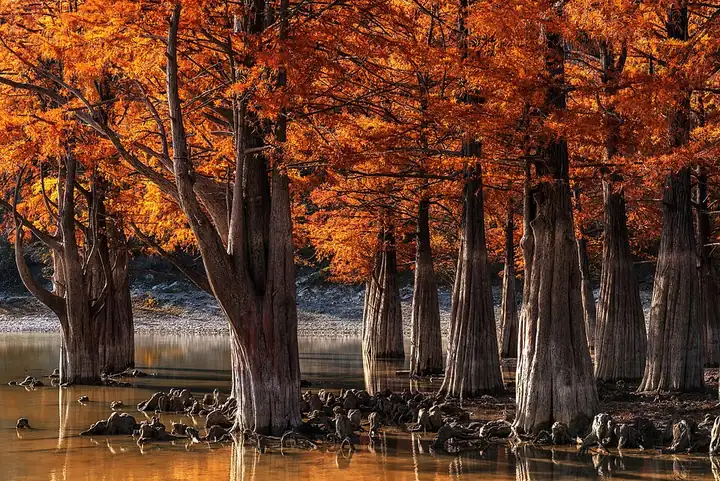
Bald cypress
Taxodium distichum · Cypress family (Cupressaceae)
When to plant: Container trees can go in any time the ground can be worked, but fall is the best season in the South because roots keep growing through mild weather (Clemson).
| Hardiness zones | 4 to 9 |
|---|---|
| Sun | full sun to part shade |
| Water | high |
| Life cycle | perennial |
| Frost | Hardy: takes frost |
About Bald cypress
Bald cypress is a native conifer of Southern swamps that loses its soft, feathery needles each winter after they turn orange to cinnamon-brown. It grows in standing water, where it forms knobby 'knees', yet does fine in ordinary yard soil, and it is among the longest-lived trees in the world.
Zones 4-9 (NC State); it yellows (chlorosis) in alkaline soil.
When to plant
Container trees can go in any time the ground can be worked, but fall is the best season in the South because roots keep growing through mild weather (Clemson).
Plant container or balled-and-burlapped trees. Dig the hole no deeper than the root ball and at least twice as wide, keep the top roots level with the soil, and mulch 2-4 inches without touching the trunk. Knees form mostly when it grows in or near water (NC State).
Soil
Acidic soil of almost any texture, wet to well-drained; tolerates standing water and long flooding, but leaves yellow in alkaline soil (NC State).
Test the soil first. Loosen a wide planting area and mix 10-20 percent compost into the native soil you dig out; don't use uncomposted bark, and don't dig deeper than the root ball (Clemson).
Feeding
- Spring to early summer, after the tree is established, and only if a soil test or pale leaves and weak twig growth show a need: slow-release nitrogen fertilizer with a ratio near 3-1-1 or 3-1-2 (3-0-1 or 3-0-2 if the soil test shows enough phosphorus). Spread it evenly from just outside the trunk flare to the dripline and water it in. Clemson cites 2-4 lb of slow-release nitrogen per 1,000 sq ft per year, split into a spring and a late-summer feeding; follow your soil test.
Look for: mostly nitrogen, in spring as growth starts. Spring feeding grows the new shoots and leaves that carry flowers and fruit; feeding after midsummer pushes soft growth that may not harden before winter. - Late summer to early fall, the second half of the year's split feeding (only if a soil test calls for it): slow-release nitrogen fertilizer, same as spring. Apply the rest of the year's amount over the root zone and water in. Don't feed a drought-stressed tree in summer (Clemson).
Look for: mostly nitrogen, in spring as growth starts. Spring feeding grows the new shoots and leaves that carry flowers and fruit; feeding after midsummer pushes soft growth that may not harden before winter.
First-year watering matters far more than fertilizer: water daily for the first 1-2 weeks, every 2-3 days until week 12, then weekly, using about 1-1.5 gallons per inch of trunk diameter, until the tree is established, roughly 1.5 years per inch of trunk (UMN). Don't count on rain unless it was over an inch. Alkaline soil causes yellowing (chlorosis); test pH before planting. It can take wet soil and even standing water (NC State). Too much fertilizer can burn roots and push soft growth that pests and cold injure (Clemson).
Varieties (9)
NC State documents these; several are dwarf or weeping forms.
| Variety | Type | Zones | Notes |
|---|---|---|---|
| Pond cypress (var. imbricarium) | Botanical variety | 4–9typical for bald cypress | Awl-like leaves pressed close to the twig and grayer bark; grows in ponds. Sources: [1] |
| Lindsey's Skyward | Columnar | 4–9typical for bald cypress | About 25 ft tall and 10 ft wide. Sources: [1] |
| Peve Minaret | Dwarf | 4–9typical for bald cypress | Shrubby, about 8 ft tall and 4 ft wide, with fern-like leaves. Sources: [1] |
| Secrest | Dwarf | 4–9typical for bald cypress | Low, spreading and slow-growing. Sources: [1] |
| Peve Yellow | Gold-leaf | 4–9typical for bald cypress | Yellow-green leaves. Sources: [1] |
| Shawnee Brave | Narrow pyramid | 4–9typical for bald cypress | Neat pyramidal form. Sources: [1] |
| Green Whispers | Pyramidal | 4–9typical for bald cypress | About 55 ft tall and 30 ft wide. Sources: [1] |
| Cascade Falls | Weeping | 4–9typical for bald cypress | Compact weeping habit. Sources: [1] |
| Cajun Snowfall | Weeping, variegated | 4–9typical for bald cypress | Weeping with white-variegated leaves; needs filtered shade. Sources: [1] |
Pests to watch for
Diseases and problems
Twig blight, Iron chlorosis
In the kitchen
Pets: Not on the ASPCA's toxic plant list for dogs.
Sources
Photo: Photo: HoroshilovAleksandr / Wikimedia Commons, CC BY-SA 4.0 (CC BY-SA 4.0). Photo resized for the web.

Planting dates and advice are general guidance; check with your local Cooperative Extension office for your area.