
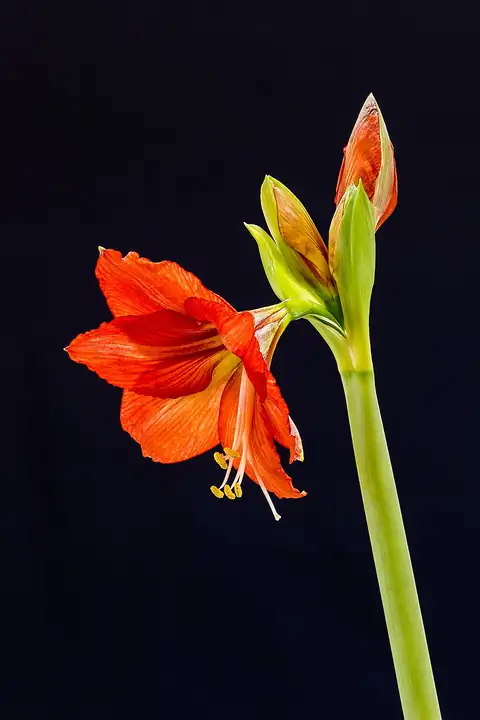
Amaryllis
Hippeastrum hybrids · Amaryllis family (Amaryllidaceae)
When to plant: Pot dormant bulbs between mid-fall and late winter; for Christmas flowers, pot them in early to mid-November. It blooms 4-8 weeks after potting.
| Hardiness zones | 7 to 10 |
|---|---|
| Sun | full sun to part shade |
| Water | moderate |
| Life cycle | perennial |
| Frost | Tender: killed by frost |
Will it grow in your window?
Pick the window it sits in. This is the same check Sow & Tell runs for every plant in your house.
It wants bright, direct light.
Pick a window above and this will tell you whether the spot suits it.
Watering: water when the top inch is dry — about every 7 days, stretching to every 12 from November to February.
Summering outside? Bring it in before nights drop below 50°F.
About Amaryllis
The amaryllis sold as a gift bulb each winter is a Hippeastrum hybrid from Central and South America, not the South African Amaryllis genus the name belongs to (NC State). A big bulb potted in November sends up one to three hollow stalks topped with 2-6 trumpet flowers up to 5-8 in across, in red, pink, orange, salmon, white and stripes, about 4-8 weeks later (Clemson, NC State). With a summer outdoors and a cool dry rest in fall it reblooms year after year, and the bulb is the poisonous part.
Hardy outdoors in zones 7-10 with winter mulch, and in zone 8 in South Carolina (NC State, Clemson); north of that it is grown indoors and can summer outdoors in part sun once nights stay above about 50 F, coming back in by mid-September (Iowa State).
When to plant
Pot dormant bulbs between mid-fall and late winter; for Christmas flowers, pot them in early to mid-November. It blooms 4-8 weeks after potting.
Bought as a dormant bulb and potted between mid-fall and late winter, early to mid-November for Christmas bloom; bloom comes 4-8 weeks after potting (Clemson, Iowa State, NC State).
Growing it indoors
- Light: Give it at least 4 hours of direct sun a day in a south window (east or west second best) and turn the pot every few days so the stalk grows straight; move it out of direct sun only while the flowers are open, to make them last (Clemson, Iowa State).
- Water: Water thoroughly after potting, then wait about a week and keep the mix just barely moist until growth shows; once leaves and stalk are up, water when the surface feels dry, about once or twice a week in bloom, and never leave the pot standing in water (Clemson, Iowa State). After bloom keep it slightly moist through summer, then stop watering in fall for the 8-10 week rest.
- Temperature: Start the bulb at 70-75 F, drop to 65-70 F in bloom to make the flowers last, rest it at 50-55 F in fall, and keep it away from heaters and vents; the plant is injured below 35 F (Clemson, Iowa State, NC State).
- Feeding: Never feed a leafless bulb; once it is growing, feed every 2-4 weeks with a balanced liquid houseplant fertilizer at half strength through spring and summer, and once or twice a month outdoors through July, then stop in fall (Clemson, Iowa State).
- Repotting: Bulbs flower best slightly rootbound, so repot only every few years, at the end of the fall rest, into a pot 1-2 in wider than the bulb with fresh mix and the top half of the bulb above the surface (Clemson, Iowa State).
- More plants: Pull firm offset bulbs from the parent during fall dormancy and pot each one 1-2 in wider than itself; they bloom at mature size, in a few years. Cultivars that don't offset can be chipped into 8-12 sections, and seed is possible but slow (Iowa State, NC State).
If something looks wrong
| What you see | Likely cause | What to do |
|---|---|---|
| Lots of leaves but no flower stalk the second year | Too little stored food, or no cool rest | Feed every 2-4 weeks and give full sun through spring and summer, then rest the bulb dry at 50-55 F for at least 8-10 weeks in fall (Iowa State). |
| Reddish-brown spots and streaks on the bulb, leaves and stalk | Red blotch, a fungal disease that spreads between bulbs | Keep the bulb neck high and dry, don't bruise bulbs, and discard badly spotted ones (Clemson). |
| Soft, sunken or dark patches on the bulb, mushy roots | Bulb and root rot from overwatering or a bruised bulb | Discard the bulb and replace the potting mix; keep new bulbs barely moist until leaves show (Clemson, Iowa State). |
| Tall stalk flopping over | Heavy flowers, too little light or an uneven turn | Stake it, turn the pot daily while the stalk grows, or cut a bent stalk and finish it in a vase, where it keeps blooming (Clemson, Iowa State). |
Soil
A well-drained potting mix, or equal parts peat and perlite, in a heavy pot with a drainage hole only 1-2 in wider than the bulb, with the top third to half of the bulb above the mix (Clemson, Iowa State).
Pot in a well-drained potting mix or equal parts peat and perlite, in a pot 1-2 in wider than the bulb with a drainage hole, with the top third to half of the bulb above the mix (Clemson, Iowa State).
Feeding
- From potting until leaves show: none. Never fertilize a leafless bulb; it can kill the new roots (Clemson).
- Once leaves and stalk are growing, through bloom and spring: balanced liquid houseplant fertilizer. Feed every 2-4 weeks at half strength (Iowa State), or twice a month diluted per the label (Clemson), after watering.
- Summer outdoors, through July: balanced liquid houseplant fertilizer. Feed once or twice a month to build the bulb for next winter's flowers (Iowa State); in the ground Clemson uses a low-nitrogen 5-10-10 or 6-12-12 at new growth, when the stalk is 6-8 in, and after bloom.
- Fall rest, 8-10 weeks at 50-55 F: none. Stop watering and feeding when you put the bulb to rest in late September (Iowa State, Clemson).
Leaves but no flowers next year means the bulb didn't store enough food: feed more through spring and summer and don't skip the cool rest (Iowa State).
Harvest
Flowers open 4-8 weeks after potting, each stalk carrying 2-6 blooms that last 3-4 weeks; cut a spent stalk 1-2 in above the bulb and leave the leaves to feed next year's flowers (Clemson, Iowa State, NC State).
Varieties (19)
| Variety | Type | Zones | Notes |
|---|---|---|---|
| Quito | Cybister (spidery) | 7–10typical for amaryllis | Narrow, spidery petals in the cybister style. Sources: [2] |
| Aphrodite | Double | 7–10typical for amaryllis | Double white flowers feathered pinkish red. Sources: [1][3] |
| Blossom Peacock | Double | 7–10typical for amaryllis | Double red with a white throat and midrib. Sources: [1][3] |
| Dancing Queen | Double | 7–10typical for amaryllis | Double flowers striped red and white; Clemson notes it blooms in spring in a garden. Sources: [1][2][3] |
| White Nymph | Double | 7–10typical for amaryllis | Double white flowers. Sources: [1][3] |
| Baby Star | Miniature | 7–10typical for amaryllis | Deep red with a white center star; miniatures are only slightly shorter but have flowers about half as wide (Iowa State). Sources: [1][3] |
| Fairytale | Miniature | 7–10typical for amaryllis | White with raspberry stripes. Sources: [1][3] |
| Green Goddess | Miniature | 7–10typical for amaryllis | White with a green center. Sources: [1][3] |
| Neon | Miniature | 7–10typical for amaryllis | Fuchsia pink with a white throat. Sources: [1][3] |
| Apple Blossom | Single | 7–10typical for amaryllis | White flowers feathered in pink. Sources: [1][2][3] |
| Christmas Gift | Single | 7–10typical for amaryllis | White flowers with a green throat. Sources: [1][3] |
| Minerva | Single | 7–10typical for amaryllis | Red flowers with a white star in the center. Sources: [1][2][3] |
| Monte Carlo | Single | 7–10typical for amaryllis | Mostly red with white stripes. Sources: [1] |
| Orange Sovereign | Single | 7–10typical for amaryllis | Clear orange single flowers. Sources: [1][3] |
| Picotee | Single | 7–10typical for amaryllis | White flowers with a thin red edge on each petal. Sources: [1][3] |
| Red Lion | Single | 7–10typical for amaryllis | Dark crimson-red single flowers; the most widely sold red. Sources: [1][2][3] |
| Voodoo | Single | 7–10typical for amaryllis | Red with yellow streaks at the center. Sources: [1] |
| White Christmas | Single | 7–10typical for amaryllis | Pure white single flowers. Sources: [2] |
| Butterfly amaryllis (H. papilio) | Species | 7–10typical for amaryllis | Cream petals striped maroon with green throats; a species rather than a hybrid. Sources: [2] |
Pests to watch for
Mealybugs, Thrips, Scale insects, Twospotted spider mite, Narcissus bulb fly, Slugs, Brown garden snail
Diseases and problems
Red blotch (leaf scorch), Root and crown rot, Mosaic viruses
In the kitchen
Safety: The bulb is the most poisonous part: it contains the alkaloid lycorine, and NC State rates it medium severity, with vomiting, drooling and diarrhea after a mouthful and convulsions, low blood pressure, tremors and irregular heartbeat after a large one; leaves, stems and flowers carry less. Store spare bulbs where children can't mistake them for onions.
Pets: Toxic to dogs, cats and horses (ASPCA, listed as Amaryllis spp.): lycorine and other alkaloids cause vomiting (not in horses), depression, diarrhea, belly pain, drooling, loss of appetite and tremors, and the bulb is the worst part.
Sources
- plants.ces.ncsu.edu
- hgic.clemson.edu
- yardandgarden.extension.iastate.edu
- extension.missouri.edu
- aspca.org
Photo: Photo: Agnes Monkelbaan, CC BY-SA 4.0, via Wikimedia Commons (CC BY-SA 4.0). Photo resized for the web.

Planting dates and advice are general guidance; check with your local Cooperative Extension office for your area.