
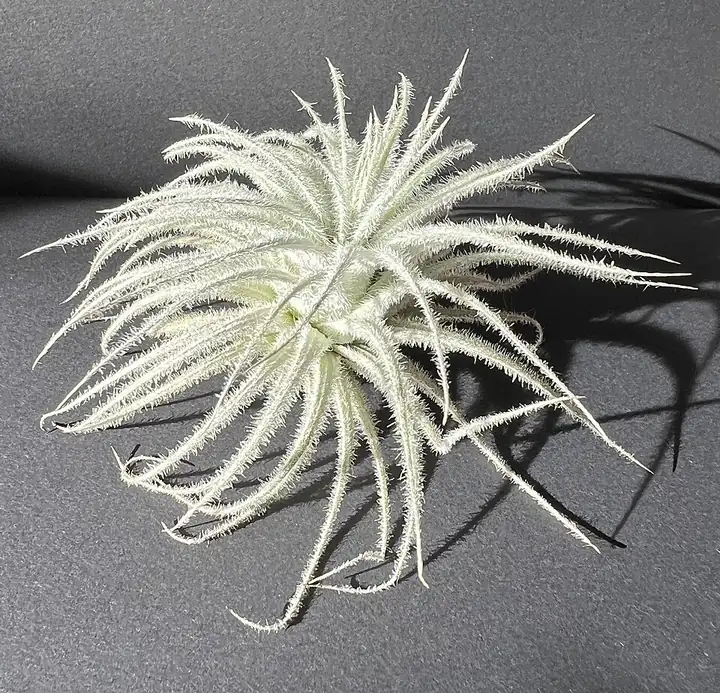
Air plants (tillandsia)
Tillandsia spp. (T. ionantha, T. xerographica and kin) · Pineapple family (Bromeliaceae)
When to plant: Any time of year: it grows without soil and never needs repotting. New plants come from the pups that form after it blooms.
| Hardiness zones | 10 to 13 |
|---|---|
| Sun | part shade |
| Water | moderate |
| Life cycle | perennial |
| Frost | Tender: killed by frost |
Will it grow in your window?
Pick the window it sits in. This is the same check Sow & Tell runs for every plant in your house.
It wants bright, indirect light.
Pick a window above and this will tell you whether the spot suits it.
Watering: soak it, then let it dry right out — about every 14 days, stretching to every 28 from November to February.
About Air plants (tillandsia)
Air plants are small bromeliads that perch on trees, rocks and even power lines from the southern United States through Mexico and South America, taking in water and nutrients through silvery scales on their leaves rather than through their few wiry roots (NC State, UF/IFAS). They grow without soil, mounted on wood, cork or shells or set in a dish, and need regular soaking or misting. Florida has its own natives, including Spanish moss and ball moss, and UF/IFAS asks gardeners never to collect air plants from the wild, where collecting already threatens them.
The Extension pages we opened give no hardiness range; air plants are grown indoors everywhere and can summer outdoors in light shade while nights stay above about 50 F, coming in before fall nights dip toward 45-50 F (UMN Extension's general cutoff for tender houseplants). UF/IFAS says to check a species against your zone before growing it outdoors year-round.
When to plant
Any time of year: it grows without soil and never needs repotting. New plants come from the pups that form after it blooms.
Usually bought as a nursery-grown plant, never collected from the wild; new plants come from the pups that form after the mother plant blooms (UF/IFAS, NC State).
Growing it indoors
- Light: Bright light near a south, east or west window, out of direct sun (UF/IFAS); NC State adds that most species need high light to flower and that LED grow lights can make up the difference.
- Water: Water at least once a week by soaking the whole plant in a bowl of water or rinsing it under the shower (NC State), or by misting until water runs off (UF/IFAS), then let it dry out before the next watering. Leaves that curl or roll inward mean it is thirsty, and a mount that holds water invites rot.
- Temperature: The pages we opened give no temperature range; treat it like other tender houseplants and keep it out of cold window drafts (Wisconsin).
- Feeding: The pages we opened give no feeding schedule; air plants take what they need from air and water through their leaf scales (UF/IFAS, NC State).
- Repotting: No repotting: if it comes loose, reattach it to its mount with wire, liquid nails or slightly cooled hot glue (UF/IFAS).
- More plants: Pups form around the mother plant after it blooms and can be separated to start new plants; seed works but is very slow (NC State, UF/IFAS).
If something looks wrong
| What you see | Likely cause | What to do |
|---|---|---|
| Leaves curled or rolled inward | Dehydration | Soak or mist it more often, at least weekly (UF/IFAS, NC State). |
| Center dark and soft, leaves pulling loose | Crown rot from staying wet | Let it dry fully between waterings and move it to a mount or dish that doesn't hold water (NC State, UF/IFAS). |
| A healthy plant that never blooms | Too little light | Move it to a brighter window or add an LED grow light (NC State). |
| Cottony tufts or brown bumps among the leaves | Mealybugs or scale | Pick or wipe them off; these are the usual houseplant pests on air plants (NC State). |
Soil
None: air plants grow without soil, mounted on driftwood, cork, bark or shells or resting on dry pebbles in a dish, and whatever they sit on must not hold water (UF/IFAS, NC State).
No soil: mount it on driftwood, cork, bark or shells, or set it on dry pebbles in a dish, using a surface that doesn't hold water (UF/IFAS, NC State).
Feeding
The pages we opened give no feeding schedule; air plants take nutrients from air and water through their leaf scales, so focus on light and regular soaking (UF/IFAS, NC State).
Varieties (3)
Air plants are sold by species rather than cultivar; NC State names 3 popular species, listed here as groups.
| Variety | Type | Zones | Notes |
|---|---|---|---|
| Tillandsia usneoides (Spanish moss) | Hanging strands | 10+typical for air plants | Hanging gray, curly strands of thin leaves and stems; native to the Southeast. A Florida native; UF/IFAS says never to collect air plants from the wild. Sources: [1][2] |
| Tillandsia xerographica | Large rosette | 10+typical for air plants | A medium-sized silvery rosette with a showy flower spike. Sources: [1] |
| Tillandsia ionantha | Small rosette | 10+typical for air plants | A popular small species that blushes red when it blooms; flowers form right among the leaves. Sources: [1] |
Pests to watch for
Diseases and problems
Crown rot
In the kitchen
Safety: None of the pages we opened list air plants as poisonous or give a toxicity rating. Wild air plants are threatened by collecting and by the invasive Mexican bromeliad weevil, so buy nursery-grown plants (UF/IFAS).
Pets: Not listed by the ASPCA under air plant or Tillandsia; NC State gives no toxicity rating.
Sources
- plants.ces.ncsu.edu
- gardeningsolutions.ifas.ufl.edu
- extension.umn.edu
- hort.extension.wisc.edu
- aspca.org
- aspca.org
Photo: Photo: Fen37, CC0, via Wikimedia Commons (CC0). Photo resized for the web.

Planting dates and advice are general guidance; check with your local Cooperative Extension office for your area.