
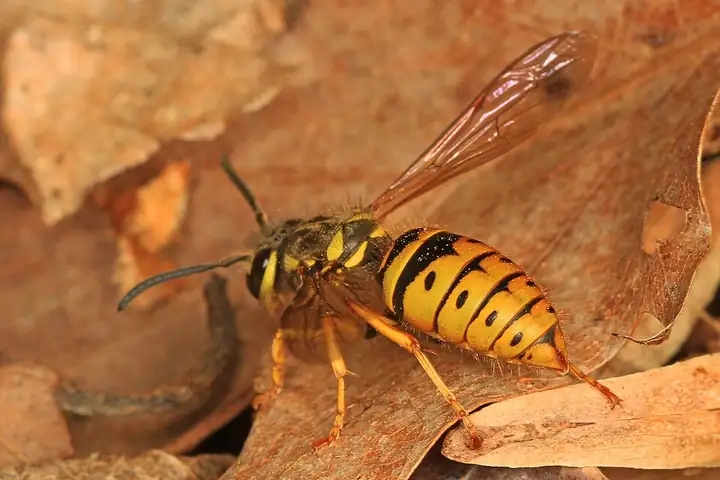
Yellowjackets (and baldfaced hornets)
Vespula species such as the western yellowjacket (V. pensylvanica), eastern yellowjacket (V. maculifrons) and German yellowjacket (V. germanica); the baldfaced hornet (Dolichovespula maculata) is a close relative
| Type | Insect |
|---|---|
| What it does | Predator |
| When | Spring through fall; worst in late summer and fall when colonies are largest |
| How common it is by region | Very common here: Northeast, Southeast, South Central, Midwest, Great Plains, Mountain West, Pacific Northwest, California |
About
Yellowjackets are stocky, shiny black-and-yellow wasps that live in big paper nests, often underground. They kill many caterpillars and flies in spring and summer, but by late summer they scavenge food and defend their nests hard.
This one is already on your side. Broad sprays kill it along with the pest, which is why the guide puts sprays last.
What it eats
Workers hunt caterpillars, flies, crickets and other insects to feed their young. In late summer and fall they switch to sweets, meat, garbage, pet food and ripe or fallen fruit.
Spotting it
How to find it early
Look for a 3/8- to 5/8-inch bright yellow and black wasp with a smooth, nearly hairless body. Nests have one entrance, often a hole in the lawn, a wall gap or an old rodent burrow; baldfaced hornets are black and white and hang gray paper nests in trees or eaves.
Its young
Larvae are white grubs inside a covered nest, out of sight.
When
Spring through fall; worst in late summer and fall when colonies are largest
Easy to mistake for
- Honey bee — Yellowjackets are shiny, bright yellow and nearly hairless and often go for meat and soda; honey bees are fuzzy, golden-brown and stick to flowers.
- Paper wasps — Yellowjackets are compact and shiny and hide their nests in covered paper balls; paper wasps are slim with long dangling legs and build open combs.
Bringing more of them in
You do not need to attract them. Leave nests that are far from people, and to cut late-season trouble, pick up fallen fruit, cover food and drinks outdoors and keep trash sealed.
Worth knowing
Yellowjackets sting readily near the nest, can sting many times, and some sting without being provoked in late summer and fall. Most people get only pain, redness and swelling, but stings can cause life-threatening allergic reactions, and many stings at once are dangerous even without an allergy. If you know you are allergic, carry the epinephrine your doctor prescribes and leave nest removal to a professional; seek emergency care for trouble breathing, throat swelling, dizziness, or stings in the mouth or throat.
How common it is by region
| Northeast | Very common here |
|---|---|
| Southeast | Very common here |
| South Central | Very common here |
| Midwest | Very common here |
| Great Plains | Very common here |
| Mountain West | Very common here |
| Southwest | Common here |
| Pacific Northwest | Very common here |
| California | Very common here |
| Alaska | Common here |
| Hawaii | Common here |
Sources
Photo: Photo: Judy Gallagher / Wikimedia Commons, CC BY 2.0 (CC BY 2.0). Photo resized for the web.

Planting dates and advice are general guidance; check with your local Cooperative Extension office for your area.