
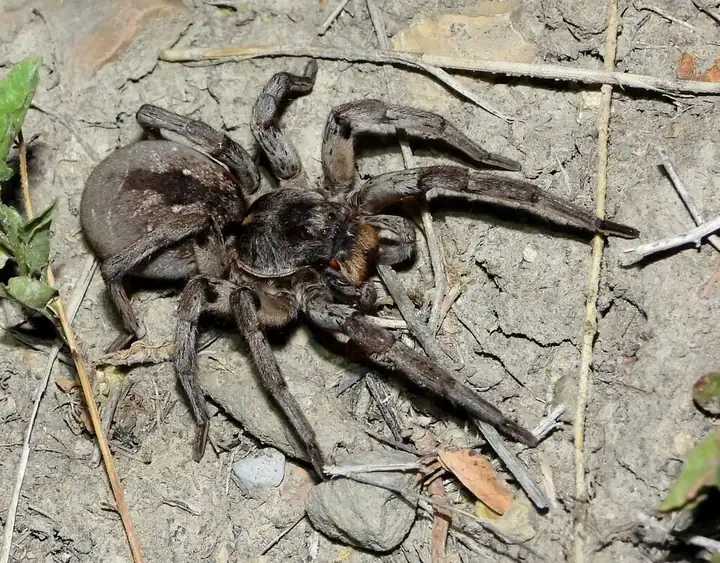
Wolf spiders
Family Lycosidae (about 240 species in the U.S., per Penn State), including the large Carolina wolf spider (Hogna carolinensis) and Tigrosa aspersa, and many small Pardosa species
| Type | Spider |
|---|---|
| What it does | Predator |
| How common it is by region | Very common here: Northeast, Southeast, South Central, Midwest, Great Plains, Mountain West, Pacific Northwest, California |
About
Wolf spiders are fast, hairy, brown or gray hunters that run down their prey on the ground instead of building webs. They patrol mulch and soil, mostly at night, and eat many of the insects that crawl through a vegetable bed.
This one is already on your side. Broad sprays kill it along with the pest, which is why the guide puts sprays last.
What it eats
Insects and other spiders that they chase down on the soil surface. In caged University of Maryland research on cucumbers, wolf spiders cut spotted cucumber beetle numbers and killed striped cucumber beetles.
Pests it goes after
Spotting it
How to find it early
Look under mulch, boards, stones and firewood, or watch them dash across the soil. At night a flashlight makes their eyes shine green. Big ones can be about an inch long or more; many lawn species are much smaller and dark.
Its young
The female drags a round egg sac attached to the tip of her abdomen. After the eggs hatch, the tiny spiderlings ride on her back for a while, so a 'fuzzy' wolf spider is usually a mother carrying babies.
When
Active spring through fall; small dark species can swarm lawns in spring, and big females may wander indoors in fall.
Bringing more of them in
Keep a layer of organic mulch or straw between rows and leave a few flat boards or stones for daytime hiding. Avoid broad-spectrum insecticides.
Worth knowing
Not dangerous to people. A bite only happens if one is handled or pressed against skin; Penn State says it causes brief pain, redness and maybe mild swelling that fades within a day. Black widows and brown recluses are not wolf spiders. They can be a nuisance when they wander into basements and garages.
How common it is by region
| Northeast | Very common here |
|---|---|
| Southeast | Very common here |
| South Central | Very common here |
| Midwest | Very common here |
| Great Plains | Very common here |
| Mountain West | Very common here |
| Southwest | Common here |
| Pacific Northwest | Very common here |
| California | Very common here |
| Alaska | Common here |
| Hawaii | Common here |
Sources
- extension.psu.edu
- extension.usu.edu
- ipm.ucanr.edu
- drum.lib.umd.edu
- entomology.wisc.edu
- agsci.colostate.edu
- hort.extension.wisc.edu
Photo: Photo: blazeclaw / Wikimedia Commons, CC BY 4.0 (CC BY 4.0). Photo resized for the web.

Planting dates and advice are general guidance; check with your local Cooperative Extension office for your area.