
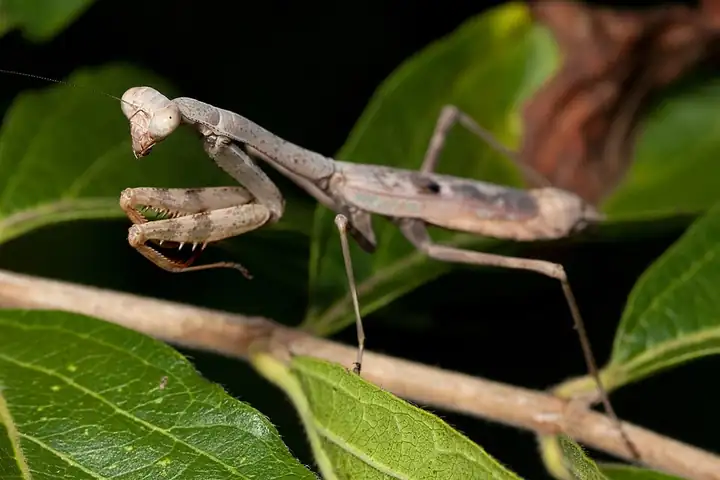
Praying mantids
Order Mantodea; the native Carolina mantid (Stagmomantis carolina) and the introduced Chinese mantid (Tenodera sinensis) and European mantid (Mantis religiosa) are the common garden species
| Type | Insect |
|---|---|
| What it does | Predator |
| When | Nymphs from spring, adults late summer into fall; egg cases through winter. |
| How common it is by region | Very common here: Northeast, Southeast, South Central |
About
Praying mantids are big, slow-moving hunters that wait on plants with their spiny front legs folded and snatch passing insects. They're fun to watch and do eat some pests, but they catch helpful insects just as readily.
This one is already on your side. Broad sprays kill it along with the pest, which is why the guide puts sprays last.
What it eats
Flies, moths, butterflies, caterpillars, crickets, grasshoppers and wasps, mostly active flying adults. They don't sort pests from friends, eating bees, butterflies and hover flies, each other, and K-State notes big ones occasionally take small animals such as hummingbirds.
Pests it goes after
Spotting it
How to find it early
Long green or brown insects 2 to 5 inches long with a triangular head that swivels and grasping front legs held up as if praying. Look on flowers and shrubs from summer into fall.
Its young
Eggs overwinter in a firm, tan, foamy egg case glued to twigs, stems, fences or siding; the Chinese mantid's case is about an inch long and rounded, the Carolina mantid's slimmer. Tiny nymphs that look like miniature adults hatch in spring, often 50 to 200 from one case.
When
Nymphs from spring, adults late summer into fall; egg cases through winter.
Bringing more of them in
If one shows up, leave it be and leave its egg case where you find it. Avoid residual insecticide sprays on shrubs and flowers.
Buying it
Not worth it for pest control: K-State and UC IPM say mantids don't kill enough pests to protect plants, and most egg cases sold are of the non-native Chinese mantid.
Worth knowing
They eat bees, butterflies and other good bugs as well as pests, and nymphs eat each other.
How common it is by region
| Northeast | Very common here |
|---|---|
| Southeast | Very common here |
| South Central | Very common here |
| Midwest | Common here |
| Great Plains | Common here |
| Mountain West | Occasional here |
| Southwest | Common here |
| Pacific Northwest | Occasional here |
| California | Common here |
| Alaska | Not found here |
| Hawaii | Occasional here |
Sources
Photo: Photo: Kaldari / Wikimedia Commons, Public domain. Photo resized for the web.

Planting dates and advice are general guidance; check with your local Cooperative Extension office for your area.