
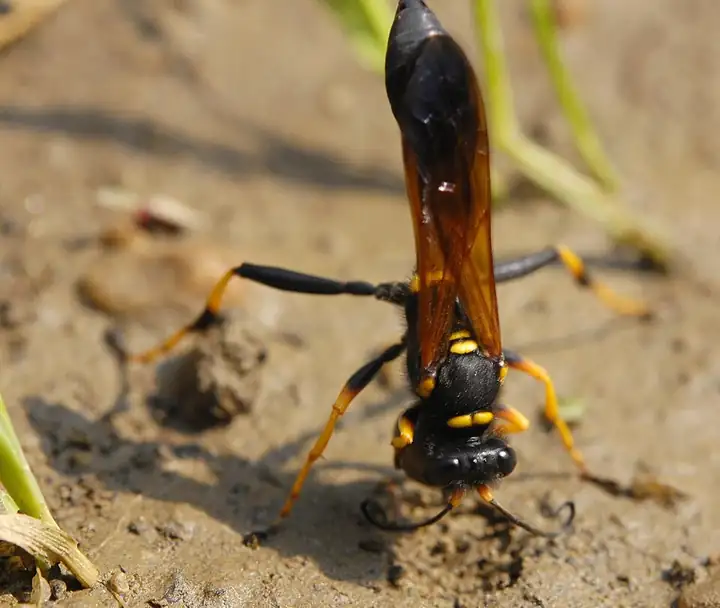
Mud daubers and other solitary hunting wasps
Solitary wasps in several families: the black-and-yellow mud dauber (Sceliphron caementarium), blue mud dauber (Chalybion californicum), thread-waisted wasps (Ammophila), great golden and great black digger wasps (Sphex), grass-carrying wasps (Isodontia), potter wasps (Eumenes) and others
| Type | Insect |
|---|---|
| What it does | Predator, Pollinator |
| When | Mostly June through August; one generation a year |
| How common it is by region | Very common here: Northeast, Southeast, South Central, Midwest, Great Plains |
About
These are wasps that live alone, not in colonies: each female builds a mud, ground or cavity nest and stocks it with paralyzed prey for her young. They look big and fierce, but they rarely sting and quietly remove spiders, caterpillars, katydids and other insects.
This one is already on your side. Broad sprays kill it along with the pest, which is why the guide puts sprays last.
What it eats
Each kind hunts its own prey: mud daubers take spiders, thread-waisted wasps take hairless caterpillars, digger wasps take katydids, grasshoppers or crickets, and others take flies or beetles. Adults drink nectar and visit many flowers.
Pests it goes after
Spotting it
How to find it early
Look for slender wasps with a long, thread-thin waist, such as the black-and-yellow mud dauber or the shiny blue-black mud dauber, carrying mud or a spider. Digger wasps leave small holes and soil piles in sandy, bare ground.
Its young
Larvae grow sealed inside mud tubes, clay pots or underground cells, feeding on the stored prey, so you seldom see them.
When
Mostly June through August; one generation a year
Bringing more of them in
Leave some bare, sunny soil and old mud nests, plant native flowers for nectar, and skip broad-spectrum sprays. Mud nests on a house can be ignored or scraped off with a putty knife.
Worth knowing
They do not defend their nests and usually sting only if grabbed or trapped against skin. Bee wolves (Philanthus) are digger wasps that hunt honey bees and other bees. Anyone with a known sting allergy should still keep their distance.
How common it is by region
| Northeast | Very common here |
|---|---|
| Southeast | Very common here |
| South Central | Very common here |
| Midwest | Very common here |
| Great Plains | Very common here |
| Mountain West | Common here |
| Southwest | Common here |
| Pacific Northwest | Common here |
| California | Common here |
| Alaska | Occasional here |
| Hawaii | Occasional here |
Sources
Photo: Photo: Fulvio314 / Wikimedia Commons, CC BY-SA 3.0 (CC BY-SA 3.0). Photo resized for the web.

Planting dates and advice are general guidance; check with your local Cooperative Extension office for your area.