
Minute pirate bugs
Family Anthocoridae; mainly the insidious flower bug (Orius insidiosus), most common in the East and Midwest, and Orius tristicolor in the West, plus Anthocoris species
| Type | Insect |
|---|---|
| What it does | Predator |
| When | Spring through fall; adults spend the winter in leaf litter. |
| How common it is by region | Very common here: Northeast, Southeast, South Central, Midwest, Great Plains, Mountain West, Southwest, Pacific Northwest, California |
About
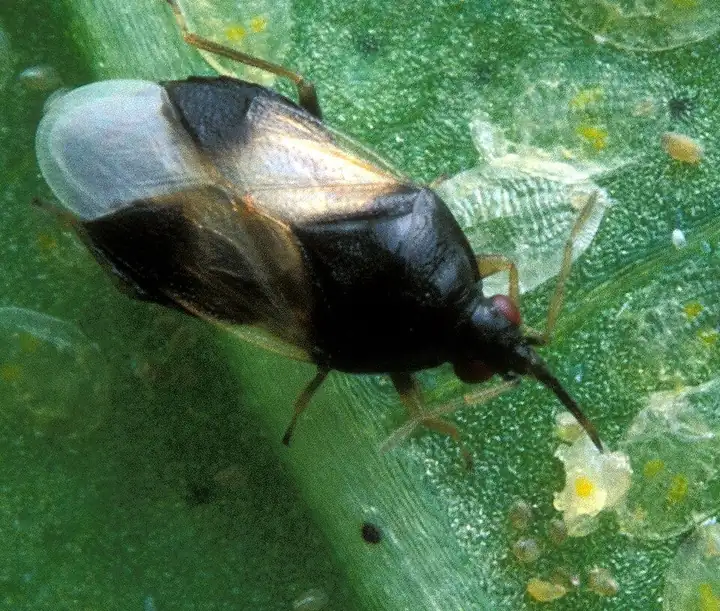
Minute pirate bugs are tiny black-and-white true bugs, only about an eighth of an inch long, that are among the first predators active in spring. They stab thrips, mites and insect eggs with a needle-like beak, and they are common in gardens and on crops like corn and tomatoes.
This one is already on your side. Broad sprays kill it along with the pest, which is why the guide puts sprays last.
What it eats
Thrips and spider mites most of all, plus aphids, whiteflies, small caterpillars, leafhopper nymphs, and the eggs of corn earworm and European corn borer. Cornell says each one can eat 30 or more spider mites a day; they also sip pollen and plant juices without harming plants.
Pests it goes after
Aphids, Corn earworm (tomato fruitworm), European corn borer, Potato leafhopper, Thrips, Twospotted spider mite, Whiteflies
Spotting it
How to find it early
Look for tiny oval bugs with black bodies and white patches on the wings, hurrying over flowers, corn silks and leaves with thrips or mites. A hand lens helps.
Its young
Nymphs are wingless and teardrop-shaped, orange, yellow or reddish brown, with red eyes; eggs are hidden inside soft plant tissue with only a tiny cap showing.
When
Spring through fall; adults spend the winter in leaf litter.
Bringing more of them in
Grow flowers that bloom across the season so they have pollen when prey is scarce, control ants, and avoid broad-spectrum insecticides and miticides.
Plants that bring it in
Cosmos, Fennel, Goldenrod, Mint
Buying it
Sold mainly for greenhouse thrips control; UC IPM says releases outdoors are unlikely to help, so protect the ones already there.
Worth knowing
They occasionally bite people with their beak; Cornell says the bite only irritates for a short while.
How common it is by region
| Northeast | Very common here |
|---|---|
| Southeast | Very common here |
| South Central | Very common here |
| Midwest | Very common here |
| Great Plains | Very common here |
| Mountain West | Very common here |
| Southwest | Very common here |
| Pacific Northwest | Very common here |
| California | Very common here |
| Alaska | Occasional here |
| Hawaii | Occasional here |
Sources
Photo: Photo: Jack Dykinga (USDA ARS) / Wikimedia Commons, Public domain. Photo resized for the web.

Planting dates and advice are general guidance; check with your local Cooperative Extension office for your area.