
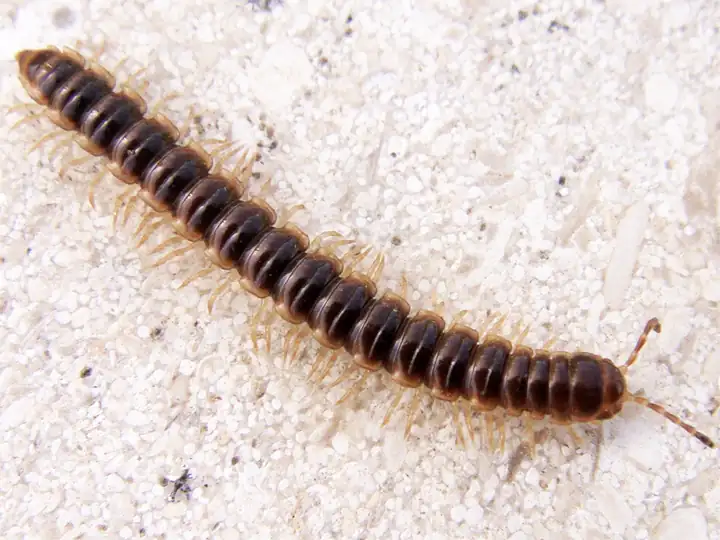
Millipedes
Class Diplopoda; common garden species include the greenhouse millipede (Oxidus gracilis) and other dark brown cylindrical millipedes
| Type | Worm or other invertebrate |
|---|---|
| What it does | Decomposer |
| How common it is by region | Very common here: Northeast, Southeast |
About
Millipedes are slow, rounded, many-legged recyclers that live in damp leaf litter and mulch. They help break down dead plant material, but in big numbers they can nibble seedlings and fruit lying on the soil.
This one is already on your side. Broad sprays kill it along with the pest, which is why the guide puts sprays last.
What it eats
Mostly rotting leaves, decaying wood and other moist plant debris. When numbers are high they can chew sprouting seeds, tender seedlings, some roots, and ripe fruit touching the ground, such as strawberries.
Spotting it
How to find it early
Look under mulch, rocks and boards for brown to black, worm-like creatures with many short legs that move in a slow wave and curl into a tight coil when touched.
Its young
Females lay clusters of eggs in the soil in spring. Newly hatched millipedes have only three pairs of legs and a few segments, adding more with each molt over two to five years.
When
Active spring through fall; mass wanderings, sometimes into houses, often follow heavy rain in late summer and fall or happen in mid-spring.
Easy to mistake for
- Wireworms — Wireworms are click beetle larvae with only three pairs of legs near the head and a flatter, shiny body; millipedes have many pairs of legs along the whole body.
- Centipedes — Millipedes are round, slow and curl up, with two pairs of legs per segment; centipedes are flat, fast and have one pair per segment.
Bringing more of them in
A normal amount of mulch and leaf litter keeps a healthy population going. If they're damaging seedlings or fruit, reduce thick mulch near those plants, avoid overwatering, and lift ripening fruit off the soil.
Worth knowing
They don't bite, but some give off a defensive fluid that can irritate skin and burn eyes, so don't handle them barehanded and wash with soap and water after contact. Swarms that wander indoors are a nuisance but die quickly in dry air. Keep ripening strawberries and melons off bare soil if millipedes are plentiful.
How common it is by region
| Northeast | Very common here |
|---|---|
| Southeast | Very common here |
| South Central | Common here |
| Midwest | Common here |
| Great Plains | Common here |
| Mountain West | Common here |
| Southwest | Occasional here |
| Pacific Northwest | Common here |
| California | Common here |
| Alaska | Occasional here |
| Hawaii | Common here |
Sources
Photo: Photo: JCoelho / Wikimedia Commons, CC BY 2.0 (CC BY 2.0). Photo resized for the web.

Planting dates and advice are general guidance; check with your local Cooperative Extension office for your area.