
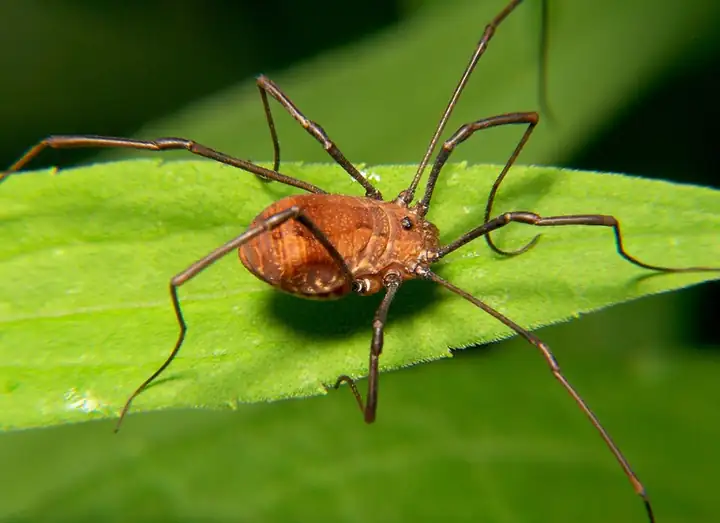
Harvestmen (daddy longlegs)
Order Opiliones (more than 6,500 species worldwide); relatives of spiders, not true spiders
| Type | Worm or other invertebrate |
|---|---|
| What it does | Predator, Decomposer |
| When | Mostly May through November; may cluster on trees and house eaves in fall. |
| How common it is by region | Very common here: Northeast, Southeast, South Central, Midwest |
About
Harvestmen look like a single round bead on eight very long legs. They are arachnids but not spiders, and they hunt and scavenge small creatures around the garden at night.
This one is already on your side. Broad sprays kill it along with the pest, which is why the guide puts sprays last.
What it eats
Soft-bodied prey, alive or dead: aphids, mites, slugs, caterpillars, grasshoppers, beetle larvae and even brown marmorated stink bugs. They also scavenge dead insects and other debris, and some eat pollen.
Pests it goes after
Aphids, Grasshoppers, Slugs, Stink bugs, Twospotted spider mite
Spotting it
How to find it early
Look for a small oval body with no 'waist' and only two eyes on a bump on top, carried on long, thin legs. You'll find them on mulch, tree trunks, walls and climbing plants. Long-legged cellar spiders also get called daddy longlegs, but those have a two-part body and hang in messy webs indoors.
Its young
Females push eggs into soil, under stones or mulch, or into cracks in wood, often in fall. The young look like small adults and molt several times as they grow.
When
Mostly May through November; may cluster on trees and house eaves in fall.
Bringing more of them in
Leave rocks, logs and mulch for shade and shelter, keep some moisture around, grow a mix of flowers, and avoid broad-spectrum insecticides.
Worth knowing
No venom, no silk and no fangs, so they cannot bite you. The tale that they're the world's most venomous spider is a myth. They release a smelly defensive fluid when handled and may drop a leg. They also eat some lady beetle eggs and other small helpers.
How common it is by region
| Northeast | Very common here |
|---|---|
| Southeast | Very common here |
| South Central | Very common here |
| Midwest | Very common here |
| Great Plains | Common here |
| Mountain West | Common here |
| Southwest | Occasional here |
| Pacific Northwest | Common here |
| California | Common here |
| Alaska | Occasional here |
| Hawaii | Occasional here |
Sources
Photo: Photo: Bruce Marlin / Wikimedia Commons, CC BY-SA 2.5 (CC BY-SA 2.5). Photo resized for the web.

Planting dates and advice are general guidance; check with your local Cooperative Extension office for your area.