
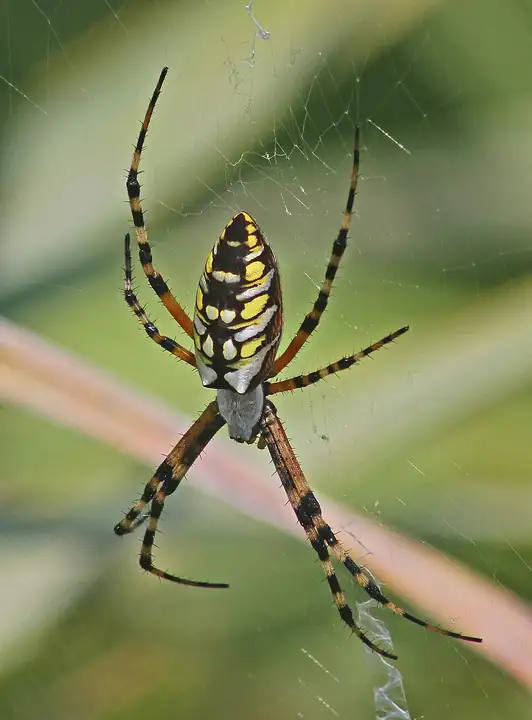
Garden orb weavers (incl. yellow garden spider)
Family Araneidae; the best known is the black-and-yellow garden spider (Argiope aurantia), plus spotted orb weavers (Neoscona), the spiny-backed orb weaver (Gasteracantha cancriformis) and, in the Southeast, the golden silk orb weaver (Trichonephila clavipes)
| Type | Spider |
|---|---|
| What it does | Predator |
| How common it is by region | Very common here: Northeast, Southeast, South Central, Midwest, Great Plains |
About
Orb weavers are the spiders that spin the classic round, wheel-shaped web, and the big black-and-yellow garden spider is the one most people notice in late summer. They catch flying and jumping insects all day, so extension experts count them as garden helpers that need no control.
This one is already on your side. Broad sprays kill it along with the pest, which is why the guide puts sprays last.
What it eats
Whatever flies, hops or blows into the web: flies, mosquitoes, wasps and grasshoppers, plus pests like cucumber beetles and brown marmorated stink bugs. They also catch the odd butterfly or bee, since a web can't pick and choose.
Pests it goes after
Spotting it
How to find it early
Look for a large vertical round web strung between tall plants, tomato cages or shrubs in a sunny spot. The yellow garden spider sits in the center and has a black-and-yellow abdomen and mostly black legs, and often adds a thick white zigzag of silk down the middle.
Its young
In late summer or fall the female hangs a round, brown, papery egg sac about an inch across near her web. Hundreds of tiny spiderlings hatch inside but stay put until spring, so leave the sac where it is or gently move it to a quiet corner.
When
Webs show up in midsummer and last until the first frost; most noticeable in late summer.
Bringing more of them in
Leave some tall plants, trellises and quiet edges where webs can stay up, and let egg sacs overwinter in place. Skip broad-spectrum insecticides, including pyrethrins and pyrethroids, which kill spiders too.
Worth knowing
Not aggressive toward people. A bite is unlikely unless you grab one, especially a female guarding her egg sac, and Penn State says it would feel no worse than a bee or wasp sting. Black widows and brown recluses are not orb weavers. The biggest risk is walking face-first into a web while picking tomatoes.
How common it is by region
| Northeast | Very common here |
|---|---|
| Southeast | Very common here |
| South Central | Very common here |
| Midwest | Very common here |
| Great Plains | Very common here |
| Mountain West | Common here |
| Southwest | Common here |
| Pacific Northwest | Common here |
| California | Common here |
| Alaska | Occasional here |
| Hawaii | Common here |
Sources
- content.ces.ncsu.edu
- extension.psu.edu
- hort.extension.wisc.edu
- marylandgrows.umd.edu
- hgic.clemson.edu
- gardeningsolutions.ifas.ufl.edu
- extension.umd.edu
Photo: Photo: Judy Gallagher / Wikimedia Commons, CC BY 2.0 (CC BY 2.0). Photo resized for the web.

Planting dates and advice are general guidance; check with your local Cooperative Extension office for your area.