
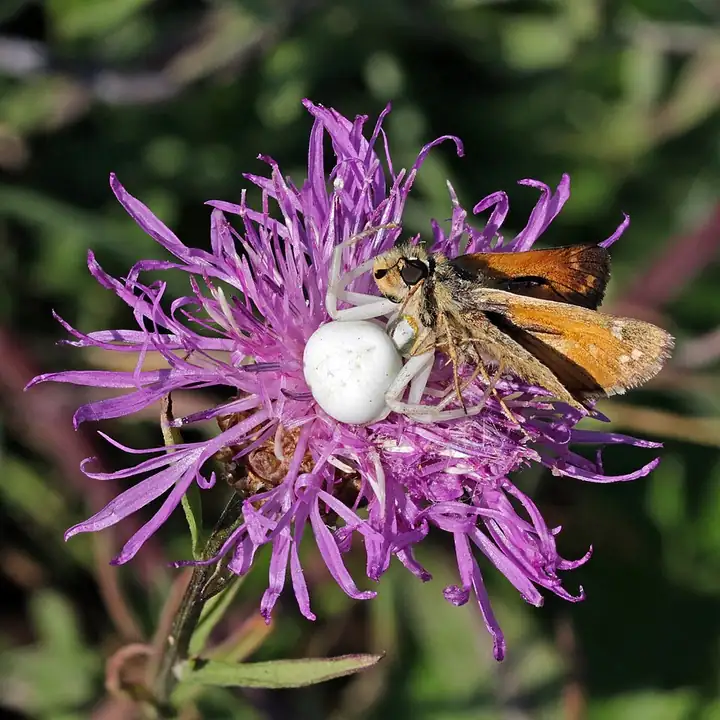
Crab spiders (flower spiders)
Family Thomisidae; flower-dwelling species include the goldenrod crab spider (Misumena vatia) and Misumenoides, while Xysticus lives in leaf litter and grass
| Type | Spider |
|---|---|
| What it does | Predator |
| When | Adults active in summer; they mate in fall. |
| How common it is by region | Very common here: Northeast, Southeast, South Central, Midwest, Great Plains |
About
Crab spiders hold their long front legs out to the side and can walk sideways like a crab. They sit perfectly still on flowers or leaves and grab insects that come close, and they spin no web.
This one is already on your side. Broad sprays kill it along with the pest, which is why the guide puts sprays last.
What it eats
Insects that visit flowers and plants, including tarnished plant bugs, aphids, thrips and pear psylla. They can take prey bigger than themselves, including bees.
Pests it goes after
Aphids, European red mite, Pear psylla, Tarnished plant bug, Thrips
Spotting it
How to find it early
Look closely at white or yellow flowers: a crab spider often matches the petals. The goldenrod crab spider can slowly shift between white and yellow, taking days to weeks to change.
Its young
Females guard an egg sac tucked into bark or under a leaf. The sac overwinters and spiderlings come out in spring.
When
Adults active in summer; they mate in fall.
Bringing more of them in
Plant lots of flowers, which gives crab spiders places to hunt, and avoid broad-spectrum insecticides.
Worth knowing
Harmless to people and pets. They do catch some bees and other pollinators, but a study of Indiana home gardens found they don't take enough to hurt pollination.
How common it is by region
| Northeast | Very common here |
|---|---|
| Southeast | Very common here |
| South Central | Very common here |
| Midwest | Very common here |
| Great Plains | Very common here |
| Mountain West | Common here |
| Southwest | Common here |
| Pacific Northwest | Common here |
| California | Common here |
| Alaska | Occasional here |
| Hawaii | Occasional here |
Sources
- urbanipm.montana.edu
- moore.ces.ncsu.edu
- entomology.wisc.edu
- treefruit.wsu.edu
- hort.extension.wisc.edu
- ipm.ucanr.edu
Photo: Photo: Charles J. Sharp / Wikimedia Commons, CC BY-SA 4.0 (CC BY-SA 4.0). Photo resized for the web.

Planting dates and advice are general guidance; check with your local Cooperative Extension office for your area.